Why the Geminids Come From an Asteroid—and How to Watch the 2026 Shower
The Geminids appear to radiate from Gemini, but their associated parent object is asteroid 3200 Phaethon. Here’s why—and how to plan a realistic viewing attempt in December 2026.
Why do the Geminids come from an asteroid?
The shower’s name points to where its meteors seem to start, not to the body associated with their material.
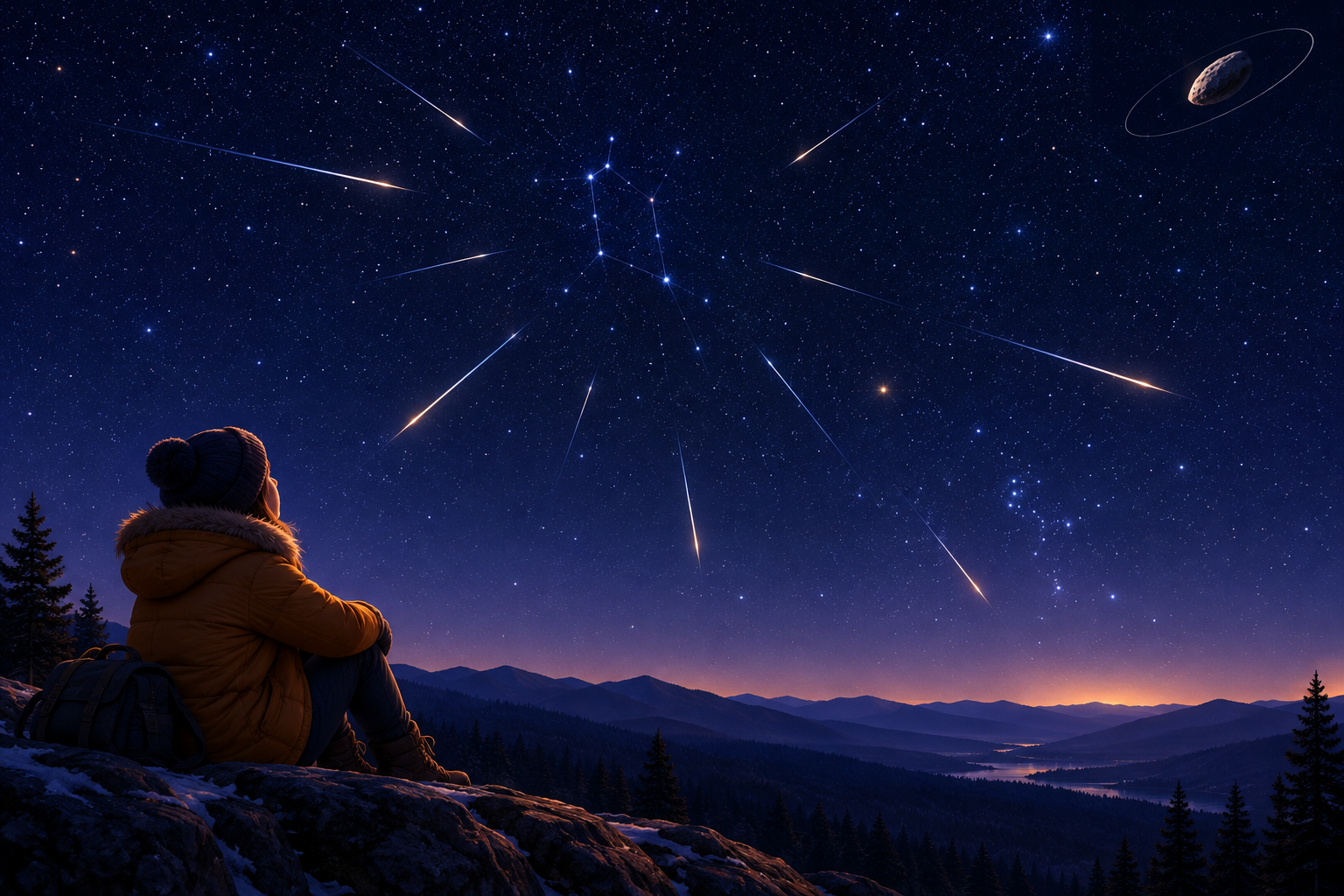
The Geminids appear to radiate from the constellation Gemini, but their associated parent object is asteroid 3200 Phaethon. The apparent direction and the object linked to the shower are different things: Gemini is where the meteors seem to converge in the sky, while Phaethon is the body associated with the stream of material Earth passes through.
When small particles in that stream enter Earth’s atmosphere, they produce the streaks we call meteors. NASA lists the Geminids as active from December 4 through 17, 2026, with a peak on December 13–14. Those dates describe the shower’s activity, not a guarantee that someone in any particular place will see meteors.
- Radiant: the apparent direction in the sky from which the meteors seem to come.
- Associated parent object: the body linked to the material that produces the shower.
Radiant versus source: why the distinction matters
Perspective explains why a meteor shower seems to begin at one point without making that point its physical source.
Picture parallel railway tracks that appear to meet in the distance. They do not actually join there; the view makes them seem to. A meteor shower’s radiant is a similar line-of-sight effect. As Earth moves through a stream of particles, their paths can appear to spread outward from one area of the sky.
That is why the Geminids can be named for Gemini even though the meteors are associated with Phaethon. The radiant is useful for identifying a shower and describing its apparent direction, but it is not a location where meteors are born or a target you need to keep centered in a telescope.
NASA notes that Geminid meteors can be seen across the night sky. If you focus only on Gemini, you may overlook streaks elsewhere. For a casual watch, a broad, unobstructed view and the unaided eye are more useful than aiming equipment at the constellation.
| Term | What it describes | Geminids example |
|---|---|---|
| Radiant | Where meteors appear to come from in the sky | A point in Gemini |
| Associated parent object | The object linked to the shower’s material | Asteroid 3200 Phaethon |
What makes 3200 Phaethon unusual?
NASA calls Phaethon an asteroid while leaving room for uncertainty about how best to characterize it.
NASA identifies asteroid 3200 Phaethon as the Geminids’ origin, but also says scientists are not certain how best to define the object. NASA mentions the possibilities of a “dead comet” or a “rock comet.” These are proposed descriptions, not a settled conclusion that Phaethon has been definitively reclassified.
A careful way to put it is that Phaethon is described as an asteroid associated with the Geminids, while its exact nature remains uncertain. The unusual part of the story is that a meteor shower is linked to an object NASA describes as an asteroid, with scientists still considering how to explain its characteristics.
The connection does not mean Phaethon itself will be visible during the shower. The streaks people watch are produced by particles entering the atmosphere; the radiant and the parent object explain different parts of the phenomenon.
When to watch the 2026 Geminids
Use the published peak as a planning guide, then choose a night based on your local forecast and sky.
NASA lists the shower’s activity period as December 4–17, 2026, and its peak as December 13–14. The American Meteor Society lists the same dates and describes the 2026 moonlight conditions as generally favorable. It also notes that Gemini is well placed from about 22:00 onward. These are useful planning details, not a promise that a particular location will have a dark or clear sky.
The best practical choice is a clear, convenient night within the activity period, ideally near the peak if conditions cooperate. The dates span calendar nights, so check a current local sky calendar for the timing where you live. Cloud cover, nearby lighting, trees or buildings, and your available viewing time can all affect what you see.
If your location is cloudy on the peak nights, another night within the activity period may still be worth considering, although the shower may be less active away from its peak. Check the forecast again before leaving rather than relying on a general outlook.
- Activity period: December 4–17, 2026.
- Peak: December 13–14, 2026.
- The American Meteor Society describes moonlight conditions as generally favorable and Gemini as well placed from about 22:00 onward.
A practical viewing plan for beginners
A simple setup helps you spend your time watching rather than troubleshooting equipment or searching for a perfect spot.
You do not need a telescope, specialist camera, or detailed knowledge of Gemini to try watching the Geminids. Prioritize a safe place with a wide, open view and as little direct light as practical. NASA recommends getting away from city or street lights, allowing time for your eyes to adapt, and dressing for cold conditions.
- Choose a date and check the local forecast. Prefer a clear night near December 13–14 if one is available to you.
- Pick a safe viewing place you are allowed to use, with a broad view of the sky. A darker location can help, but do not trespass or choose an unsafe roadside stop.
- Arrive, settle in, and reduce bright screen use while your eyes adjust. Give yourself time to watch rather than expecting an immediate streak.
- Dress for a cold, still wait. Bring a chair or blanket if useful, and make sure your layers let you remain comfortable outdoors.
- Look around the sky rather than staring only at Gemini. Meteors may appear in other parts of the sky, with quiet gaps between them.
What to expect—and what not to expect
A peak date or favorable general conditions cannot predict how many meteors one observer will see.
Published hourly rates depend on observing conditions and should not be treated as a personal forecast. Even under promising skies, the number you notice can vary with cloud, light pollution, the amount of sky you can see, and whether you are watching steadily. This guide does not promise a count.
A clear night can still have quiet stretches, and a meteor may appear when you are looking elsewhere. If you see none, that does not show that the shower failed: visibility is local, and a short or obstructed view can make a difference. A flexible plan—a warm place, a wide view, and time to look—is more realistic than expecting a fixed display.
Before you go, make one final check of the local forecast and your viewing location. Then treat the date as an opportunity to watch, not a guarantee. The central science is straightforward: Gemini is the Geminids’ apparent radiant, while Phaethon is the associated parent object.
Frequently asked questions
Do Geminid meteors really come from Gemini?
They appear to come from a radiant in Gemini, an effect of perspective. NASA identifies asteroid 3200 Phaethon as the object associated with the shower’s origin.
Why is Phaethon called an asteroid if scientists discuss comets?
NASA describes Phaethon as an asteroid but says its exact nature is uncertain. “Dead comet” and “rock comet” are possibilities mentioned by NASA, not settled classifications.
When is the 2026 Geminid meteor shower?
NASA lists it as active December 4–17, 2026, with a peak on December 13–14. Check local weather and sky conditions before choosing a night.
Should I look directly at Gemini to see the Geminids?
No. The radiant helps identify the shower, but meteors can appear across the night sky. Choose a dark, open location and watch a broad area.
How many Geminids will I see per hour?
There is no dependable personal count. Published rates refer to particular observing conditions; clouds, light pollution, your view of the sky, and timing all affect what you notice.
Sources & further reading
Explore the original sources behind this article. Our editorial perspective is separate from the organizations we reference.
- [S1] Geminids - NASA Sciencescience.nasa.gov
- [S2] 2026/2027 Meteor Shower Calendar | American Meteor Societyamsmeteors.org