How to Bring Outdoor Plants Indoors for Winter and Reduce Pest Risk
Before moving summer-outdoor plants inside, check the forecast, inspect and rinse each plant, and keep it separate while you monitor for pests. Then adjust its light and watering to indoor conditions.
When to bring outdoor plants indoors
Use the forecast as an early signal, while allowing for differences between plant species and local conditions.
A useful general cue is to bring many houseplants inside when nighttime temperatures are consistently around 50°F. This is not a safe-temperature guarantee for every plant: cold tolerance varies by species, and a plant’s exposure and condition matter. Iowa State University Extension notes that many houseplants can be damaged in the mid-to-lower 40s°F, while University of Minnesota Extension also advises moving most houseplants inside before temperatures fall below 50°F.
Check the coming nighttime forecast and look up the needs of plants whose names you know. If a cold night is approaching, move sensitive plants sooner rather than waiting for an ideal day to inspect them. You can do the inspection and rinse just outside the door or in another suitable area before bringing a plant near your indoor collection.
- Treat 50°F as a planning cue, not a hard rule for all plants.
- Make a short list of plants and check their individual cold tolerance where possible.
Inspect the whole plant before moving it
A careful check of foliage and the pot can reveal issues a quick glance may miss.
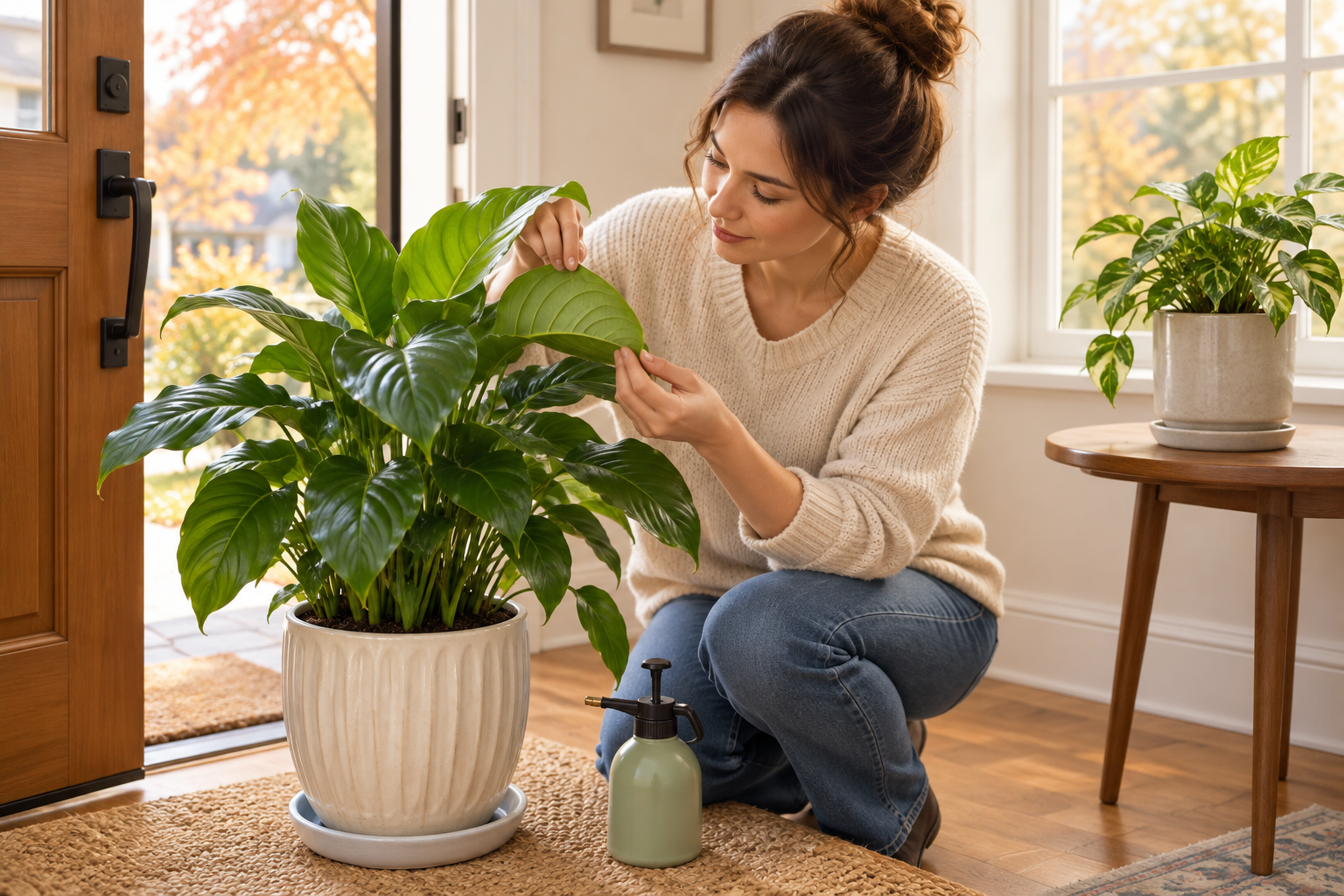
Inspect each plant in good light. Look at the upper and lower surfaces of leaves, the stems, and the places where leaves join stems. Watch for insects, fine webbing, sticky residue, cottony clusters, or small bumps that merit a closer look. A mark is not always evidence of an active pest, so examine it rather than assuming what caused it.
Check the pot rim, the outside and underside of the pot, the saucer, and any plant supports. Remove fallen leaves and loose debris. If you find a possible pest, keep that plant apart from your other plants while you decide what to do. Check nearby plants too if they were grouped together outdoors.
University of Minnesota Extension recommends inspecting plants before bringing them indoors. A thorough first look is useful, but it cannot guarantee that every pest or egg has been found; plan to keep monitoring after the move.
- Use a flashlight or magnifier if small insects or marks are hard to see.
- Avoid placing a plant with a suspected pest directly beside your established houseplants.
Rinse and clean plants outdoors
Physical cleaning can remove debris and some visible pests before plants enter the home.
Rinse foliage outdoors with a gentle stream of water, paying attention to leaf undersides and stems. Use enough pressure to wash away loose debris without damaging delicate leaves or tipping the plant over. Clean the pot exterior and saucer, remove visible debris by hand, and let the plant drain and dry before bringing it in. Iowa State Extension recommends rinsing plants outdoors and allowing them to dry.
Rinsing can help, but it does not make a plant certain to be pest-free. If you see a substantial or persistent pest problem, do not put the plant beside your collection simply because you rinsed it. Keep it separate and choose a response suited to the plant and the pest.
Quarantine returning plants for 3–4 weeks
Separation gives you time to notice pests that were missed during the first inspection or appear later.
Keep plants returning from outdoors separate from established houseplants for 3–4 weeks, as Iowa State Extension recommends. A separate room is helpful, but the practical goal is to prevent close contact while you observe the plant. Keep leaves from touching neighboring plants, and avoid moving the quarantined plant around your collection.
Inspect it regularly during this period, including the leaf undersides, stems, and pot area. If you find a possible pest, continue the separation while you assess the plant. One clean inspection is not proof that no pests remain, which is why continued observation matters.
If you do not have a separate room, create as much distance as your space allows and keep the plant from touching others. Pay particular attention to nearby plants as well. Quarantine reduces the chance of pests spreading; it does not eliminate that possibility.
- Keep saucers and tools clean, and avoid using the same damp cloth across multiple plants.
- Make a note of the move-in date and what you observe so you can track the quarantine period.
Choose an indoor location and allow for adjustment
The move changes a plant’s environment, so choose a suitable spot and watch how it responds.
Place the plant in bright, indirect light unless its species has different requirements. Outdoor light can be stronger than indoor light, so the sunniest window is not automatically the best choice. Keep the plant away from cold drafts and direct heat from vents, and leave enough room to inspect it while it is quarantined.
Some leaf drop can occur as a plant adjusts to a change in light. It is not, by itself, proof of a pest problem. Check for pests, but also consider the new light and watering conditions before deciding what may be causing the change. Iowa State Extension notes that some plants may drop leaves after the move.
Adjust watering and routine care
Indoor conditions can change how quickly potting mix dries, so use the plant and its soil—not the summer calendar—as your guide.
Do not assume a plant needs water on the same schedule it did outdoors. After moving it, check the potting mix before watering and make sure excess water can drain rather than sitting in a saucer. The right check depends on the plant and its potting mix; a finger test near the surface may help with some pots, while others need a different approach.
Iowa State Extension advises adjusting watering to the new conditions. If you are unsure what changed, keep a simple record of when you moved the plant, when you checked the soil, and how it responded. That is more useful than applying one fixed schedule to every plant. Avoid making several major changes at once unless the plant’s condition calls for them.
- Assess soil moisture and drainage separately for each pot.
- If leaves change or drop, consider light, watering, and possible pests rather than assuming a single cause.
If you find pests, keep the response targeted
Maintain separation and choose any treatment only after identifying what the plant and setting can safely support.
If you spot pests during inspection or quarantine, keep the plant apart from the rest of your collection. When appropriate for the plant, remove visible pests or affected debris, then recheck the plant and the surfaces around it. A rinse or one round of cleaning may not resolve a continuing problem, so keep observing before returning the plant to the group.
If you consider using a pesticide, read and follow its label. A product may not be suitable for indoor use, the plant, or the pest you found. University of Minnesota Extension cautions that not every insecticide is appropriate for indoor use or every plant. Do not apply a product indoors unless the label permits that use.
- Inspect first rather than applying a pesticide simply because a plant is moving indoors.
- Keep the plant separated while monitoring whether the problem has stopped.
At-a-glance fall move-in guide
Use this comparison to keep the main decisions clear without treating any step as a guarantee.
The details depend on the plant and your home, but this overview can help you plan the transition. Keep checking plants after they are indoors, including after the quarantine period.
| Task | Practical approach | Important limit |
|---|---|---|
| Timing | Use nighttime temperatures around 50°F as a general cue. | Plant needs and local conditions vary. |
| Inspection and cleaning | Inspect foliage, stems, pots, and saucers; rinse outdoors and let the plant dry. | Cleaning cannot guarantee that pests are gone. |
| Quarantine | Keep returning plants separate for 3–4 weeks and inspect them regularly. | Continue monitoring; separation reduces risk but does not remove it. |
| Indoor care | Choose suitable light and check soil before watering. | Indoor conditions may differ from summer conditions. |
Frequently asked questions
Is 50°F too cold for every outdoor houseplant?
No. Around 50°F is a general cue for many houseplants, not a universal cutoff. Check the needs of each plant and your local nighttime forecast; some may be more sensitive to cold.
How long should I quarantine plants brought indoors?
Iowa State University Extension recommends keeping returning plants separate from other houseplants for 3–4 weeks and inspecting them during that period.
Does rinsing a plant remove every pest?
No. Rinsing can remove debris and dislodge some visible pests, but it cannot guarantee that none remain. Continue inspecting the plant during quarantine.
Should I keep the same watering schedule after moving a plant indoors?
Not automatically. Indoor conditions can change how quickly potting mix dries. Check the soil and drainage for each plant, then water according to its needs.
Does leaf drop after moving indoors mean the plant has pests?
Not necessarily. A change in light can lead to leaf drop as a plant adjusts. Check for pests, but also consider the plant’s new light and watering conditions.
Sources & further reading
Explore the original sources behind this article. Our editorial perspective is separate from the organizations we reference.
- [S1] Bringing houseplants in for winter | UMN Extensionextension.umn.edu
- [S2] How and when do I bring my houseplants back indoors before winter? | Yard and Gardenyardandgarden.extension.iastate.edu