Can You Bring a Power Bank on a Plane? Check These Four Things Before You Fly
Most travelers can bring a power bank on a plane, but it must go in your cabin baggage. Check its watt-hour rating, pack it so it cannot be damaged, and confirm your airline’s rules for the route.
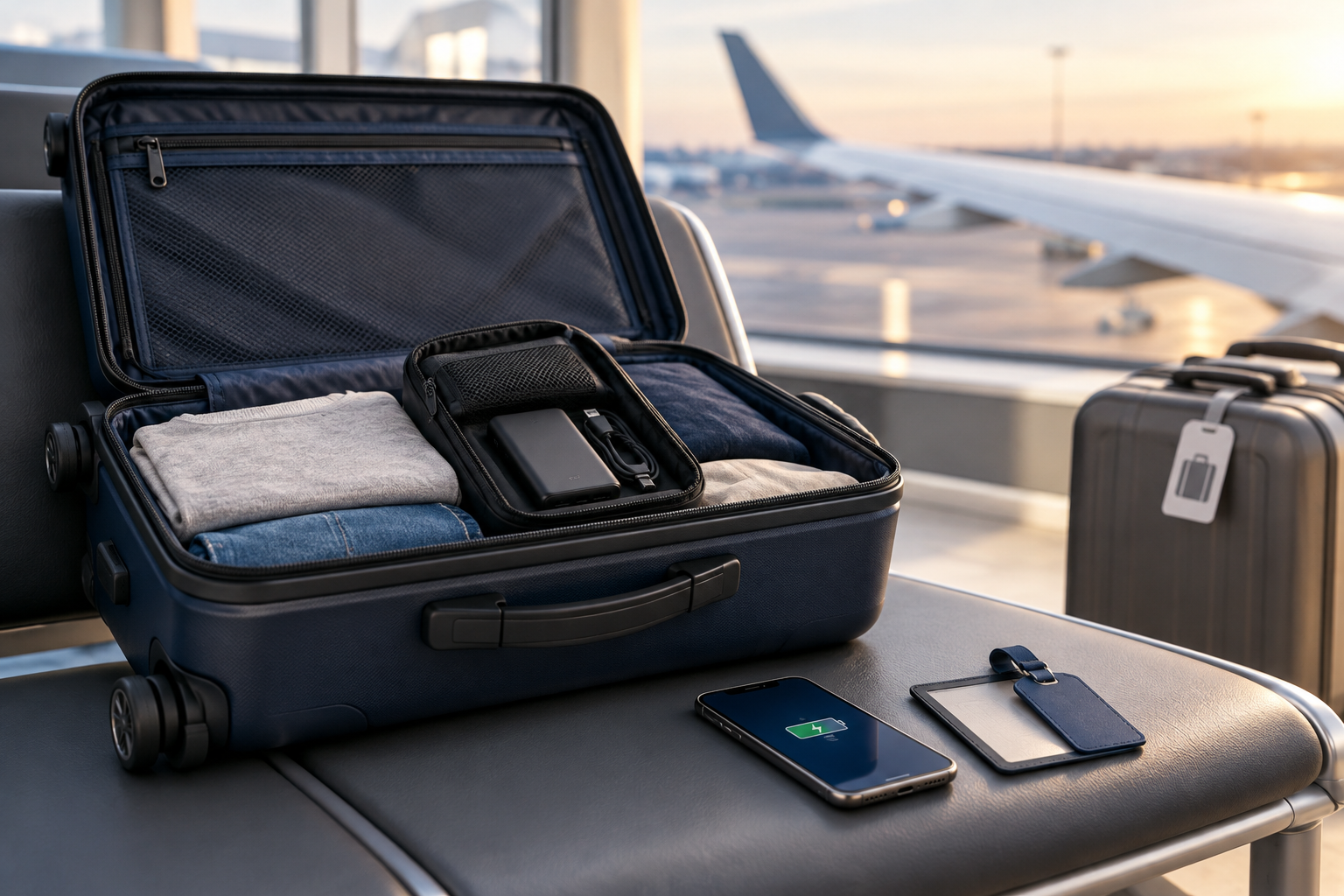
Can you bring a power bank on a plane?
For most ordinary consumer power banks, the key is where you carry it and how much energy it stores.
Usually, yes: you can bring a power bank on a plane if it meets the applicable capacity rules and stays in the cabin with you. Do not put it in checked baggage. A power bank is treated as a spare lithium battery, so cabin placement helps keep it accessible to the crew if a battery problem occurs.
Before leaving for the airport, check four things: the power bank’s watt-hour rating, whether its capacity needs airline approval, how you will protect it in your carry-on, and any quantity or use restrictions for your airline and route. The FAA’s rules are a useful U.S. baseline, not a guarantee that every airline or country applies identical requirements.
1. Find the power bank’s watt-hour rating
The Wh figure—not the size of the casing or the mAh number alone—is the most useful number for checking flight limits.
Look for a label on the power bank that states its capacity in watt-hours (Wh). It may be printed on the back, underside, or packaging. If the Wh rating is present and legible, use that figure rather than trying to infer capacity from a marketing description.
If the label gives only volts and milliamp-hours (mAh), convert mAh to amp-hours (Ah) by dividing by 1,000, then multiply amp-hours by volts. For example, a battery rated at 20,000 mAh and 3.7 V is 20 Ah × 3.7 V, or 74 Wh.
The printed Wh rating is preferable because a power bank’s advertised mAh figure may not state the voltage used in the calculation. If the label is missing, unreadable, or gives conflicting figures, do not assume the battery falls below a limit. Ask the manufacturer or your airline before travel.
Quick calculation
Wh = V × Ah. To convert mAh to Ah, divide by 1,000. For example: 20,000 mAh ÷ 1,000 = 20 Ah; 20 Ah × 3.7 V = 74 Wh.
2. Match the capacity to the applicable limit
A power bank near the common 100 Wh threshold may be treated differently from a smaller one, even if both fit in the same pocket.
Under FAA passenger guidance, spare lithium batteries and power banks up to 100 Wh are allowed in carry-on baggage. A power bank rated from 101 to 160 Wh needs airline approval. More than 160 Wh is prohibited on passenger aircraft under this guidance.
For example, a 20,000 mAh power bank rated at 3.7 V works out to 74 Wh, below the 100 Wh threshold. A 30,000 mAh unit at the same voltage works out to 111 Wh, so you should get approval from the airline before taking it. These examples assume the stated voltage is the correct rating for the Wh calculation; use the product label when available.
Approval is not automatic, and an airline may set tighter conditions. Contact the operating airline before departure if the bank is over 100 Wh, if its rating is unclear, or if you are connecting with another carrier. Keep the product label or manufacturer’s specification available in case staff need to identify its capacity.
These thresholds concern ordinary consumer power banks. Batteries for mobility devices, medical equipment, or other specialized uses can be subject to separate procedures; check with the airline rather than applying this checklist to them.
| Power-bank capacity | General FAA guidance | What to do |
|---|---|---|
| Up to 100 Wh | Allowed in carry-on baggage | Keep it in the cabin and confirm any stricter airline or route rules. |
| 101–160 Wh | Requires airline approval | Contact the airline before travel; do not assume approval. |
| More than 160 Wh | Prohibited on passenger aircraft under this guidance | Do not take it on the flight. |
3. Pack it in the cabin and protect it
The right bag matters even when the power bank is within the capacity limit.
Place the power bank in your carry-on baggage or personal item, where it remains in the cabin. Do not pack it in checked luggage. If an overhead bag must be gate-checked, remove the power bank first and keep it with you; the FAA specifically advises passengers to remove spare batteries and power banks from a carry-on that is checked at the gate.
Avoid leaving a power bank loose where its terminals could be damaged or come into contact with metal objects. Keeping it in a protective case or separate pouch is a practical precaution, especially when you carry cables, keys, or other small items in the same bag. Do not fly with a visibly damaged or swollen battery; contact the airline for instructions rather than putting it in checked baggage.
Keep the power bank accessible enough to remove if staff ask you to do so. The exact screening process can vary, so follow instructions from airport security and the airline.
4. Check the airline’s rules for your route
Capacity is only one part of the answer; quantity and onboard-use rules can also depend on current aviation requirements and the carrier.
ICAO announced international guidance effective March 27, 2026, limiting passengers to two power banks and prohibiting recharging power banks during a flight. IATA’s 2026 passenger guidance also reflects these restrictions. Since individual carriers and authorities may apply requirements through their own procedures, confirm the current rule with the airline operating each flight on your itinerary.
The restriction on recharging power banks during flight means you should not plug the power bank in to recharge it onboard. It does not, by itself, answer whether you may use that bank to charge a phone or another device; check your airline’s specific onboard-use instructions rather than assuming either way.
This is especially important on an international itinerary, a trip with multiple airlines, or a flight where one segment is operated by a different carrier from the one that sold the ticket. Check the operating carrier’s baggage and battery guidance, and ask whether its policy applies to every segment.
Also verify the airline’s policy if your power bank is unusually large, damaged, unmarked, or needed for a medical or accessibility device. Rules for those cases may not be covered by the ordinary consumer-battery checklist.
A departure-day power-bank checklist
A quick check before you leave can catch the issues most likely to lead to a repack or a question at the airport.
Use this checklist for an ordinary consumer power bank. If any answer is uncertain, resolve it with the airline before heading to the airport.
- Read the label and note the Wh rating. If it is not printed, calculate Wh from volts and amp-hours; do not guess if the voltage or capacity is unclear.
- Compare the rating with the applicable limit: up to 100 Wh, 101–160 Wh, or over 160 Wh. Get airline approval for a unit in the 101–160 Wh range.
- Check the current rules for each operating airline, including quantity limits and rules about recharging or using the bank in flight.
- Pack the power bank in cabin baggage, not checked baggage, and keep it protected from damage.
- If your carry-on is gate-checked, remove the power bank and keep it with you.
- If the label is missing, the battery is damaged, or the device is for a specialized purpose, ask the airline how to proceed.
The practical answer
For a typical small power bank, the decision is straightforward once you verify the label and route-specific policy.
Most standard power banks can travel with you when they are within the permitted capacity, packed in cabin baggage, and carried in line with your airline’s current rules. Check the Wh rating first, obtain approval for a bank over 100 Wh where required, and keep the device with you if a bag is gate-checked.
Before flying, use your airline’s current battery guidance rather than relying on a rule from a past trip or another carrier. That final check is particularly important for international journeys and for power banks whose capacity or condition is uncertain.
Frequently asked questions
Can I put a power bank in checked baggage?
No. Power banks are spare lithium batteries and should be carried in the cabin. If your carry-on is gate-checked, remove the power bank and keep it with you.
How do I tell whether my power bank is under 100 Wh?
Check the product label for Wh. If it lists volts and mAh instead, divide mAh by 1,000 to get Ah, then multiply Ah by volts. For example, 20,000 mAh at 3.7 V equals 74 Wh.
What if my power bank is rated between 101 and 160 Wh?
FAA guidance requires airline approval for this range. Contact the airline before travel, and check the rules of every carrier operating a segment of your trip.
Can I use a power bank to charge my phone during the flight?
ICAO’s 2026 guidance prohibits recharging the power bank during flight. That is different from using it to charge a phone; check the operating airline’s current onboard-use policy.
How many power banks can I bring?
ICAO guidance effective March 27, 2026, limits passengers to two power banks. Confirm the applicable quantity limit with your airline, particularly for an international or multi-carrier itinerary.
Sources & further reading
Explore the original sources behind this article. Our editorial perspective is separate from the organizations we reference.