How to Check Your Oven Temperature—and When to Calibrate It
An oven thermometer can help you investigate inconsistent baking, but one reading is not a diagnosis. Learn how to check it, interpret the results, and decide when to consult your oven manual.
How to check your oven temperature
Use a thermometer to look for a repeatable pattern, not a perfect match to the oven dial at every moment.
If food repeatedly cooks too quickly, too slowly, or unevenly, an oven-safe thermometer can help you investigate whether temperature may be contributing. It measures the temperature around the thermometer, not the whole oven or the food itself, so think of it as one clue rather than a diagnosis.
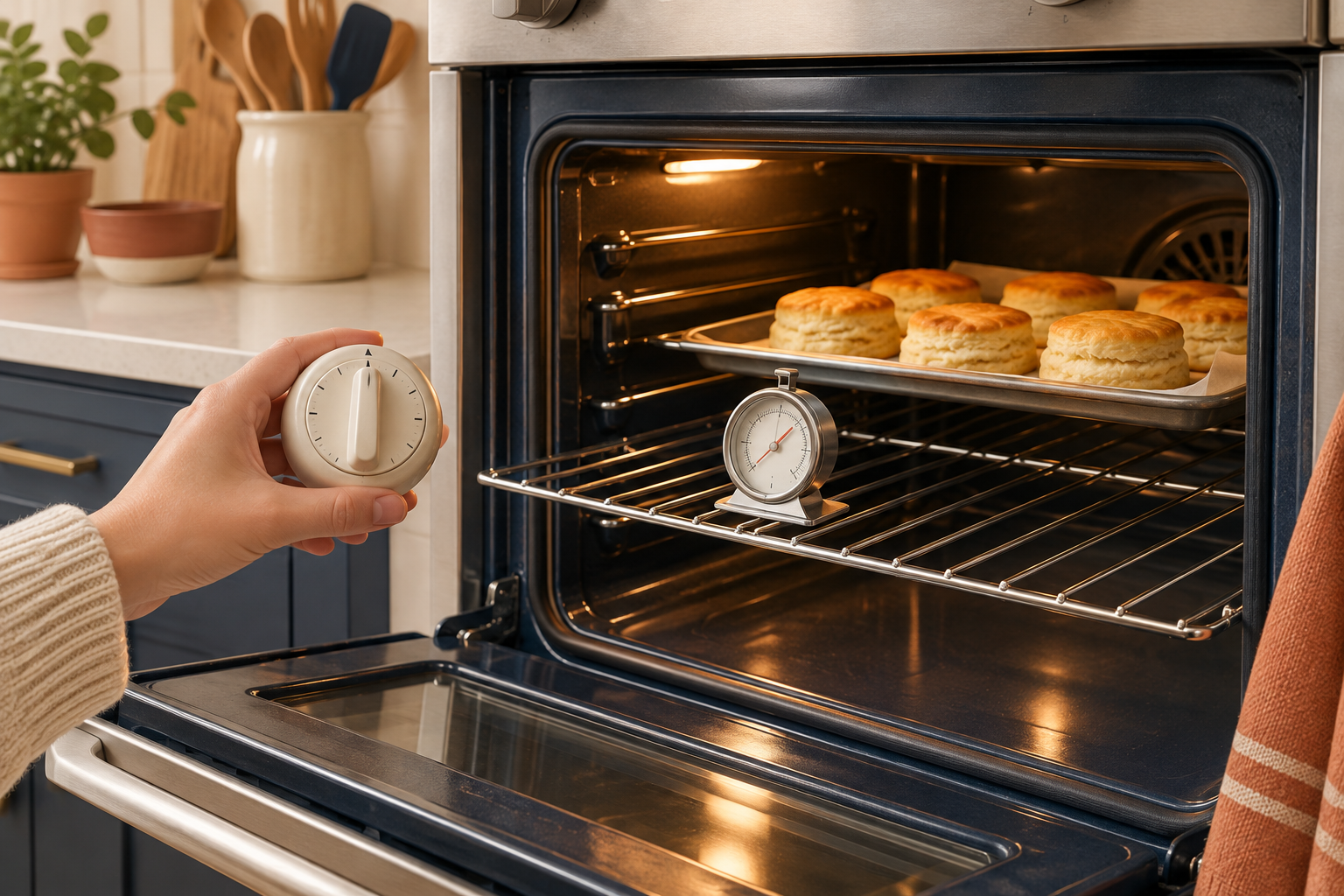
Place the thermometer securely near the center of the oven, away from the walls and heating elements, unless its instructions specify otherwise. Follow the thermometer maker’s directions for use. The USDA Food Safety and Inspection Service describes setting an oven between 325°F and 350°F, allowing it to preheat, and checking the thermometer again after five minutes. Use that as a reference check, not a guarantee that every oven, thermometer, or test setup should produce an identical number.
Use a repeatable check, not a single number
Consistent placement and timing make comparisons more useful than chasing an exact reading.
Before checking, note the oven setting, rack position, thermometer location, and when you take the reading. Keep those conditions as similar as possible if you repeat the check. If your thermometer cannot be read through the oven door, open the door briefly, note the result, and close it promptly; opening the door can affect oven conditions.
The USDA notes that oven readings can vary because heating elements cycle on and off. GE Appliances also points out that placement and opening the door can affect a reading. A number that moves up or down is therefore not, by itself, evidence of a problem. Look instead for a recurring pattern across comparable checks, and check the thermometer’s own instructions if you are unsure how to use it.
- Record the oven setting and the thermometer reading.
- Keep the thermometer in the same place between checks.
- Note when you read it and whether you opened the door.
Consider a manufacturer-recommended baking test
A test bake can add evidence about how the oven performs, but its setup is model-specific.
Some manufacturers recommend baking biscuits as a practical performance check. GE Appliances and Whirlpool both describe versions of this test. The details can differ, including the pan, rack position, preheating instructions, and what to observe. Find the directions for your oven model rather than treating a test from another brand as interchangeable.
Follow the specified setup and note how the biscuits bake, including whether browning appears uneven. A different pan, rack position, or recipe can change the result, so one batch is not proof that the oven needs calibration. Consider the test alongside repeat thermometer readings and a pattern in your usual cooking.
- Look for a test in the manual or the manufacturer’s support guidance for your model.
- Use the pan, rack position, and preheating directions provided.
- Record what happened before making any calibration adjustment.
Check the baking setup before changing settings
Uneven results can have more than one cause, so check the recipe and test conditions as well as the oven.
Before assuming temperature is the issue, compare your setup with the recipe or manufacturer’s test directions. Check the recommended rack position, pan type, and preheating instructions. These details matter especially when you are using a biscuit test: changing the setup makes the result harder to interpret.
Also consider whether the oven door was opened often or left open for a while. If a problem appears with only one recipe or one pan, repeat it with the same setup before changing oven settings. If several recipes show a persistent pattern, or the model-specific test raises concern, consult the manual for the next step.
| What you notice | First check | Next step |
|---|---|---|
| One unexpected thermometer reading | Timing, placement, and thermometer instructions | Repeat the check under comparable conditions |
| Uneven results from one recipe | Recipe directions, pan, rack, and door opening | Repeat with the same setup |
| Concerns across several recipes | Repeat readings and the oven’s recommended performance test | Consult the manual or manufacturer |
| A persistent temperature concern | The model’s calibration instructions and limits | Follow the manual or ask the manufacturer before adjusting |
When to calibrate your oven
Only use calibration instructions written for your specific oven model.
Consider calibration only after repeat checks or the manufacturer’s recommended test suggest a consistent difference and you have checked your measurement and baking setup. The manual should explain whether calibration is available, how to make an adjustment, and what limits apply. Whirlpool directs owners to their model’s instructions for calibration guidance.
Do not copy a button sequence or adjustment range from another oven. Models differ, and calibration may not address every performance problem. If the manual’s test indicates a concern, the controls behave unexpectedly, or results remain unreliable after you follow the instructions, contact the manufacturer or a qualified service professional.
- Repeat the thermometer check under comparable conditions and record the results.
- Use a baking-performance test only if your oven’s instructions recommend one.
- Read the manual for the model-specific calibration method and limits.
- Contact the manufacturer or a qualified service professional if the concern persists.
Keep oven checks separate from food-safety checks
An oven-air reading cannot tell you whether the center of food has reached a safe temperature.
An oven thermometer measures the appliance environment; it is not a food thermometer. When food-safety guidance calls for checking internal temperature, use a food thermometer in the appropriate part of the food and follow that guidance. Neither the oven dial nor an oven-air reading confirms that the center of a dish is safely cooked.
For a practical next step, start with a careful thermometer check and record the conditions. Repeat it if the result looks unexpected. If a consistent concern remains, use your oven’s own test and calibration instructions or contact its manufacturer rather than making an unsupported adjustment.
Frequently asked questions
Where should I put an oven thermometer?
Place an oven-safe thermometer securely near the center of the oven, away from the walls and heating elements, unless its instructions say otherwise. Follow the thermometer maker’s directions.
Should an oven thermometer match the dial exactly?
Not at every moment. Oven temperatures rise and fall as heating elements cycle, and readings depend on placement and timing. Compare checks made under similar conditions instead of relying on one number.
How long should I wait before checking the temperature?
USDA FSIS describes setting the oven between 325°F and 350°F, allowing it to preheat, and checking the thermometer again after five minutes. Follow your thermometer’s instructions too.
Can I calibrate any oven the same way?
No. Calibration controls and adjustment limits vary by model. Check your oven’s manual or ask its manufacturer for the correct procedure.
Will calibration fix uneven baking?
Not necessarily. Check the recipe and test setup, including the pan and rack position, and consider whether frequent door opening affected the result. If concerns persist, consult the manual or manufacturer instead of assuming calibration is the answer.
Sources & further reading
Explore the original sources behind this article. Our editorial perspective is separate from the organizations we reference.
- [S1] Appliance Thermometers | Food Safety and Inspection Servicefsis.usda.gov
- [S2] Range & Wall Oven - Oven Temperature Is Not Correctproducts.geappliances.com
- [S3] How to Evaluate if Temperature Calibration is Needed - Product Help | Whirlpoolproducthelp.whirlpool.com