How to Choose and Maintain a Room Humidifier Without Overdoing Humidity
Check room humidity before buying, choose a humidifier that suits your space and upkeep preferences, and follow a simple routine to limit excess moisture and keep the unit clean.
Check the room before choosing a humidifier
A humidity reading helps you decide whether adding moisture is appropriate at all.
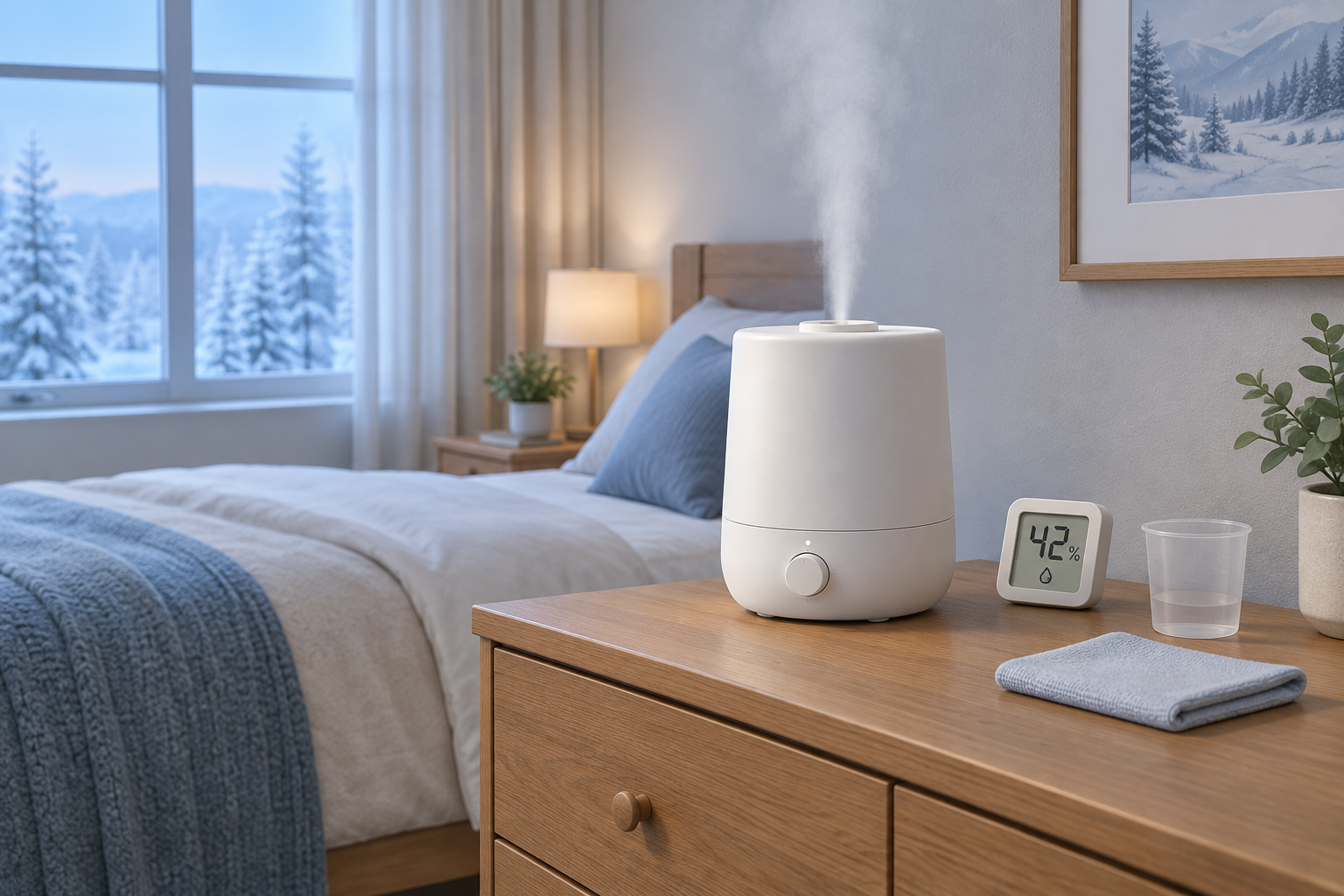
Before buying or switching on a room humidifier, measure the room’s relative humidity with a hygrometer. It is a small instrument that reports how much moisture is in the air. Take a reading in the room where you plan to use the unit, rather than assuming that winter heating means the room needs more moisture.
The U.S. Environmental Protection Agency (EPA) advises measuring indoor humidity and avoiding levels above 50% when using a humidifier. Treat that figure as a ceiling, not a target you need to reach. If the room is already comfortable and there is no practical reason to add moisture, leaving the humidifier off is a sensible option.
Readings can vary by room and over time, so check again after changing the unit’s settings or moving it. Also look for physical signs: water on windows, damp walls, or wet surfaces near the machine suggest that moisture is accumulating. A meter gives you a reference; it does not replace checking the room.
This guide focuses on household setup and care, not treatment for an illness. A humidifier is not a substitute for medical advice, and the available guidance here does not establish that one model prevents or treats a health condition.
Compare humidifier types by their trade-offs
The useful choice is the one that fits your room and routine while remaining practical to clean and operate.
Portable humidifiers differ in how they put moisture into the air and what they ask of you in return. Check the product manual and specifications before deciding: descriptions and maintenance requirements vary by model. The comparison below is a starting point, not a ranking or a substitute for the manufacturer’s instructions.
| Type | How it adds moisture | Practical consideration |
|---|---|---|
| Evaporative | A fan moves air through a wet wick or filter. | Check whether the model uses a replaceable wick and how often the manufacturer says to maintain or replace it. |
| Ultrasonic or impeller | Vibration or a rotating component disperses a fine mist. | EPA recommends low-mineral water to limit scale and mineral dispersal; check the manual for the water it specifies. |
| Steam vaporizer | Heats water and releases steam. | Hot water and steam can cause burns. Keep the unit out of children’s reach and follow the product’s placement and safety directions. |
Match the unit to the room and your routine
Capacity, controls, cleaning access, and a safe location matter as much as the humidifier’s type.
Start with the room where you expect to use the humidifier, not the largest area mentioned in an advertisement. Compare the maker’s stated room guidance with your space, and check whether the tank capacity and refill frequency suit your schedule. A unit that is awkward to carry, refill, or clean may be a poor fit even if its specifications look appealing.
Look for controls that make it easy to reduce output or switch the unit off. A built-in humidity display can be convenient, but it does not remove the need to notice dampness or condensation. If the device is hard to open, has parts you cannot reach, or requires a maintenance routine you are unlikely to follow, consider another model.
For example, someone who wants to use a humidifier occasionally in a small bedroom may value a compact unit with a straightforward tank and controls. A household choosing a model for a larger room might prioritize the manufacturer’s room guidance and how often it needs refilling. In either case, the best choice depends on the space and the care routine—not a universal claim that one type is best.
Set it up to keep nearby surfaces dry
Safe placement makes it easier to spot excess moisture and reduces avoidable spills or exposure.
Follow the manual for assembly, filling, placement, and operation. Set the unit on a stable, level surface where it cannot be easily knocked over. Choose a position that keeps the surrounding area dry and gives you room to refill and clean the tank without spilling water. Do not direct mist toward walls, curtains, electronics, or other items that could become damp.
Keep the humidifier where you can check for condensation and wipe up any splashes. If you use a steam vaporizer, take particular care around children: EPA warns that steam models can cause burns and advises keeping them out of children’s reach. Follow the product’s safety instructions even if its placement recommendations differ from general advice.
Once it is running, check the room rather than assuming the setting is suitable. If moisture gathers on windows or surfaces, turn the output down, reposition the unit, or use it less often. If dampness continues, switch it off until the area is dry and reassess whether the room needs humidification.
Use a simple water and cleaning routine
Standing water and missed cleaning can make a humidifier harder to keep in good condition.
Build care into your daily routine. The EPA and the Centers for Disease Control and Prevention (CDC) advise emptying portable humidifiers daily. After emptying, wipe the tank and accessible surfaces dry, then refill with fresh water when you are ready to use the unit again. Follow the manual for which parts can be removed and how to handle them.
Clean on the schedule and by the method stated in the manufacturer’s instructions. EPA guidance recommends cleaning portable humidifiers every third day; CDC advises regular cleaning according to the manufacturer. Use the more specific directions for your model, and do not improvise a cleaning-chemical mixture. EPA advises following the product instructions for cleaning agents and rinsing thoroughly after using them.
After cleaning, let the parts air-dry as directed before reassembling or storing the unit. If you will not use it for a while, empty it and follow the manufacturer’s directions for drying and storage. A regular routine is easier to maintain if you tie it to an existing habit, such as emptying the tank when you make your morning coffee.
- Turn the unit off and empty the tank each day.
- Wipe the tank and accessible surfaces dry.
- Clean the unit on the schedule in its manual; EPA recommends cleaning portable humidifiers every third day.
- Rinse thoroughly when cleaning instructions call for it, then let parts air-dry as directed.
- Refill with fresh water when you are ready to use the humidifier.
Choose water and respond to warning signs
Water quality and visible moisture can help you decide whether to adjust, pause, or continue using the device.
EPA recommends low-mineral water to limit scale and mineral dispersal, particularly for ultrasonic and impeller humidifiers. Check the manufacturer’s directions to see what water is appropriate for your model. Distilled water is one low-mineral option. CDC notes that distilled or boiled-and-cooled water can further reduce germ growth; boiling and cooling water should not be confused with removing minerals.
Keep watching the room after you refill or change a setting. Condensation on windows, damp walls, or wet nearby surfaces are reasons to reduce output, reposition the unit, or use it less. If the signs do not clear, turn the humidifier off rather than continuing to add moisture.
If you notice respiratory symptoms that seem to occur when the unit is running, stop using it and consider discussing the concern with an appropriate healthcare professional. The EPA notes that some potential effects of dispersed minerals and microorganisms are not fully understood. That uncertainty is a reason to maintain the device carefully and avoid claims that it will prevent or cure illness.
A practical first-use checklist
A few checks before and after switching the unit on help turn the guidance into a manageable routine.
Use this sequence when you bring home a humidifier or start using one again for the season. It keeps the decision tied to the actual room and makes daily upkeep less likely to be forgotten.
- Measure the room’s humidity and decide whether adding moisture is appropriate.
- Choose a unit whose room guidance, controls, refilling, and cleaning routine suit your space.
- Read the manual, then place the humidifier on a stable surface where it is easy to inspect and keep away from children if it is a steam model.
- Use the water specified for the device; consider low-mineral water where the manufacturer allows it.
- Check for condensation or dampness after use and reduce output or switch off if moisture appears.
- Empty and wipe the tank daily, then clean and air-dry the unit as instructed.
Frequently asked questions
What humidity level should I aim for with a room humidifier?
EPA guidance says to measure indoor humidity and avoid raising it above 50%. That is a ceiling, not a recommended target. Use a hygrometer and check for condensation or dampness as well.
How often should I clean a portable humidifier?
EPA recommends cleaning portable humidifiers every third day, while CDC advises regular cleaning according to the manufacturer’s instructions. Check your model’s manual for the cleaning method and any product-specific requirements.
Can I leave water in the humidifier between uses?
EPA and CDC advise emptying portable humidifiers daily. Wipe the tank dry and refill with fresh water when you are ready to use it again.
Is distilled water necessary?
Not necessarily; follow the manufacturer’s directions. EPA recommends low-mineral water to limit scale and mineral dispersal, especially for ultrasonic and impeller models. CDC says distilled or boiled-and-cooled water can further reduce germ growth.
What should I do if I see condensation near the humidifier?
Reduce its output, reposition it, or use it less. If dampness persists, switch it off until the area is dry and reassess whether the room needs a humidifier.
Sources & further reading
Explore the original sources behind this article. Our editorial perspective is separate from the organizations we reference.