How to Winterize a Rain Barrel Without Sending Roof Runoff Toward Your House
Drain and disconnect your rain barrel before freezing weather, then restore a suitable downspout route and store the empty barrel according to its instructions.
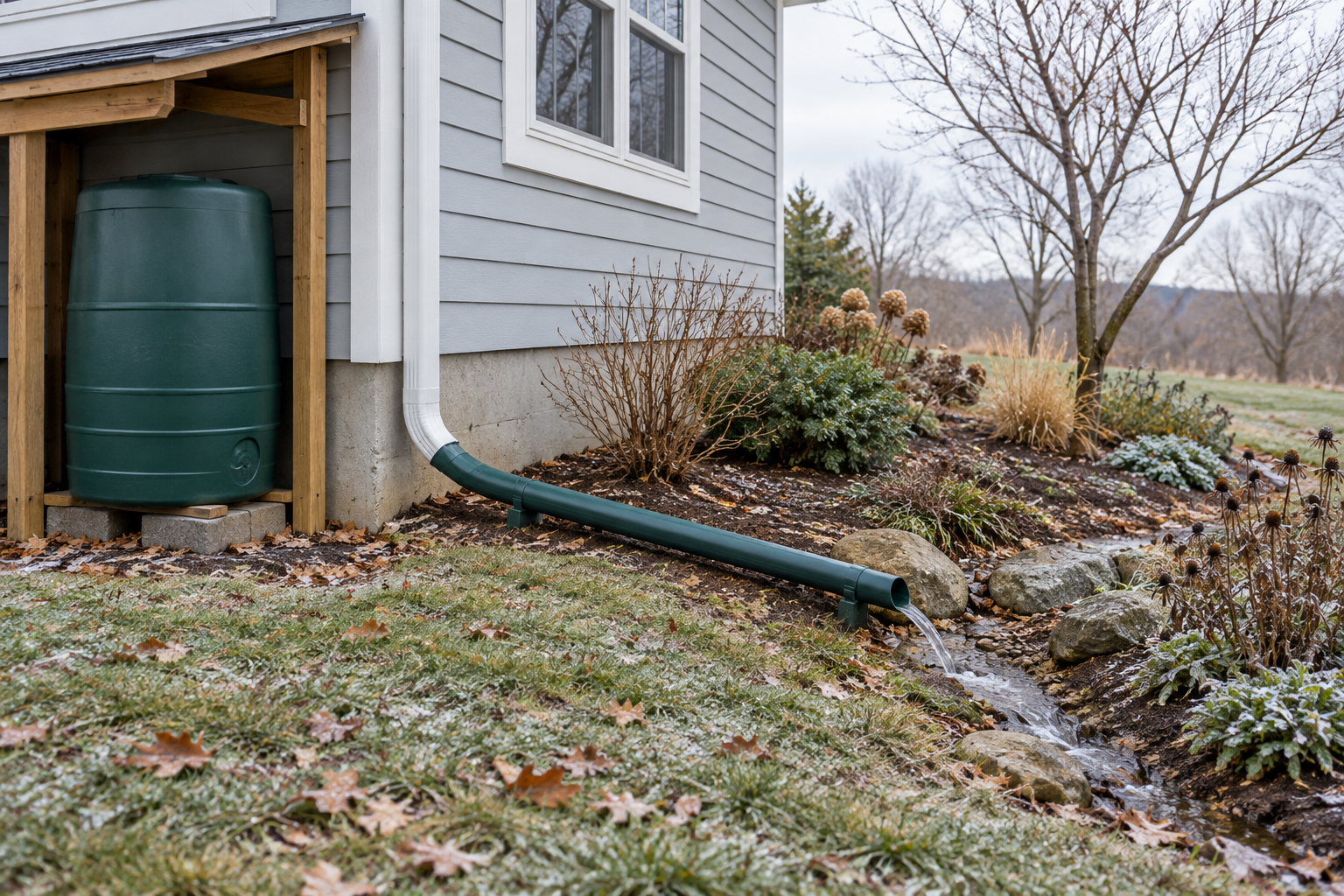
Plan before your area’s first hard freeze
A little preparation makes the shutdown easier and helps avoid hurried changes to the downspout.
To winterize a rain barrel, drain it, disconnect it from the downspout, and store it according to its instructions before freezing weather arrives. Then make sure the downspout can carry roof runoff somewhere suitable instead of leaving water to spill beside the house.
Use your local forecast as a timing cue. Rutgers Cooperative Extension recommends draining the barrel before the first hard freeze, but the timing varies by location and season. Plan ahead far enough to inspect the connections and decide where runoff will go after the barrel is removed.
Find the instructions for both the barrel and its diverter, if you use one. Connections and winter settings vary: a diverter may have a bypass position, a removable hose, or another arrangement. If you rent, check with the property owner or manager before changing a downspout or drainage setup.
- Locate the faucet or outlet, downspout connection, overflow outlet, and any removable fittings.
- Check the product instructions for winter drainage, storage, and connection details.
- Choose a dry, stable place to store the barrel or plan how to secure it outside.
Drain and disconnect the barrel
Empty the barrel through its intended outlet and take apart the connection without forcing parts.
Drain the barrel before storing it. Opening the faucet may not remove every drop, so check that the barrel is empty rather than assuming it is. Rutgers Cooperative Extension recommends leaving the faucet open for winter after draining; follow your product’s instructions to confirm whether that applies to your model.
Disconnect the barrel from the downspout or diverter using the method specified by the manufacturer. Some systems need a diverter moved into a bypass position; others require a hose or fitting to be removed. Avoid pulling hard on a connection that resists, since its design may require a different release method.
If the barrel is difficult to reach, do not tip it while it is full or use attached plumbing as a handle. Empty it through its normal outlet first. Set aside any removable caps, screens, hoses, or fittings so you can find them when you put the system away.
- Open the outlet or faucet and let the barrel drain.
- Check the barrel and its instructions for any remaining water or additional drainage steps.
- Disconnect or bypass the downspout connection as directed for your model.
- Keep the removable parts together with the barrel.
Restore a safe route for roof runoff
The barrel is only one part of the system: check where water will discharge once the downspout is disconnected.
Reconnect or adjust the downspout so it carries roof water away from the building. Depending on the setup, this could mean returning a diverter to its bypass position, reattaching a downspout section, or fitting an extension. Use the product instructions to identify the intended winter configuration rather than guessing.
Choose a discharge area that can receive the water without sending it toward the foundation, a neighbor’s property, or septic components. University of Nebraska–Lincoln Extension cautions against directing runoff to those locations. A downspout can be connected correctly yet still discharge somewhere unsuitable, so check the full route and outlet, not just the fitting at the gutter.
If space is limited or you are uncertain where runoff can appropriately go on your property, consult local drainage guidance or a qualified professional. Do not use an extension to send water somewhere it could create a problem.
- Trace the route from the downspout outlet to the place where water reaches the ground.
- Check that the outlet is not aimed toward the foundation, neighboring property, or septic components.
- After a rain, observe whether water pools or flows back toward the house; adjust the setup if needed.
Choose indoor or outdoor storage
Indoor storage can shelter the barrel; an empty barrel may also be stored upside down outdoors when its design and location permit.
If you have a suitable indoor space, store the drained barrel there according to the manufacturer’s instructions. A garage or shed may work if the barrel fits, can be moved safely, and can be left stable without blocking access or creating a hazard.
If the barrel must stay outdoors, University of Nebraska–Lincoln Extension advises storing it upside down. Rutgers Cooperative Extension also recommends securing an outdoor barrel against wind. Only turn it over if the barrel’s design allows it, and position it on a stable surface where it will not easily blow over.
Neither storage option guarantees that a barrel will avoid all damage. The comparison below is a practical guide; the barrel’s own instructions and your local conditions should guide the final choice.
| Option | May suit you when | What to check |
|---|---|---|
| Indoors | You have a suitable sheltered space and can move the barrel safely. | Follow the product instructions; keep it empty and stable. |
| Outdoors, upside down | Indoor storage is impractical and the barrel can be positioned safely. | Confirm the design permits it; secure the barrel against wind. |
Inspect and put away loose parts
A brief end-of-season check can make it easier to address visible problems and find everything at spring startup.
With the barrel empty and disconnected, inspect the faucet, screen, overflow, and fittings for visible debris, wear, or damage. This is a basic visual check, not a repair procedure. If a fitting is cracked, a seal looks damaged, or a connection no longer sits securely, consult the manufacturer’s instructions about an appropriate repair or replacement.
Clean and dry removable parts if the product instructions recommend doing so. Keep small components together in a labeled bag or container near the barrel. If something needs attention, make a note now rather than discovering the issue when you are ready to collect rainwater again.
Before finishing, take a photo of the diverter and fittings in their winter configuration, or write down what you changed. Keep that note with the instructions and stored parts. It can reduce guesswork when you reconnect the system.
- Look for visible debris or damage on screens, the faucet, and fittings.
- Store loose components together with the barrel.
- Record any part that needs attention before spring.
Make spring startup straightforward
Use a short restart check after freezing weather has passed and before relying on the barrel again.
When you are ready to put the system back into service, inspect the barrel and fittings for visible damage. Reconnect the diverter and downspout according to the product instructions, then check that the faucet and overflow are fitted as intended. If a part is damaged or will not connect securely, resolve that before using the system.
After reconnection, check the setup during the next rain. Confirm that water enters the barrel as expected and that overflow follows its intended route. Keep your winter photo or note until the system is working properly.
For now, start with three tasks: check your local forecast, locate the barrel and diverter instructions, and decide where the downspout will discharge once the barrel is disconnected.
Frequently asked questions
When should I winterize a rain barrel?
Plan to drain and disconnect it before the first hard freeze expected in your area. The timing varies, so use your local forecast rather than relying on a fixed national date.
Should I leave the faucet open over winter?
Rutgers Cooperative Extension recommends leaving the faucet open after draining. Check your barrel’s instructions, since the correct arrangement depends on the product.
Can I leave my rain barrel outside?
University of Nebraska–Lincoln Extension advises storing a barrel indoors if possible or upside down outdoors. If it stays outside, keep it empty and secure it against wind; follow its instructions and turn it upside down only if the design permits.
Where should the downspout send water after I disconnect the barrel?
Route it to a suitable area away from the house. Avoid directing runoff toward the foundation, neighboring property, or septic components. If you are unsure what is appropriate for your property, consult local drainage guidance or a qualified professional.
Do all rain barrels disconnect from downspouts the same way?
No. Barrel and diverter designs vary. Follow the instructions for your model and do not force a fitting that will not come apart.
Sources & further reading
Explore the original sources behind this article. Our editorial perspective is separate from the organizations we reference.
- [S1] Winterizing Your Rain Barrel – Rutgers Cooperative Extension of Camden Countycamden.njaes.rutgers.edu
- [S2] extensionpubs.unl.eduextensionpubs.unl.edu