How to Compare Checking Accounts: Fees, Access, and the Fine Print
Compare checking accounts against your real habits: how you get paid, use cash, pay bills, and maintain a balance. Check fees, waiver conditions, access, overdraft terms, and deposit insurance before applying.
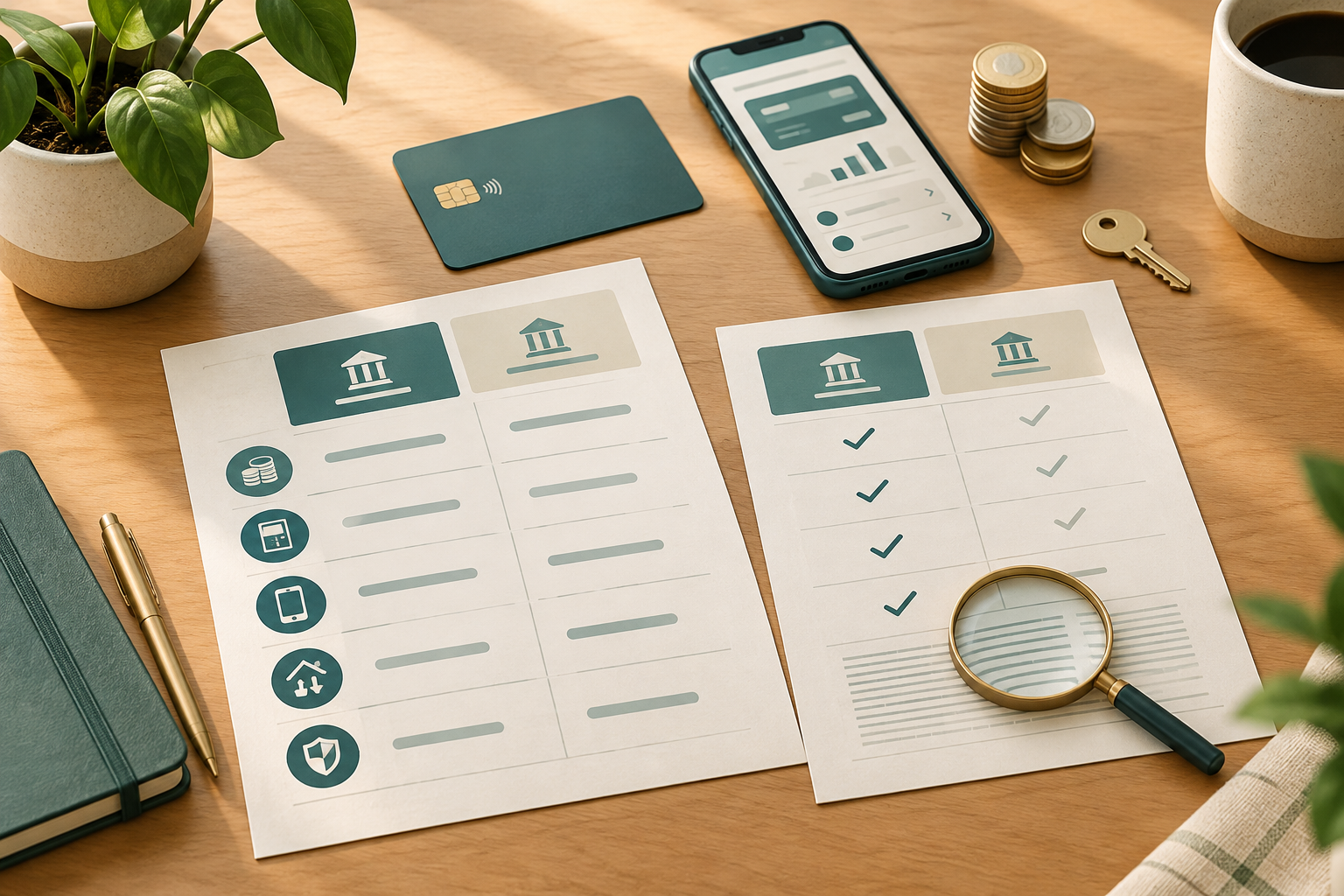
Compare checking accounts against your everyday habits
Your banking routine provides a more useful comparison than an account’s headline offer.
To compare checking accounts, write down how money reaches you, how you pay, how often you need cash or in-person service, and what balance you typically keep. Then compare each account’s fees, waiver rules, access, services, overdraft terms, and deposit-insurance status against that list. A “no monthly fee” label or an interest feature alone cannot tell you whether the account suits your daily needs.
Consider two different routines. Someone whose pay arrives by direct deposit and who rarely handles cash may prioritize a reliable app, online bill pay, and a fee waiver they can consistently meet. Someone who deposits cash or prefers in-person help may care more about nearby branches, their hours, and convenient ATM access. Neither set of priorities makes one account type universally better.
The Consumer Financial Protection Bureau (CFPB) recommends comparing fees and convenience, including ATM and branch access, hours, online or mobile banking, and the opening deposit. Use those topics as prompts, then focus on the features that matter to you; they are not a universal list of required services.
- How and when does income arrive: direct deposit, paper check, cash, or transfers?
- How do you pay: online bill pay, debit card, checks, automatic payments, or cash?
- How often do you withdraw or deposit cash, and where?
- What balance do you usually keep, including during a lower-income month?
- Do you need a branch, particular support hours, or a specific mobile feature?
Compare the full fee picture and waiver conditions
Distinguish a fee stated in the terms from one that disappears only when you meet a condition.
For each account, record the monthly maintenance fee and the exact conditions for avoiding it. A waiver might depend on a minimum balance or qualifying direct deposits. Check what counts as a qualifying deposit, which balance is measured, and when the institution checks it. If your income varies or you may change jobs, consider whether the requirement fits your likely routine rather than assuming you will always meet it.
The CFPB explains that maintenance fees and waiver requirements vary by institution and account. Its guidance is to check the institution’s stated fees and requirements. In your notes, keep the listed fee and the waiver condition in separate fields. A fee is not simply “free” if avoiding it depends on a rule you may not meet.
Look beyond the monthly charge. Check for fees related to out-of-network ATM use, certain transactions or checks, and overdraft or insufficient-funds events. Ask whether ATM fees are reimbursed and whether limits or conditions apply. Do not assume a service is free just because it is available in an app; check the account disclosure and fee schedule.
- Monthly maintenance fee and precise waiver requirements
- Minimum opening deposit and any ongoing balance rules
- Out-of-network ATM and cash-deposit costs
- Check, transaction, and other account-service fees
- Overdraft and insufficient-funds fees, if applicable
Check access and everyday services
Compare how easily you can use the account where and when you need it.
Map the institution’s ATMs against places you regularly visit, not only your home address. If you deposit cash, confirm where and how you can do so, and whether limits or fees apply. If you may need in-person help, check branch locations and hours and whether the branch offers the services you need.
Review mobile and online features one by one. Check whether the account offers mobile check deposit, online bill pay, low-balance or transaction alerts, and a practical way to contact support. Feature names do not establish eligibility, timing, limits, or cost, so look for those details in the product terms or ask the institution.
The CFPB’s checking-account guidance includes access, hours, and online or mobile banking among factors to compare. Its account-opening checklist also raises questions about ATM costs, bill pay, and low-balance alerts. Treat these as useful prompts, not guarantees that every account offers the same features or terms.
- Can you get cash without a regular out-of-network charge?
- Can you deposit the kinds of checks or cash you receive?
- Are mobile deposit and bill pay available, and are limits or fees disclosed?
- Can you set alerts in a way that works for you?
- How can you reach support, and do the hours fit your schedule?
Read overdraft and insufficient-funds terms
Find out how the account handles payments that exceed your available balance before you encounter the situation.
Check how the account treats transactions that exceed the available balance and payments that are returned unpaid. The terms may distinguish overdraft fees from insufficient-funds fees, and treatment can vary by transaction type. Ask whether the institution offers an overdraft service, which transactions it may cover, what it costs, and whether enrollment is optional for a particular service.
An alert or linked-account option is not a substitute for reading the terms. Alerts may help you notice a low balance, but their timing and delivery can vary; they cannot guarantee that every payment will clear without a fee. If you do not want an optional service, ask how to decline it and what may happen if a transaction is then declined or returned.
Compare the specific terms rather than relying on a broad phrase such as “overdraft protection.” The CFPB’s account-opening checklist prompts consumers to ask about overdraft and insufficient-funds rules.
- Which transactions may be covered by an overdraft service?
- Is enrollment optional, and how do you accept or decline it?
- What fees may apply to overdrafts or returned payments?
- What happens if you do not enroll or the account has insufficient funds?
- Can you set low-balance alerts, and how are they delivered?
Use a side-by-side checking-account comparison
A consistent worksheet makes it easier to spot conditions and decide which tradeoffs matter.
Fill in the same fields for every account, using the current fee schedule and account disclosure rather than a promotional summary. Mark a fee as avoidable only when you understand the exact condition and believe it fits your routine. If a term is unclear, leave it unresolved and ask the institution before deciding.
Give more weight to rows connected to your habits. If you use cash weekly, ATM availability and cash-deposit access may matter more than a feature you rarely use. If your balance fluctuates, examine a waiver tied to a minimum balance closely. This table is a decision aid, not a score that identifies one best account for everyone.
| What to compare | Account A | Account B | What to verify |
|---|---|---|---|
| Monthly fee and waiver | Fee and condition | Fee and condition | Can you meet the condition reliably? |
| Opening deposit and balance rules | Amount or rule | Amount or rule | When is the balance measured? |
| ATM and cash access | Network, costs, deposit options | Network, costs, deposit options | Are locations practical for you? |
| Digital services and support | Features and hours | Features and hours | Check availability, limits, and fees |
| Overdraft and insufficient funds | Terms and available choices | Terms and available choices | Which transactions and fees are involved? |
| Insurance status | Institution and status | Institution and status | Check with the relevant official agency |
Verify deposit-insurance status
Confirm both the institution’s status and whether the product is an eligible deposit account.
For a bank, the FDIC explains that eligible deposit accounts at FDIC-insured banks, including checking accounts, are covered by deposit insurance. Use the FDIC’s BankFind tool to check a bank’s status. Confirm that the product you are considering is an eligible deposit account: not every financial product offered by a bank is an insured deposit.
For a credit union, use the NCUA’s Credit Union Locator to check federal insurance status. The NCUA notes that some state-chartered credit unions instead use private insurance, which is not backed by the U.S. government. Do not assume private insurance and federal coverage are interchangeable; check which applies to the institution.
Insurance rules can depend on account ownership and other details. If you expect to keep a substantial balance or have multiple accounts at one institution, consult the relevant agency’s current guidance or ask the institution how the rules apply. This guide provides general information, not individualized financial advice.
- For a bank, verify the institution through FDIC BankFind.
- For a credit union, check federal insurance status with the NCUA locator.
- Confirm the product is an eligible deposit account, not another financial product.
- For questions about coverage limits or ownership categories, consult the agency’s guidance.
Confirm the current terms before applying
A final review helps ensure the account you apply for matches the offer you evaluated.
Fees, waiver conditions, ATM networks, and features vary by institution and product. Before applying, open the current account disclosure and fee schedule on the institution’s own site or request them directly. Confirm the monthly fee, waiver trigger, minimum opening deposit, ATM costs, overdraft terms, and any service you consider essential.
The CFPB’s account-opening checklist can help you prepare questions, but it is not a universal list of required documents. Ask the institution what identification, application information, and opening deposit it requires for your situation.
If you are switching accounts, list pending automatic payments and deposits. Update the relevant payers and billers, then check that important transactions have moved successfully before closing the old account. Keep your comparison notes so you can revisit the same details if you apply later.
A practical final check
First, confirm that any fee-waiver condition is realistic in an ordinary month. Second, make sure cash access, bill pay, and support fit how you bank. Third, verify the institution’s insurance status and review the account’s overdraft choices. If a key detail is unclear, ask the institution before proceeding.
- Open the current fee schedule and account disclosure for each finalist.
- Check the exact waiver condition, opening deposit, ATM and transaction fees, and overdraft terms.
- Verify the bank or credit union through the appropriate official insurance-status tool.
- Ask what identification and application information the institution requires.
- Keep your notes and recheck the terms when you are ready to apply.
Frequently asked questions
What is the most important thing to compare when choosing a checking account?
Start with the factors that fit your routine: monthly fees and waiver conditions, access to cash, bill-payment needs, and overdraft terms. The most important details depend on how you receive and use money.
Is a checking account with no monthly fee always the cheapest option?
Not necessarily. Check whether the fee is waived only under specific conditions, then compare other possible charges, such as ATM or transaction fees. Use the full fee schedule rather than relying on the headline description.
How can I check whether a bank account is FDIC-insured?
Use the FDIC’s BankFind tool to verify the bank, then confirm that the product is an eligible deposit account. Other financial products offered by a bank are not automatically insured deposits.
Are credit union deposits covered by the FDIC?
Federal share insurance for credit unions is handled by the NCUA, not the FDIC. Check the credit union’s status using the NCUA locator; some state-chartered credit unions may use private insurance instead.
What should I check about overdraft fees before opening an account?
Ask which transactions may be covered, whether enrollment is optional, what fees can apply, and what happens when a transaction is declined or returned. Check the account’s current terms for the specific rules.
Sources & further reading
Explore the original sources behind this article. Our editorial perspective is separate from the organizations we reference.
- [S1] Why am I being charged a monthly maintenance fee for my bank or credit union account? | Consumer Financial Protection Bureauconsumerfinance.gov
- [S2] Moving your checking account | Consumer Financial Protection Bureauconsumerfinance.gov
- [S3] Checklist for opening a bank accountfiles-prod.consumerfinance.gov
- [S4] Deposit Insurance FAQs | FDIC.govfdic.gov
- [S5] Share Insurance Coverage | NCUAncua.gov