Got an Explanation of Benefits? Match It to Your Medical Bill Before Paying
An Explanation of Benefits is not a bill. Compare it with your provider’s bill and your payment records to understand the balance and identify what to ask before paying.
An EOB explains the claim; the provider’s bill requests payment
Start by identifying what each document is meant to tell you.
An Explanation of Benefits (EOB) is a health plan’s summary of how it processed a claim. It may list the provider, date of service, services or charges submitted, what the plan paid, and the amount it says may be your responsibility. It is not a bill. The provider’s bill is the document that requests payment for care.
That distinction matters because the two documents can arrive at different times, and the EOB may not include payments you have already made. A copayment collected at an appointment, for example, may appear on your receipt but not be reflected in the EOB’s patient-balance figure. CMS recommends comparing the EOB with the provider’s bill and notes that separate EOBs may arrive for different providers, services, or dates. [Check the service details and balances against the paperwork you have, rather than treating one number in isolation.]
- EOB: how the insurer processed the claim and what it says you may owe under the plan.
- Provider bill: the provider’s record of charges, payments, adjustments, and any balance it is requesting.
- Receipt or payment confirmation: evidence of money you have already paid.
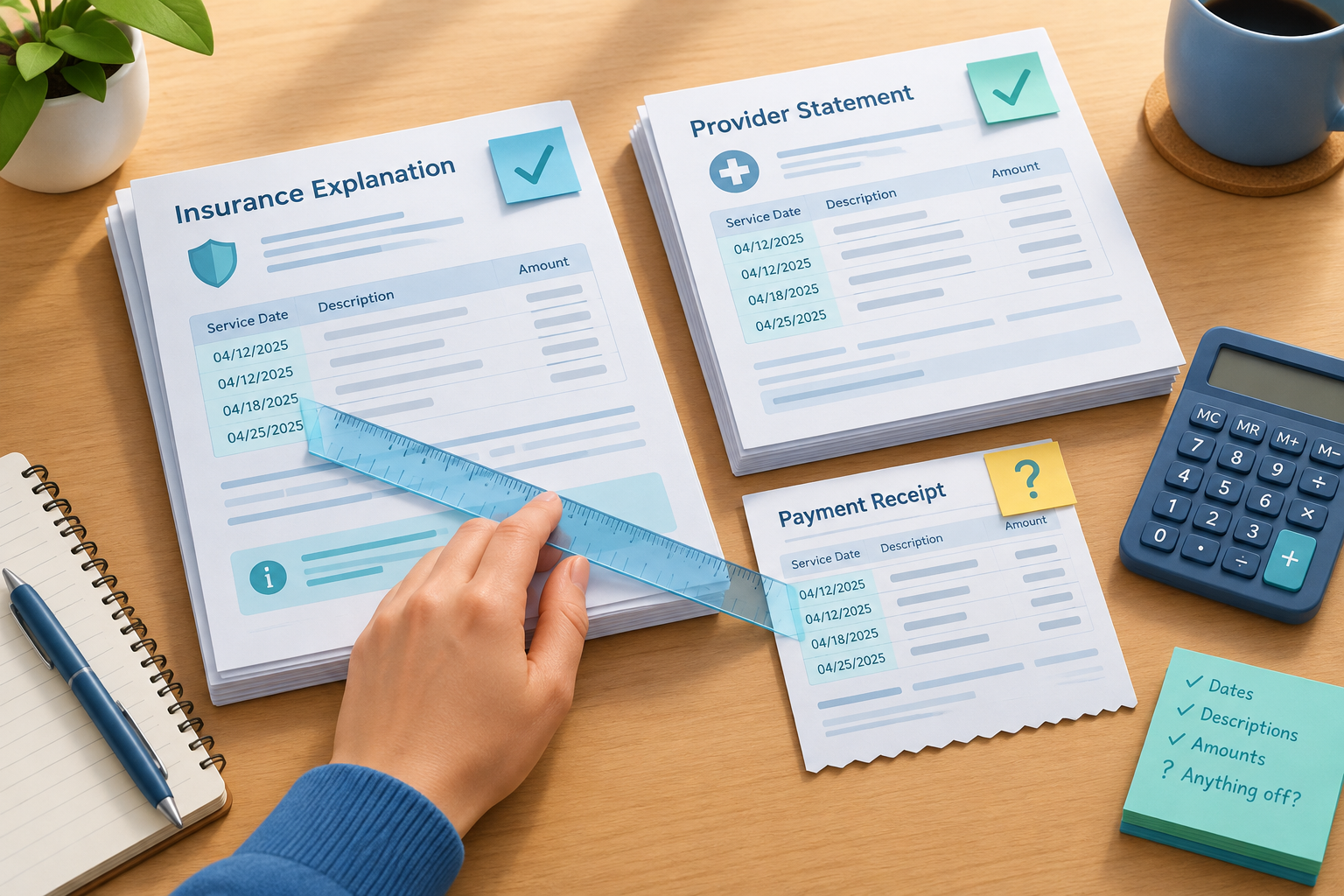
Gather the records for a three-way match
Put the insurer’s explanation, the provider’s bill, and your own payment history side by side.
For the clearest comparison, gather the EOB for the claim, the provider bill that may relate to it, and any receipts, card confirmations, or account statements showing payments. If you have them, keep the health plan’s explanation of your benefits and any claim status messages nearby. You do not need to understand every insurance term before starting; the first task is to make sure the documents refer to the same care.
Write down the patient name, provider or facility, service date, service description, and claim or account number shown on each record. A claim number and a provider’s account number may be different identifiers, so do not assume a mismatch in those numbers alone means the documents are unrelated. If a bill covers several visits, identify the line or date that corresponds to the EOB.
- Keep original documents or clear copies, including both sides if there is information there.
- Use a secure place for records that contain personal or health information.
- Note when each document arrived and when you contacted the insurer or provider.
Compare the service, date, and patient balance
Match the details first, then interpret the amounts in context.
Check that the EOB and bill concern the same person, provider, service, and date. A hospital visit, for instance, may produce separate claims from the facility and from clinicians who treated you. A single appointment can therefore lead to more than one EOB or bill. CMS also cautions that EOBs may be issued separately for different providers, services, or dates; a document that does not match one bill may relate to a separate part of the care.
Once you have a likely match, compare the EOB’s patient-responsibility amount with the amount the provider says is due. They may not be identical if the provider’s bill includes earlier payments, if a payment has not yet been recorded, or if the documents cover different items. The EOB can help explain the plan’s calculation, while the provider’s billing office can explain how its account balance was calculated. Your plan terms and the details of the claim determine how cost sharing is handled, so do not infer that every difference is an error.
| What to compare | What to check | Question to ask if it differs |
|---|---|---|
| Patient and provider | Do the names and provider or facility match? | Does this bill relate to the same patient and provider as the claim? |
| Service and date | Does the description and date line up with the care you received? | Is this a separate service, date, or provider claim? |
| EOB patient balance and bill balance | Are both figures for the same claim or service, and is either document showing payments? | What makes up the amount currently due? |
| Payments you made | Do receipts or confirmations show a copayment or other payment? | Has that payment been applied to the account? |
Why the paperwork may not match yet
Several ordinary timing and billing details can create a difference without establishing that either document is wrong.
A copayment paid at the visit is one common reason your own records may differ from the EOB or bill. CMS notes that a copayment or coinsurance may be requested at the time of care, and that an EOB may not reflect amounts already paid. Keep the receipt and ask the provider to confirm whether the payment was credited to the right account and service.
Other possibilities include a provider bill covering multiple dates, separate claims from different professionals, or documents issued at different stages of claim processing. The EOB might refer to a facility while the bill is from a clinician, or a bill may include a payment or adjustment that is not obvious at first glance. These are prompts to clarify what each line represents—not reasons to assume that a charge is valid or invalid. Ask for an itemized list if you cannot tell what the bill includes.
- Check whether the bill groups multiple services or dates together.
- Look for a payment you made at the appointment, even if it is absent from another record.
- Confirm that you are comparing the same provider and claim, not separate parts of one visit.
- Ask whether the provider has received and applied the insurer’s claim processing information.
Who to contact when something is unclear
Direct each question to the organization that can verify that part of the record.
Contact the provider’s billing office about its bill, itemized charges, account balance, and payments credited to your account. Have the bill, EOB, and payment proof in front of you. Ask them to identify which services and dates the bill covers and how they arrived at the amount currently due. If charges seem wrong or unclear, the Consumer Financial Protection Bureau advises asking the provider for an itemized list.
Contact your health plan about how it processed the claim, what a term or remark code means, or how the patient-responsibility amount was determined under your coverage. Use the member-services contact information on your insurance card or plan materials. If you disagree with the claim decision, consult your plan documents for its process and deadlines for requesting review or appealing; steps and time limits can vary by plan. The CFPB also recommends consulting the EOB and plan documents when you disagree with charges or need more information.
When you call, state the specific discrepancy rather than saying only that the bill looks wrong. For example: “I paid a copayment on the service date. Can you confirm whether it was credited to this account?” Or: “This bill lists a date that does not match the EOB. Can you tell me which claim it refers to?” Record the date, the department or representative you spoke with, what they said, and any reference number.
Keep the question focused
If the provider confirms that a payment is missing, ask what documentation it needs and how the account will be updated. If the insurer says it processed the claim as shown, ask where that calculation appears in your plan materials and what review options apply. Keep copies of correspondence and follow the written instructions you receive. This is general information; only the provider and your insurer can answer questions about your specific account and plan.
A practical checklist before paying
Use this short sequence to make the comparison repeatable and keep a record of what you learn.
A mismatch does not automatically mean you should ignore a bill, and an EOB is not by itself a demand for payment. If a due date is approaching while you seek clarification, contact the provider and ask what options or timing apply to your account. Do not assume that contacting the insurer automatically pauses provider billing; confirm directly with the provider.
- Match the patient, provider, service description, and date on the EOB and bill.
- Check whether separate bills or EOBs may cover different providers, services, or dates.
- Compare the EOB’s stated patient balance with the provider’s requested balance for the same care.
- Subtract or otherwise account for payments you have made using receipts or confirmations; ask whether each payment has been posted.
- For unclear charges, request itemized details from the provider. For claim processing or plan terms, contact the insurer.
- Save the documents and notes, then follow the provider’s and plan’s instructions for next steps or review.
Frequently asked questions
Is an Explanation of Benefits a bill?
No. An EOB explains how your health plan processed a claim and may show what it says you are responsible for. The provider’s bill is the payment request. Compare the two, but do not treat the EOB itself as an invoice.
Why is my provider bill different from my EOB?
The documents may cover different providers, dates, or services, or they may reflect different stages of processing. A copayment or other payment you made may also be missing from one record. Ask the provider to explain its bill and the insurer to explain its claim calculation.
Should I pay a medical bill that does not match my EOB?
A difference is a reason to ask questions, not proof that the bill is incorrect. Check that the documents refer to the same care, account for payments, and contact the provider about the amount requested. If a due date is near, ask the provider what timing or options apply while you seek clarification.
Who should I call about an EOB or medical bill?
Call the provider’s billing office about itemized charges, the account balance, and payments credited. Call your health plan about claim processing, benefit terms, and remark codes. Keep notes of both conversations.
What if I still disagree with how my claim was handled?
Review your plan documents for its process and deadlines for requesting a review or appeal, which can vary. Contact the insurer for claim-specific instructions and keep copies of the EOB, bill, correspondence, and any supporting payment records.
Sources & further reading
Explore the original sources behind this article. Our editorial perspective is separate from the organizations we reference.