How to Measure a Carry-On Bag Before Your Next Flight
Measure your bag packed, then compare it with the current carry-on or personal-item rules that apply to every flight on your itinerary.
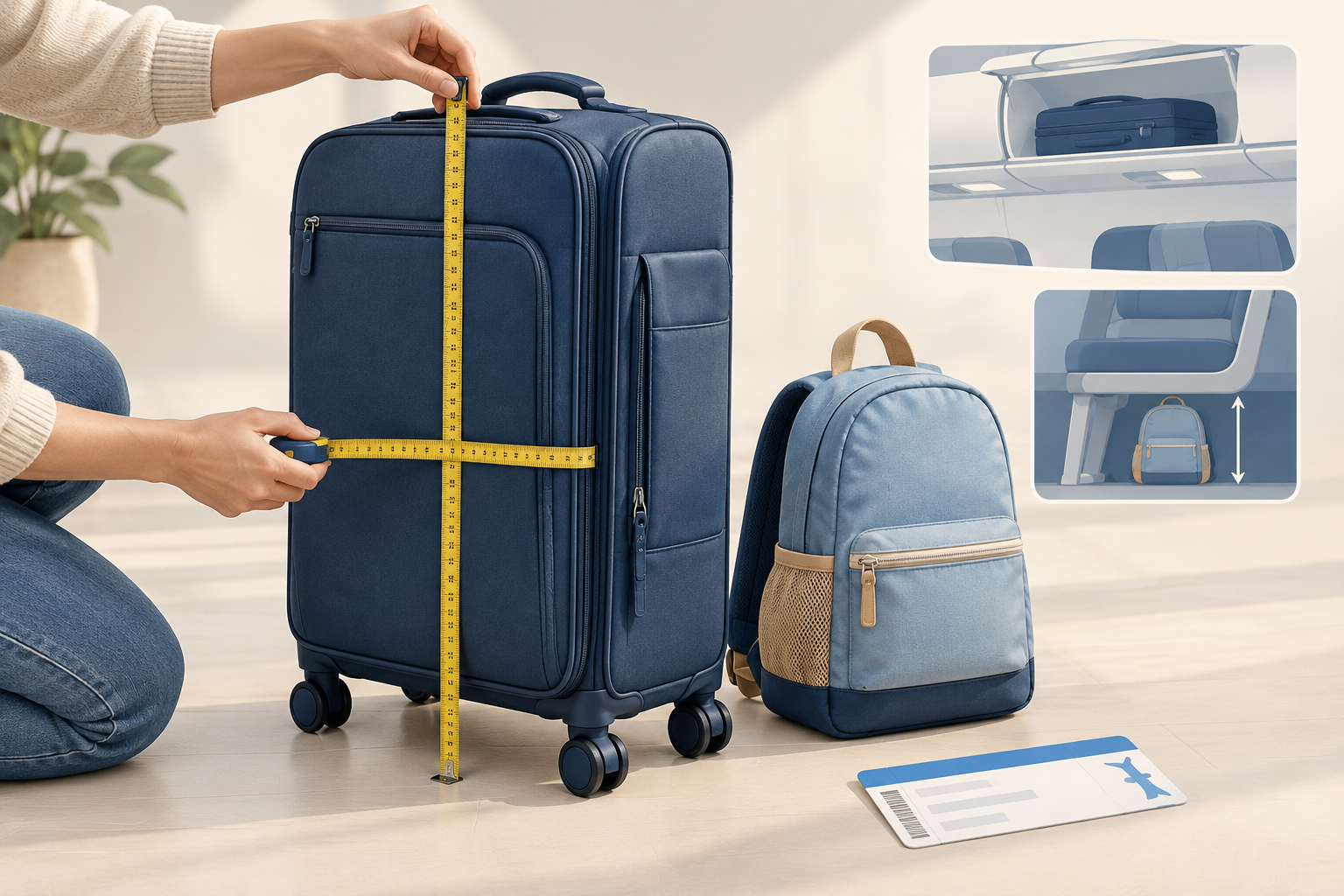
How to measure a carry-on bag before your flight
The reliable check combines the airline’s current rules with measurements of the bag in travel-ready condition.
To find out whether your suitcase, backpack, or personal item is likely to be accepted, check the baggage rules that apply to every flight on your itinerary, then measure the bag as you plan to carry it. Compare its height, width, and depth with the limit for the correct bag category. Don’t assume that a limit you saw on a luggage label—or used on a previous trip—applies to this flight.
There is no single carry-on measurement you can rely on for every airline. The Federal Aviation Administration advises passengers to check with their airline for its carry-on requirements. Use the airline’s current policy and your booking details to confirm what applies. [Source: S1]
Check your itinerary and fare first
A connection or ticket with multiple carriers can make a quick policy check especially useful.
Review your confirmation and identify the airline operating each flight, not only the company that sold the ticket. If your itinerary includes different carriers, check the baggage information for each segment and confirm with the airline or booking provider which rules apply to your ticket. If the answer is unclear, ask before travel rather than assuming that acceptance on one flight settles the question for another.
Check what your fare permits as well as the bag’s dimensions. Your booking may specify whether you can bring an overhead-bin carry-on, a smaller personal item, or both. Policies may also provide details for a particular route, aircraft, or fare. Use the terms and limits in the current policy that applies to your booking.
Save the relevant policy page or note when you checked it. That gives you a useful reference if you need to revisit the rules or ask the airline about a borderline measurement. It is not a substitute for the airline’s current instructions, but it can help you keep the details straight.
Measure the bag packed, not just the empty case
The packed shape is what matters for a useful pre-flight fit check, particularly with soft-sided luggage.
Pack the bag with the items you expect to take. A backpack’s depth can change when its pockets are full, and a soft-sided case may bulge. Set it on a level surface and use a tape measure or ruler to check the exterior dimensions in the order and manner specified by the airline. If the policy lists height, width, and depth, measure each separately rather than relying on a combined total.
Measure straight across the bag, not along its curved surface. Check the widest, tallest, and deepest points. Follow the airline’s definition of what counts: it may specify whether wheels, handles, feet, side pockets, or other protrusions are included. Delta, for example, says its carry-on dimensions include handles and wheels. That is a Delta-specific policy detail, not a rule to assume for every carrier. [Source: S2]
If the airline does not explain how to position a telescoping handle or measure an unusual protrusion, don’t guess when the result is close to the limit. Ask the carrier. Write down the three measurements using the same units as the policy. If you convert units, avoid rounding a borderline result down.
A simple measuring routine
Measure from the lowest exterior point to the highest for height; across the broadest side for width; and from the frontmost to the rearmost point for depth. Include packed pockets and protruding parts when the airline’s instructions count them. Repeat any measurement that appears close to the limit.
- Pack the bag as you expect to travel.
- Place it in the position described by the airline’s measurement instructions.
- Measure height, width, and depth at the outermost points.
- Record the results and compare each dimension with the relevant policy limit.
Check whether it is a carry-on or personal item
The airline’s definitions and your ticket determine which cabin-bag allowance to compare against.
A carry-on is generally intended for overhead storage, while a personal item is intended to fit beneath the seat. These descriptions help you think about where a bag will go, but they do not replace the airline’s definitions or dimensions. A backpack is not automatically a personal item, and a small suitcase does not automatically qualify as one.
Compare your packed bag with the specific category you intend to use. If you plan to bring two items, confirm that the fare allows both. Check whether the airline gives a separate measurement or fit requirement for the personal item. If the policy is ambiguous, ask the airline how it applies to your booking rather than relying on a retailer’s product description.
| Bag category | What to check | Practical comparison |
|---|---|---|
| Carry-on | The applicable carry-on dimensions and fare allowance | Compare all stated exterior dimensions with the packed bag. |
| Personal item | The airline’s definition, any separate size limit, and under-seat fit requirement | Check whether the packed bag meets the stated dimensions and fit conditions. |
| Two items | Whether your fare permits both categories on each relevant flight | Confirm the permitted combination for your booking before packing. |
Compare your measurements with the airline’s current rules
A measurement check helps you spot a mismatch early, but it cannot guarantee that a bag will stay in the cabin.
Open the current baggage policy for the airline and booking details you have confirmed. Compare height with height, width with width, and depth with depth. Do not compare only the sum of the dimensions unless the policy tells you to use a combined measurement. Check the policy’s instructions about wheels, handles, and other parts of the bag.
If the packed bag exceeds a listed limit, do not count on soft sides or an unfastened expansion section to bring it within the rules. Repack and measure again, remove items if that changes its exterior dimensions, or consider a smaller bag. If it is very close to the limit, repeat the measurement and contact the airline before you leave.
A measurement match does not promise cabin space. Delta says its crew may need to gate-check carry-on bags when space is limited. This is a Delta policy example, not a universal assurance about how every airline handles cabin capacity. Follow the instructions for your flight if the airline requires a gate check. [Source: S2]
Do a final fit check before leaving
Use the policy comparison to make decisions while you still have time to repack or choose another bag.
If a baggage sizer is available at the airport for your airline, it can offer a practical final check. Follow its posted instructions and do not force a bag into it. A sizer for one carrier is not proof that a bag meets another carrier’s rules, and it does not resolve questions about what your ticket permits.
Make a backup plan if your bag is close to the limit or you may be asked to check it. Keep essentials you need during the journey in a smaller item only if you have confirmed that item is permitted. Consider whether you can manage the trip if the larger bag is not available in the cabin. For unclear policy wording or unusual items, contact the airline before departure.
- Recheck the baggage policy and confirm which rules apply to each flight.
- Measure the bag packed, including the parts counted by the airline.
- Confirm your fare permits the category and number of items you plan to bring.
- Use an appropriate airport sizer if one is available.
- Decide what you will do if the bag must be checked or repacked.
Example: one backpack on a connecting trip
Checking each segment separately can reveal a problem before you reach the airport.
Suppose you plan to use one backpack on a trip with a connection. Pack it as you intend to travel and measure its height, width, and depth. Then check the baggage policy and fare conditions that apply to each flight. Pay particular attention to the packed depth if the backpack has a bulging front pocket.
If the backpack meets one carrier’s personal-item conditions but exceeds a limit that applies to another segment, do not assume the first carrier’s acceptance guarantees acceptance later. Repack, choose a smaller bag, or ask the airline or booking provider how the rules apply to your itinerary. The FAA’s advice to check with the airline and the carrier-specific nature of Delta’s published details support treating this as a flight-by-flight check. [Sources: S1, S2]
Your next step is simple: identify the relevant airline rules, measure the bag packed, and compare it with the right allowance. If the result is borderline, resolve the question before travel day.
Frequently asked questions
Do I include wheels and handles when measuring a carry-on?
Follow the airline’s written measurement instructions. Delta, for example, includes handles and wheels in its carry-on dimensions, but do not assume that policy applies to every carrier.
Should I measure my bag empty or packed?
Measure it packed as you plan to travel. Contents can change the shape of a soft-sided suitcase or backpack, especially if pockets are full.
Are carry-on and personal-item dimensions the same?
Not necessarily. Airlines may define the categories and their dimensions separately. Check the current policy and confirm what your fare permits.
If my bag meets the size limit, is it guaranteed to stay in the cabin?
No. A bag that meets a published dimension limit may still need to be checked if cabin space is limited or the airline directs you to check it.
Sources & further reading
Explore the original sources behind this article. Our editorial perspective is separate from the organizations we reference.