How to Pack Prescription Medicine for a Flight: A Carry-On Checklist
Keep prescription medicine accessible in your carry-on, prepare for U.S. airport screening, and check the rules for every destination and layover.
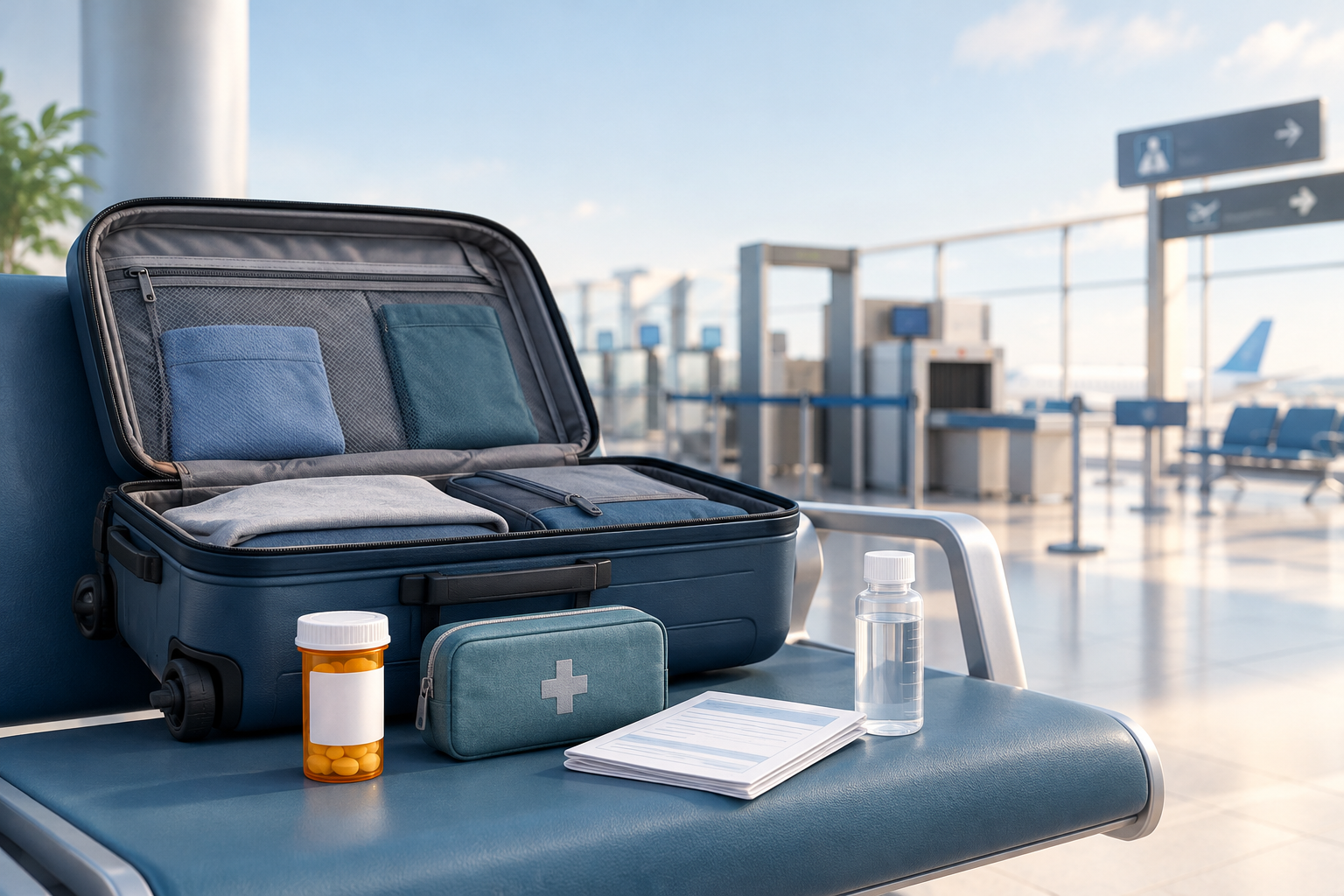
How to pack prescription medicine for a flight
Plan for access during travel, screening at departure, and the rules that apply when you cross borders.
Pack prescription medicine in your carry-on, keep it identifiable, and check the rules that apply to your route. If you are departing from a U.S. airport, prepare for Transportation Security Administration (TSA) screening. For an international trip, check medication requirements in every destination and transit country—not just your final destination.
The steps below help you prepare without changing your treatment plan. Questions about doses, time-zone changes, or medicine-specific storage should go to your pharmacist or healthcare professional.
- Make a list of medicines and related supplies.
- Keep them accessible in your carry-on.
- Check screening and country-specific requirements before travel.
Build a medication packing list
A written inventory helps you match what you pack to the itinerary and the way each medicine must be handled.
List each medicine by the name on its label and note any supplies you use with it. Compare the list with your travel dates and planned itinerary, then pack the amount arranged for your needs with your prescriber or pharmacist. If you are unsure how to plan for a delay or an extended trip, ask them rather than assuming one extra-supply rule applies to everyone.
Include a copy of each prescription or other documentation your healthcare professional recommends. CDC travel guidance advises carrying prescription copies and checking storage requirements, including whether a medicine needs refrigeration. Keep this information with the medicine so it is available if you need to identify it or explain what you are carrying.
For medicine with temperature or handling requirements, follow its instructions and ask a pharmacist or healthcare professional how to maintain the required conditions in transit. Do not assume a regular pouch, ice pack, or cabin environment will suit every medicine.
- Prescription medicine for the planned trip.
- Relevant prescription copies or recommended documentation.
- Supplies needed to take or manage the medicine.
- A storage plan confirmed with a professional if the medicine has special requirements.
Prepare medicine for U.S. airport screening
The screening steps depend partly on whether you are carrying pills or medically necessary liquids.
TSA guidance says medically necessary liquids may exceed the usual 3.4-ounce limit when carried in reasonable quantities. You must declare them for screening, and they may receive additional inspection. Keep liquid medicine easy to show and follow the screening officer’s instructions.
TSA’s medication list says pills are allowed in both carry-on and checked bags. That permission is about screening; it is not a recommendation to put medicine in checked luggage. Keeping medicine you may need in your carry-on makes it accessible and avoids relying on a suitcase that is out of reach during the flight or a delay.
Screening can depend on the medicine and equipment you carry. Check TSA’s current “What Can I Bring?” guidance for your particular items before departure. These instructions concern U.S. airport screening; they do not establish the rules at airports in other countries.
- Declare medically necessary liquids to the TSA officer at the start of screening.
- Be prepared for a liquid medicine to receive additional inspection.
- Keep medicine and any related supplies accessible so you can present them if asked.
- Check current guidance for any equipment or less common medication item you plan to carry.
| Item | How to prepare | What to expect |
|---|---|---|
| Pills or capsules | Keep them accessible and identifiable, preferably in the labeled packaging. | TSA says pills are allowed in carry-on and checked bags; carry-on storage keeps them within reach. |
| Medically necessary liquid medicine | Keep it easy to show and declare it for screening. | It may exceed 3.4 ounces in a reasonable quantity, but may receive additional inspection. |
| Prescription information | Keep a copy with your medicine. | It can help identify the medicine if questions arise; it does not replace country-specific permissions. |
Keep medicine identifiable and accessible
Labels and a consistent place in your bag make it easier to find and identify medicine while traveling.
CDC’s Yellow Book advises travelers to keep medicines in their original labeled containers and carry them in hand luggage. When practical, leave the pharmacy label with the medicine rather than transferring pills into an unlabeled container. If you use a separate organizer, consider carrying the original labeled packaging or relevant prescription information too.
Choose a secure place in your carry-on where the medicine will not be crushed, spilled on, or buried under other belongings. Before leaving home, check that it is in the bag you will take into the cabin. A prescription label helps identify what you have, but it does not by itself establish that the medicine is permitted in another country.
Check international rules for your medicine and route
Use the medicine’s precise identity and your full itinerary to find requirements in official country guidance.
Medication laws differ by country, and a medicine prescribed at home may be restricted elsewhere. CDC’s Yellow Book advises checking restrictions in both destination and transit countries. A layover can matter even if you do not plan to leave the airport, so include every country shown on your itinerary in your check.
Start with the name printed on the medicine label. If the official guidance uses a different name, ask a pharmacist or prescriber for the active ingredient—the substance that produces the medicine’s intended effect. Search the official government, customs, health, or embassy guidance for each country using both the medicine name and active ingredient where appropriate. Check whether the medicine is allowed, whether a quantity limit applies, and whether you need a permit, advance approval, or supporting documents.
Do not treat a general travel page, online discussion, or prescription from your home country as confirmation of another country’s rules. If official guidance is unclear, contact the relevant country authority or seek help from your prescriber or pharmacist identifying the medicine. CDC’s Yellow Book chapter was dated April 23, 2025; its general travel-medicine page was last reviewed August 18, 2022. Use them as starting points and verify current requirements with the relevant authorities.
- Write down every destination and transit country on your itinerary.
- Record the medicine’s labeled name and, if needed, ask a professional for its active ingredient.
- Look for official country guidance on permission, quantity limits, and documentation.
- Resolve unclear requirements with the relevant authority before travel.
Finish with a pre-flight check
Use your packing list and route to close any gaps before you leave for the airport.
On the day before travel, compare the medicine in your carry-on with your written list. Confirm that prescription information is with it and that you have completed the country-by-country check for an international itinerary. If you are departing from the United States with liquid medicine, review the current TSA instructions and be ready to declare it.
For a storage question, a possible delay, or a treatment-timing concern, contact your pharmacist or healthcare professional before departure. They can advise on your particular medicine and care plan; general travel guidance cannot determine a safe change to a dose, schedule, or storage method.
- Put prescription medicine and relevant supplies in your carry-on.
- Keep medicine identifiable and prescription information close by.
- Declare medically necessary liquids during U.S. screening and follow officer instructions.
- Check official rules for every destination and transit country.
- Ask a healthcare professional about medicine-specific storage, delay, or timing questions.
Frequently asked questions
Can I bring prescription pills in my carry-on through U.S. airport security?
Yes. TSA guidance says pills are allowed in carry-on bags. Keeping them there also makes them accessible during travel. Check current TSA guidance for questions about a particular medicine or related equipment.
Can prescription liquid medicine be larger than 3.4 ounces?
TSA permits medically necessary liquids in reasonable quantities beyond the usual 3.4-ounce limit, but you must declare them for screening. They may receive additional inspection.
Should I keep medicine in its original container?
CDC’s Yellow Book advises keeping medicines in their original labeled containers. Prescription copies or other relevant documentation can also be useful, particularly for international travel.
Do I need to check medication rules for a layover?
Yes. Check official guidance for each transit country as well as your destination. Requirements can vary by country, even when you are not planning to leave the airport.
What if my medicine needs refrigeration or I have a timing question?
Ask your pharmacist or healthcare professional how to handle storage or timing for your specific medicine. Do not change storage conditions, doses, or schedules based on general travel guidance.
Sources & further reading
Explore the original sources behind this article. Our editorial perspective is separate from the organizations we reference.