How to Read an OTC Drug Facts Label Before Choosing a Cold Medicine
Compare the Drug Facts panels on the specific cold medicines in front of you. Check active ingredients, labeled uses, warnings, and directions—and ask a pharmacist when questions remain.
Start with the Drug Facts panel, not the brand name
The panel offers a consistent place to compare the information on different nonprescription medicines.
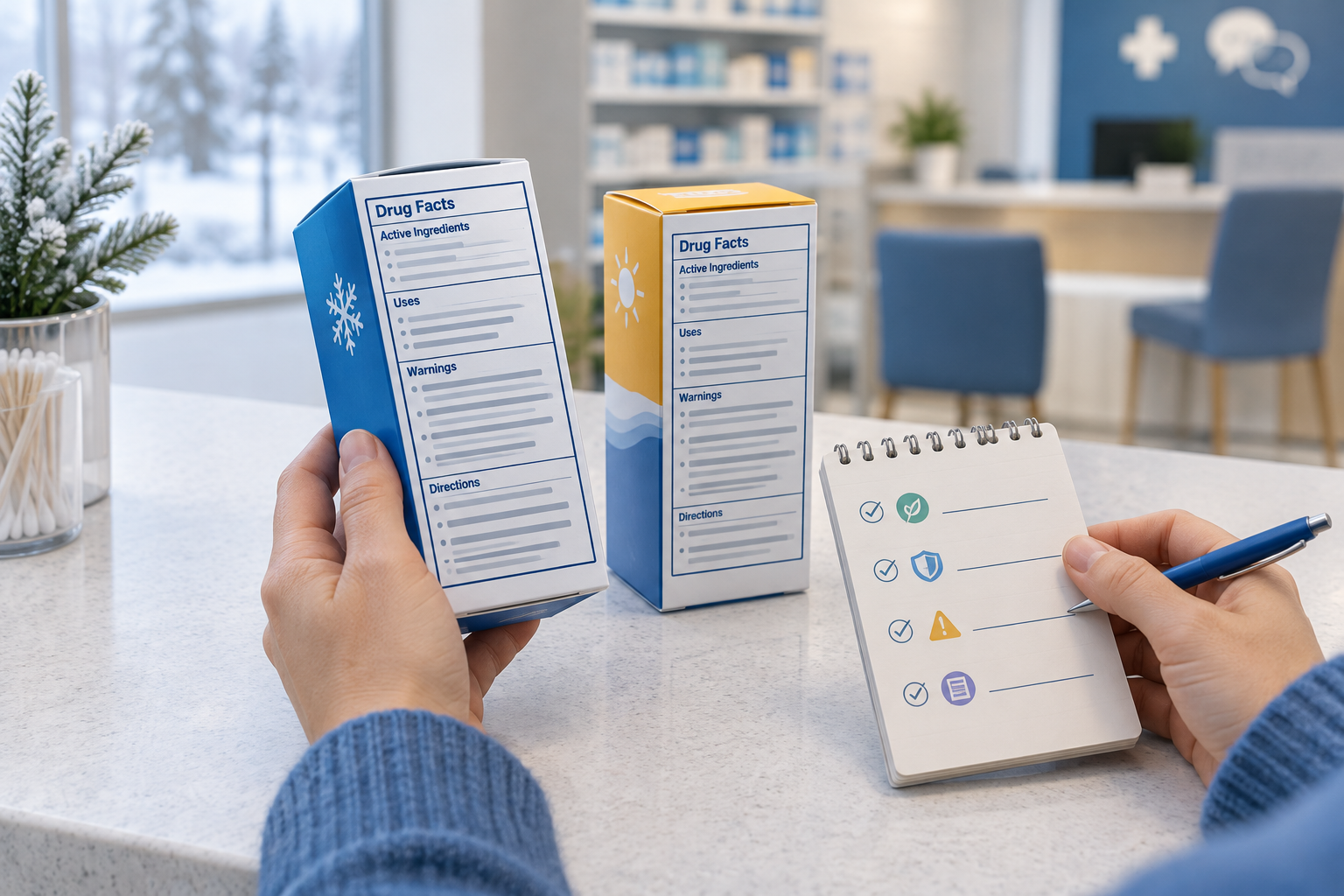
To compare over-the-counter (OTC) cold medicines, read the Drug Facts panel on each package in front of you. Check its active ingredients, labeled uses, warnings, and directions. This helps you understand what each product’s label says and identify questions to take to a pharmacist or clinician; it does not determine which medicine is right for a particular person.
The U.S. Food and Drug Administration (FDA) describes Drug Facts as a standard label format with sections including Active ingredients, Purpose, Uses, Warnings, Directions, and Inactive ingredients. Products with similar brand names can have different active ingredients, so check the exact product rather than relying on a familiar name, package color, or previous purchase. The active package is a more useful reference than an old box or a remembered formula.
In a store, turn each package over and find the Drug Facts box. At home, use the package for the product you are considering. Front-of-package wording may help you identify a product to examine, but the panel is where to check its ingredients, uses, warnings, and directions.
- Confirm the exact product you are comparing.
- Use the package label rather than the brand name or an online description alone.
Check active ingredients across every medicine
Comparing ingredient lists can reveal overlap that product names and packaging may not make obvious.
Start with the Active ingredients section. Read the full list on each cold medicine and compare it with the labels of other medicines being used, including prescription medicines. Different product names do not necessarily mean the ingredients are different; one product may also contain a combination of active ingredients.
The Centers for Disease Control and Prevention (CDC) advises checking active ingredients across prescription and OTC medicines. Its consumer guidance cautions against giving a child two medicines that contain the same active ingredient. If you notice a possible overlap or are unsure how to interpret it, ask a pharmacist or clinician rather than deciding on your own whether to combine products.
For example, two packages may have different names and describe different combinations of cold symptoms on the front. If their Active ingredients lists share an ingredient, pause and ask a pharmacist or clinician about the situation. This is an illustrative label-reading example, not a recommendation to use or avoid a particular product; formulas vary.
- Compare ingredient names, not only product names or front-of-package claims.
- Include prescription and nonprescription medicines in the comparison.
- For a child, check for overlapping active ingredients and ask a professional if anything is unclear.
Match the Uses section to the symptoms listed
The product’s labeled uses help distinguish what its panel says it is intended to address.
Read the Uses section on each product and note the symptoms or purposes it lists. Do not assume a product addresses a symptom just because it appears on the front of the package, or because another product in the same brand range lists it. Check the panel for the specific product you are comparing.
A practical comparison is to write down the symptoms you want to ask about, then see whether each appears in the Uses section. This is a way to understand the label, not a recommendation about which medicine to take. If the wording is unfamiliar, a pharmacist can explain it and help identify questions that depend on an individual’s circumstances.
More listed ingredients do not, by themselves, establish that a product is a better fit. Consider the product’s own labeled uses, warnings, and directions, and seek professional advice for questions the label cannot resolve.
- Look for the stated uses on the panel, not only a marketing phrase on the front.
- Do not transfer a use from one product to another.
- Ask a pharmacist about wording you do not understand.
Read Warnings before Directions
Warnings may tell you to avoid use or seek professional advice before proceeding.
Before focusing on how to use a product, read its Warnings section. Look for instructions to avoid use, cautions involving other medicines, and directions to ask a doctor or pharmacist. The relevant warnings depend on the specific product and its ingredients; do not assume two cold medicines have identical cautions.
The FDA notes that OTC labels may direct people to seek professional advice in situations involving certain health conditions, pregnancy, breastfeeding, or possible interactions. If a warning may apply to you—or you cannot tell whether it does—ask a pharmacist or clinician. A package label cannot assess every detail of an individual’s circumstances.
Read the warnings even if you have used a similar product before. FDA guidance advises reading the label each time and consulting a doctor or pharmacist when questions remain.
- Check every warning on the specific package.
- Do not skip a warning because the product is available without a prescription.
- Ask a pharmacist or clinician when a warning or possible interaction may apply.
Follow the Directions on that exact package
Instructions are product-specific; do not borrow a schedule from another medicine.
After reviewing the warnings, read the Directions section on the same package. It provides instructions for that product, which may include amount, timing, and any stated limits or duration. Follow the label rather than estimating or borrowing directions from another medicine.
Check who the directions apply to and how the product is meant to be used. If the package is damaged, the directions are missing or hard to read, or you have a question about timing or measurement, ask a pharmacist before using it. This guide does not provide a dose: directions vary by product, and the package is the relevant source for its instructions.
If you are comparing two products, read each Directions section separately. Similar packaging does not make instructions interchangeable.
- Read the directions for the exact product and intended user.
- Follow the package rather than a remembered dose or another product’s instructions.
- Ask a pharmacist if the directions are unclear.
Check inactive ingredients and other package information
These details serve a different purpose from active ingredients but can matter for specific questions.
The Inactive ingredients section lists ingredients other than the active components. It does not tell you the product’s labeled uses, but it may help you check for a particular ingredient. If you have a known sensitivity or another concern, ask a pharmacist or clinician how to interpret the list rather than guessing from an ingredient’s name.
Review any other package information relevant to the product, including storage instructions. Do not assume information on an older package applies to a new one. If a label is incomplete or difficult to read, ask a pharmacist to help you locate reliable information before use.
A short comparison table can keep your notes focused. Fill it in from the packages themselves, then bring unresolved questions to a pharmacist or clinician.
| Label section | What to check | Question to resolve |
|---|---|---|
| Active ingredients | Names listed for each product | Is an ingredient repeated across medicines being used? |
| Uses | Symptoms or purposes stated for the product | Does the label list the use I want to understand? |
| Warnings | Avoid-use instructions and advice to consult a professional | Does a warning or possible interaction need clarification? |
| Directions | Instructions for the product and intended user | Are the amount, timing, and other instructions clear? |
| Inactive ingredients | Other ingredients listed on the package | Is there a particular ingredient I need to ask about? |
Use a repeatable check—and ask when questions remain
A consistent sequence helps you compare labels while leaving personal medical decisions to a qualified professional.
When comparing packages, use the same sequence each time: identify the product, compare active ingredients, check labeled uses, read warnings, and then review directions. Write down anything you cannot resolve instead of inferring an answer from advertising or a similar product.
Ask a pharmacist or clinician if you find overlapping active ingredients, a warning that may apply, a possible interaction, or directions you cannot interpret. Seek professional guidance when the label directs you to do so, including for questions related to certain health conditions, pregnancy, or breastfeeding. These are examples of reasons to ask, not a complete list.
Before using a product, return to its package and read the label again. FDA guidance recommends reading OTC labels each time and consulting a doctor or pharmacist when questions remain. If you are still unsure, ask rather than guess.
- Find the Drug Facts panel on each package you are comparing.
- Compare its active ingredients with those on other medicines being used.
- Check the Uses section for the symptoms or purposes listed.
- Read all Warnings before moving to Directions.
- Follow the instructions on that package and ask a pharmacist or clinician about unresolved questions.
Frequently asked questions
Can two cold medicines with different brand names contain the same active ingredient?
Yes. Different brand names can have products with an active ingredient in common, and similar brand names can also have different ingredients. Compare the Active ingredients sections on the exact packages. Ask a pharmacist or clinician if you are unsure about using products together.
Which part of the Drug Facts label says what symptoms a product is for?
Read the Uses section. It describes the uses stated for that product. Do not assume it covers a symptom unless the label says so.
Should I read the label if I have used the same medicine before?
Yes. Read the current package each time because products and instructions can differ. The FDA also advises consulting a doctor or pharmacist when questions remain.
What should I do if a warning may apply to me?
Read the full warning and ask a pharmacist or clinician for guidance rather than guessing. This is especially important if you have a relevant health condition, are pregnant or breastfeeding, or are concerned about possible interactions.
Can I use this guide to choose cold medicine for a child?
This guide can help you locate information on a label, but it does not recommend a medicine for a child. Check the child-specific instructions on the exact package and compare active ingredients across medicines. The CDC cautions against giving a child two medicines with the same active ingredient. Ask a pharmacist or clinician about questions specific to the child.
Sources & further reading
Explore the original sources behind this article. Our editorial perspective is separate from the organizations we reference.