Saw a Banded Bird? What to Record and How to Report It
If you spot a banded bird, note the date, location, and visible band or marker details from a respectful distance. Then report what you observed through the appropriate official channel—without guessing at unreadable details.
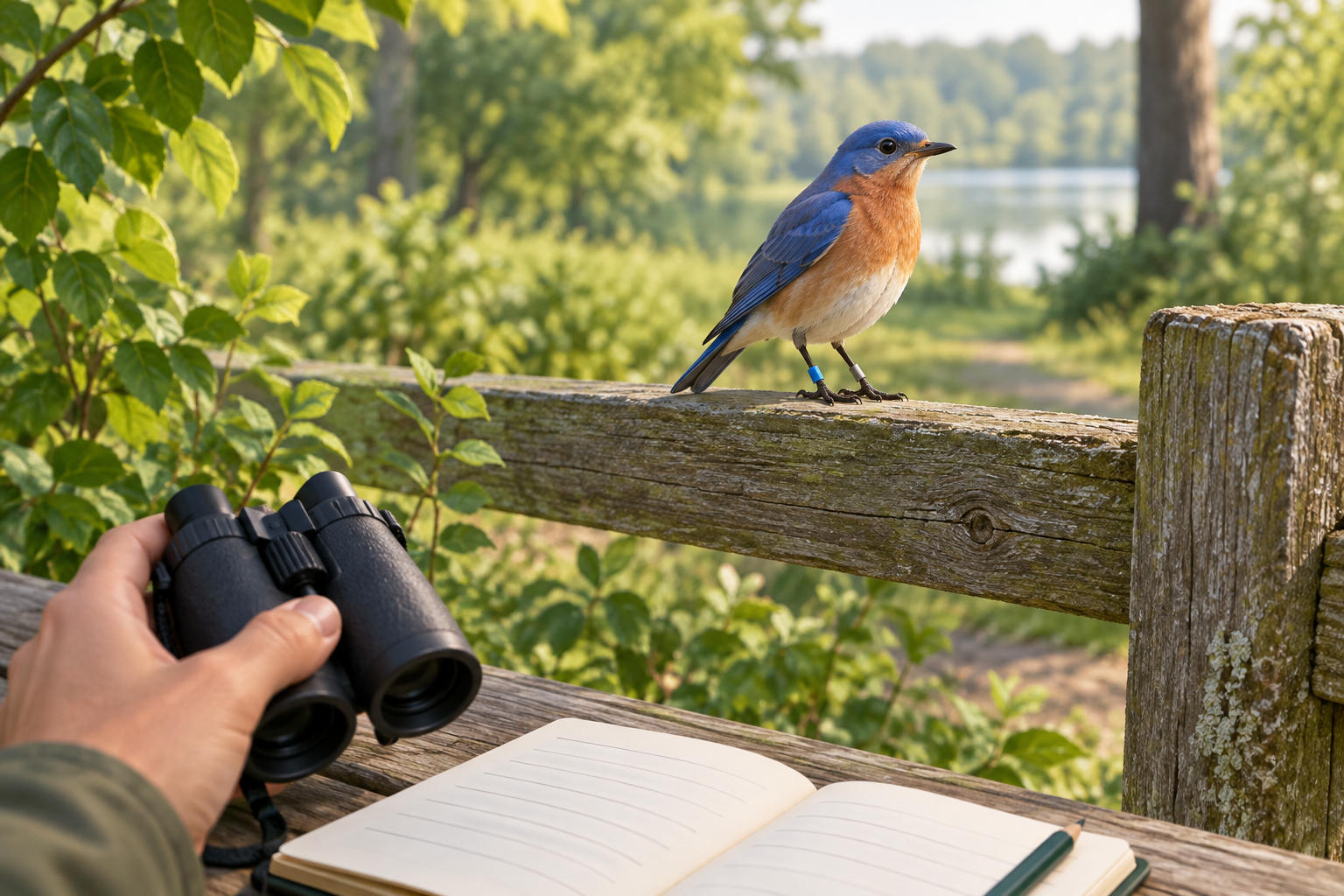
Start with the bird’s welfare
A useful report begins with a calm observation, not an attempt to get closer.
If you see a metal band or colored marker on a wild bird, you can record and report the sighting without catching the bird or identifying its species with certainty. A readable band number is helpful, but it is not the only detail that may matter.
Stay where the bird can behave normally. Binoculars or a camera’s zoom can help if you already have them, but do not follow, corner, trap, or handle the bird to improve your view. Canada’s official reporting guidance says not to catch birds or remove bands from live birds; observing without disturbing the bird is the right approach for a U.S. sighting too.
- Observe from a path or another place where you can stand safely and lawfully.
- Do not climb, enter restricted areas, or pursue the bird for a better look.
- If it flies away before you finish, report what you already observed.
What to record when you see a banded bird
Capture the basics that place the sighting in time and space, then describe the marker plainly.
Write down the details soon after the sighting, while they are fresh. For location, be as specific as you comfortably can: a park and its pond, a trail segment, a nearby intersection, or a recognizable landmark can be more helpful than a town name alone. If you have reliable coordinates, you can include them when the reporting form allows.
Describe the band or marker without interpreting it. Note readable digits in their observed order, visible colors, which leg or other location the marker appeared on, and the order of multiple markers if you can see it. Include the bird’s condition and any identification details you know. Official reporting guidance asks for details such as band information, date, location, condition, and identification when known; a photograph may help clarify an observation.
- Band number: copy only digits you can read. Mark unclear parts as unreadable or uncertain.
- Marker: note colors and placement, such as a colored ring above or below a metal band, only if that is what you can see.
- Bird: include the species if you know it; otherwise write “unknown” or leave identification uncertain.
- Condition: describe observable facts, such as whether the bird flew away normally or appeared injured.
- Photo: keep an original image if you took one safely; mention what it shows and what it does not.
| Record | What to note | Example |
|---|---|---|
| Date and time | When you saw the bird; include an approximate time if known. | April 12, about 8:15 a.m. |
| Location | A specific site or landmark, with town or other context. | East side of the pond at a named local park |
| Band or marker | Readable digits, visible colors, and placement; identify uncertainty. | Metal band on the right leg; remaining digits unclear |
| Bird and condition | Species if known and a short factual description of its condition. | Species uncertain; bird flew away normally |
| Photo | Whether you have an image and which details it captures. | Zoomed photo shows a blue marker; no readable number |
If you can’t read the number or identify the bird
Uncertainty does not make the sighting useless; it just needs to be reported as uncertainty.
Do not complete a faint number by guessing what a digit probably is. Record the portion you can read and identify the rest as unclear—for example, “first two digits visible; remaining digits unreadable.” A photograph may help you check the image later, but do not alter it to imply that a detail is clearer than it was.
You do not need to name the bird to report its marker. If you are unsure, say so rather than selecting a species based on a quick glimpse. The USGS reporting form provides an option for a color-marker report when a band number is unavailable, so a careful description of the marker may still be useful.
- Use “uncertain” or “unreadable” instead of guessing a digit.
- Describe marker colors and placement in ordinary language.
- Do not postpone a report just because the species is unknown.
Where to report a banded bird in the United States
For a standard North American program band or marker, begin with the official reporting route rather than an informal post.
The North American Bird Banding Program is jointly administered by the U.S. Geological Survey and the Canadian Wildlife Service. For a bird band or color marker, USGS directs the public to its bird-band reporting site. The reporting form includes a route for a color marker when the band number is not available.
Before opening the form, gather your notes and any useful photograph. Follow the form’s current fields and instructions; online forms may change. Enter only the details you observed, and review the number and location before submitting. If a field does not fit your observation, do not invent an answer just to make the report look complete.
- Open the bird-band reporting site recommended by USGS.
- Choose the option that matches what you saw, including a color-marker report if there is no readable band number.
- Enter the date, location, visible number or marker description, and any other requested details.
- Add a photograph only if the form accepts it and you took it without disturbing the bird.
- Review the entry for transposed digits or an imprecise location, then submit and save any confirmation the site provides.
Check unusual bands before choosing a destination
A ring or tag that looks different may not belong to the standard federal program.
Not every band or marker follows the same reporting route. USGS provides guidance for identifying unusual bands, so compare an unfamiliar marker with official guidance instead of assuming every ring belongs in the same form. If it appears unusual, note visible material, color, wording, and placement from a distance, then check the relevant official instructions.
Do not remove the marker or contact an organization based only on a guess about who placed it. If you are outside the United States, reporting arrangements may differ; check the responsible national wildlife or bird-banding authority. Canada’s official guidance explains its reporting process.
What a band report can—and cannot—tell you
A sighting adds an observation to a wider record; it is not a guaranteed answer about an individual bird.
Reports can help researchers and wildlife managers learn about bird distribution and movement. That contribution does not mean every report will produce a particular finding about the individual bird, or that the observer will receive a specific follow-up. Canada’s reporting guidance describes the value of reports without promising a result for each sighting.
After submitting, keep your notes and any confirmation. If you see the same bird again, record the new date and location as a separate sighting and report it through the appropriate route. Treat each observation as evidence of what you saw at that place and time—not as proof of the bird’s full history.
- Keep a copy of your field notes and any confirmation the reporting site provides.
- Describe what the marker looked like; avoid inferring where the bird came from.
- Check official guidance again if you encounter a different or unusual marker.
Frequently asked questions
Do I need to know the bird’s species before reporting it?
No. Include the species if you know it, but do not guess. You can report the marker and sighting details while identifying the bird as unknown or uncertain.
Can I report a bird if I can’t read its band number?
Yes. Describe the visible marker, its colors, and its placement as accurately as you can. The USGS reporting form includes an option for a color-marker report without a band number.
Should I catch the bird or remove its band to read it?
No. Record what you can see from a respectful distance. Do not catch a live bird or remove its marker to improve the report.
Where should I report a banded bird in the United States?
USGS directs people to its bird-band reporting site for bands or color markers. If the marker appears unusual or outside the standard program, check USGS guidance on unusual bands before choosing a destination.
Will I find out where the bird has been?
A report can support research on bird distribution and movement, but it does not guarantee a particular finding or follow-up about that individual bird.
Sources & further reading
Explore the original sources behind this article. Our editorial perspective is separate from the organizations we reference.