How to Store Holiday Leftovers Safely: A Simple 2-Hour, 4-Day Plan
Refrigerate or freeze perishable leftovers within two hours, cool them in shallow containers, and use food-specific storage guidance to decide when to eat or discard them.
The two-hour rule for holiday leftovers
Start with a deadline, then decide how to store the food before the gathering winds down.
For perishable leftovers, refrigerate or freeze the food within two hours. If the air temperature is above 90°F, shorten that limit to one hour. These are the practical deadlines for food left without safe temperature control—not a reason to leave dishes on the table until everyone has finished lingering.
The clock matters when food is no longer being kept safely hot or cold. If a dish has been sitting out at room temperature, count the time it has been out; do not restart the clock when you move it to a different serving dish. If you are unsure how long it has been out, choose the safer option and discard it.
For a busy holiday meal, designate someone to pack food as the meal ends. That simple handoff can prevent dishes from being forgotten while guests visit or cleanup begins.
- Normal indoor conditions: refrigerate or freeze within two hours.
- Air temperature above 90°F: refrigerate or freeze within one hour.
Cool and pack leftovers promptly
Smaller portions are easier to chill quickly and easier to use later.
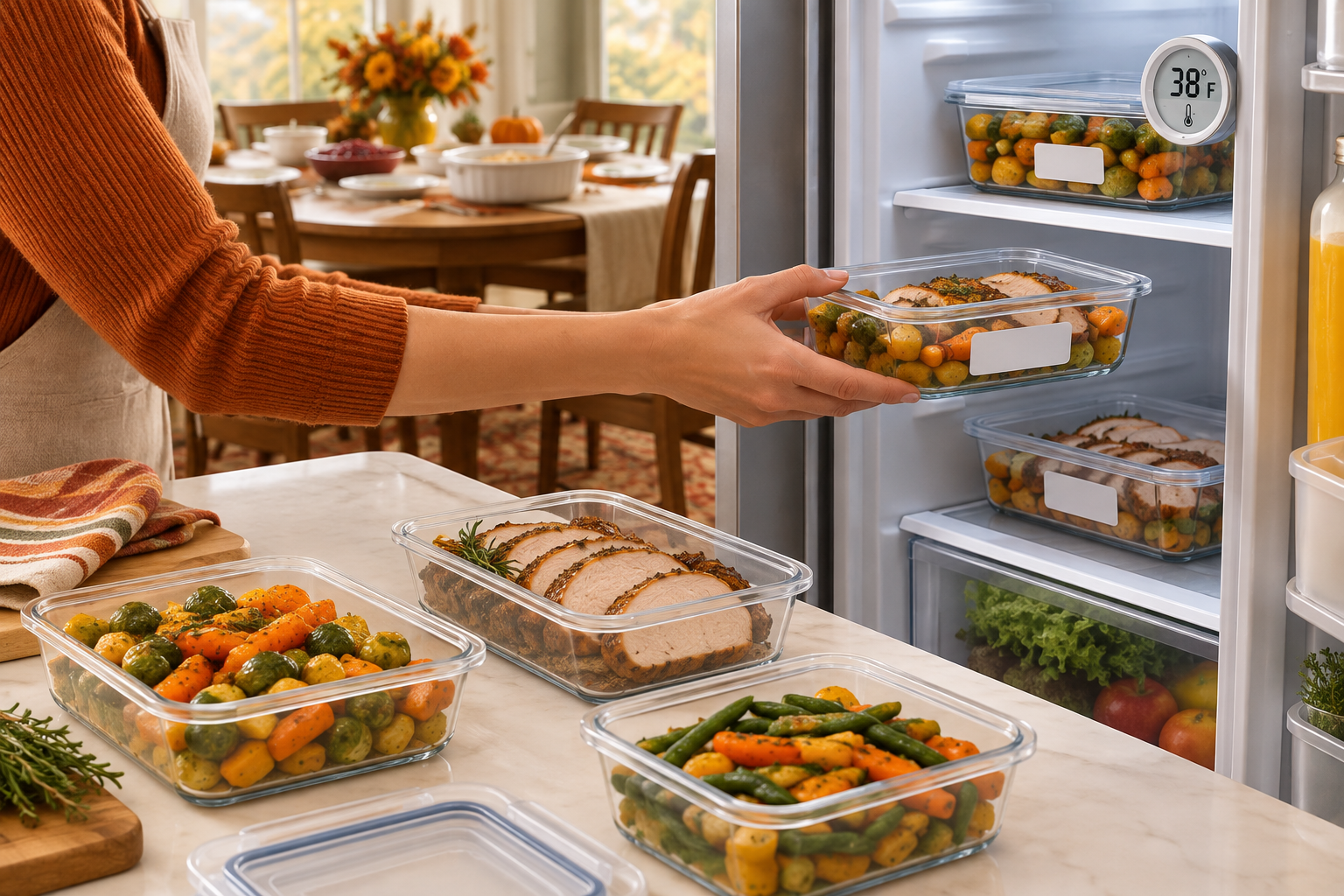
Large pots, deep bowls, and whole roasts can take longer to cool than small portions. Divide food into shallow containers instead of placing a large, dense amount in one deep container. For a roast or other large piece, cutting it into smaller portions can also help it cool more quickly.
Do not leave hot food on the counter until it feels cool. FDA guidance says hot food can go directly into the refrigerator. Put it in shallow containers, cover it, and make room for air to circulate around the containers. If the meal produced more than your refrigerator can reasonably hold, freeze some portions promptly rather than leaving them out to cool.
Use clean containers and utensils when packing. Avoid topping up a container of older leftovers with a fresh batch; keeping batches separate makes dates and storage decisions clearer.
Set up the refrigerator for safe storage
A quick check of temperature and available space helps leftovers chill as intended.
Keep the refrigerator at 40°F or below and use an appliance thermometer if you do not know its actual temperature. A dial setting alone does not tell you exactly how cold the interior is. Store leftovers covered, and avoid packing containers so tightly that cold air cannot circulate.
If the refrigerator is full after a large meal, prioritize getting perishable food into safe storage rather than stacking warm containers into a crowded space. Divide dishes into smaller portions and use the freezer for food you will not eat soon. Keep raw foods separate from ready-to-eat leftovers to reduce the chance of drips or contact contaminating them.
These are storage steps, not a way to make food safe after it has already been left out too long. Prompt chilling and a suitably cold refrigerator help manage food that was handled within the time limit.
Use a date plan for the refrigerator and freezer
Label containers and make a plan based on the food, rather than treating every dish the same.
Write the date on each container before putting it away. This is especially useful when several dishes look similar or different people are packing food. Put the most time-sensitive items where you will notice them, and decide which portions to freeze instead of trying to use everything at once.
Cooked meat and poultry leftovers generally keep for three to four days in the refrigerator. That is a useful planning window for those foods, not a universal rule for every side dish, sauce, dessert, or mixed recipe. Storage recommendations vary by item, so check the federal cold-storage chart or FoodKeeper for guidance specific to the food you have.
Freezer recommendations also vary by food. Use the item-specific chart rather than assuming every leftover has the same freezer window. Freezing is a practical way to store food you do not plan to eat within its refrigerator window, but it does not undo unsafe time at room temperature. Label the contents and date so you can identify the portion later.
| Situation | What to do | Planning note |
|---|---|---|
| Perishable food has been out for less than two hours | Refrigerate or freeze it promptly | Use shallow, covered containers |
| Air temperature is above 90°F | Refrigerate or freeze within one hour | Do not use the usual two-hour window |
| Cooked meat or poultry is refrigerated | Plan to eat within three to four days or freeze sooner | Label the container with the date |
| A different dish or frozen portion needs a storage window | Check an item-specific federal chart or FoodKeeper | Storage times are not identical for all foods |
Know when to discard food
Time and temperature are more dependable safety guides than a taste test or a quick sniff.
Food can be unsafe even when it looks and smells normal. Do not taste a leftover to test whether it is safe, and do not treat a pleasant smell as proof that it was stored properly. When perishable food has exceeded the recommended time out of temperature control, discard it rather than trying to save it by refrigerating or freezing it afterward.
If you cannot remember when a dish was packed, or you do not know how long it sat out, uncertainty is a reason to be cautious. The cost of throwing away one container is frustrating, but it is not worth substituting guesswork for the time-and-temperature guidance.
A quick after-meal leftovers checklist
Follow the same short routine after a holiday meal or any shared gathering.
A repeatable routine helps when the kitchen is busy. Before guests leave, clear serving dishes, pack portions, and mark containers so tomorrow’s meal does not depend on anyone remembering what went where.
- Note when perishable food is no longer being kept safely hot or cold; use the two-hour limit, or one hour above 90°F.
- Divide large amounts into shallow containers and cut large pieces into smaller portions.
- Refrigerate or freeze promptly; hot food can go directly into the refrigerator.
- Check that the refrigerator is at or below 40°F, cover containers, and leave room for airflow.
- Label each container with its contents and date.
- Use item-specific storage guidance, and discard food that exceeded the time limit or has an uncertain history.
Frequently asked questions
Can I put hot leftovers straight into the refrigerator?
Yes. FDA guidance says hot food can go directly into the refrigerator. Divide large amounts into shallow containers first so they cool more quickly, and leave space for cold air to circulate.
How long can cooked leftovers stay out?
Refrigerate or freeze perishable leftovers within two hours. If the air temperature is above 90°F, use a one-hour limit. Do not rely on smell or appearance to decide whether food left out longer is safe.
How long do cooked meat and poultry leftovers last in the refrigerator?
They generally keep for three to four days in the refrigerator. Other dishes can have different storage windows, so check item-specific guidance rather than applying that range to every leftover.
Should I freeze leftovers if I will not eat them within a few days?
Freezing can be a useful option when you will not eat food within its recommended refrigerator window. Freeze it promptly, label the container, and check an item-specific chart for storage guidance.
Can I keep leftovers if they smell and look fine?
Not necessarily. Food may be unsafe even when it appears and smells normal. Use the time and temperature history to decide, and discard food that was left out beyond the recommended limit.
Sources & further reading
Explore the original sources behind this article. Our editorial perspective is separate from the organizations we reference.