How to Check a Turkey’s Temperature: Where to Probe and How to Check Stuffing
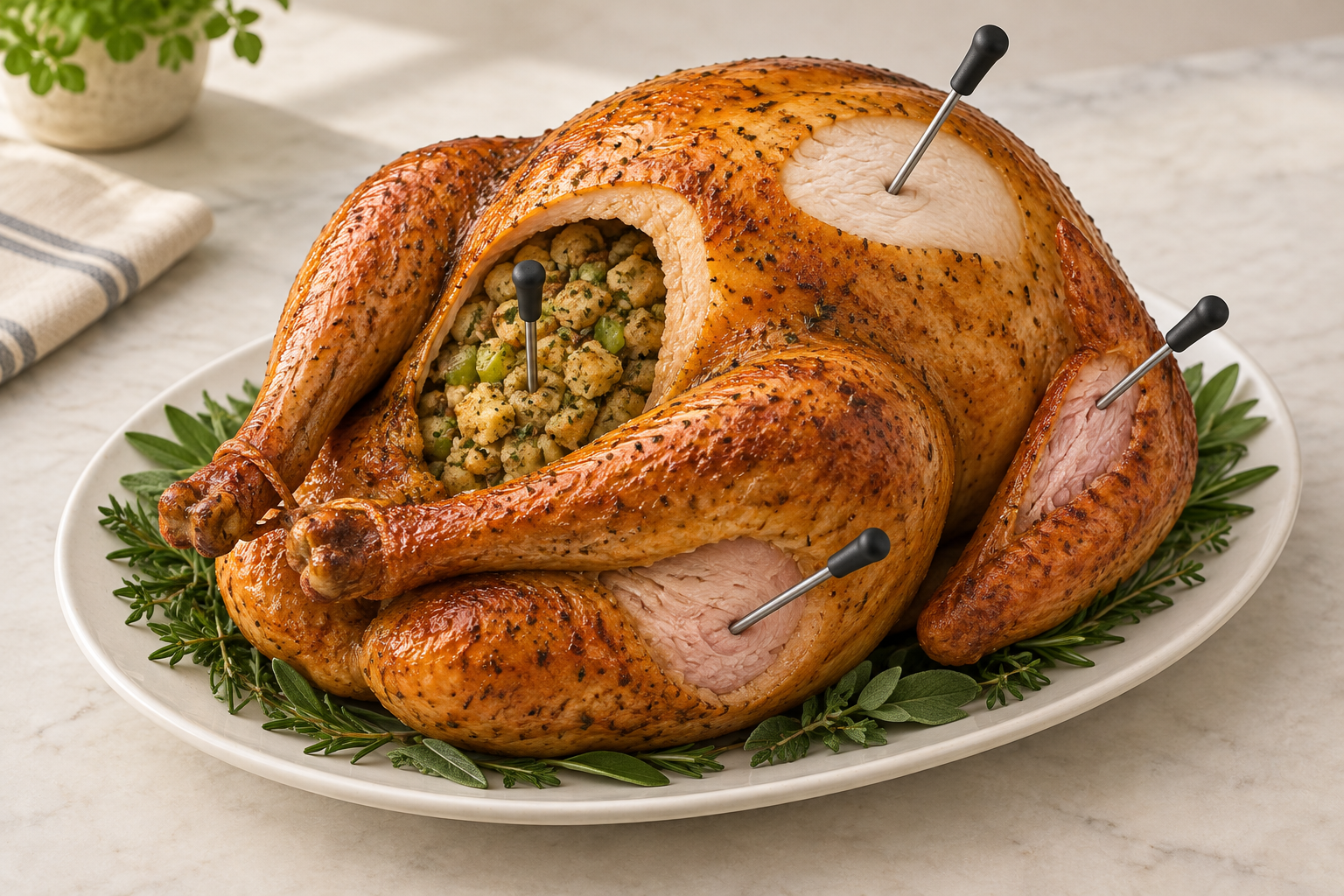
Use a food thermometer to check the innermost thigh, innermost wing and thickest part of a whole turkey. If it is stuffed, check the center of the stuffing too; every reading must reach 165°F (74°C).
The temperature a turkey needs to reach
A thermometer reading—not elapsed cooking time or appearance—is the way to verify that the turkey has reached the recommended minimum.
A whole turkey should reach an internal temperature of at least 165°F (74°C). Check the innermost part of the thigh, the innermost part of the wing and the thickest part of the breast. If you cooked stuffing inside the bird, the center of that stuffing must also reach 165°F (74°C).
One high reading does not confirm that the other parts are ready. Different areas can be at different temperatures, so check each recommended location rather than relying on one spot. Browned skin, a cooking-time estimate or a pop-up indicator does not replace these thermometer checks.
Prepare to take a reliable reading
A little setup makes it easier to check the bird systematically and handle the thermometer safely around a hot roasting pan.
Use a food thermometer and follow the instructions for your particular device. Thermometers can differ in how the probe is positioned and how long the display takes to settle, so do not assume every model is used in exactly the same way. Make sure you can read the display before beginning.
Set the roasting pan on a stable, heat-safe surface before probing. Keep the thermometer’s sensing area in the meat and away from bone, as USDA guidance recommends. If you are unsure where the sensing area is or how deeply to insert the probe, check the thermometer’s instructions.
Plan to check the three parts in sequence and note each result. This simple routine helps prevent a common mistake: remembering one temperature while overlooking another location or, for a stuffed bird, the stuffing.
Where to place the thermometer on a whole turkey
Work through the thigh, wing and breast, aiming for the specified part of each area without contacting bone.
USDA FSIS recommends checking the innermost part of the thigh, the innermost part of the wing and the thickest part of the breast. At each location, position the thermometer in the meat and avoid bone. Follow the device instructions for inserting the probe and reading the temperature.
The table is a practical checklist, not a substitute for your thermometer’s directions. The shape of the bird and the thermometer design may affect the approach angle; focus on reaching the named area and getting a reading from the meat.
| Area | Probe location | Minimum reading |
|---|---|---|
| Thigh | Innermost part, in the meat and away from bone | 165°F (74°C) |
| Wing | Innermost part, in the meat and away from bone | 165°F (74°C) |
| Breast | Thickest part, in the meat and away from bone | 165°F (74°C) |
| Stuffing, if cooked inside the bird | Center of the stuffing | 165°F (74°C) |
If the turkey is stuffed, check the center of the stuffing
The stuffing needs its own reading because the temperature of the surrounding meat does not establish the temperature at its center.
Insert the thermometer into the center of stuffing cooked inside the turkey and confirm that it reaches 165°F (74°C). Check the stuffing separately from the thigh, wing and breast. For example, if all three meat readings are at least 165°F but the stuffing center reads 160°F, the stuffing has not yet met the target.
USDA recommends cooking stuffing in a separate dish for optimum safety. If you choose to cook it inside the bird, do not treat the turkey’s meat readings as a substitute for checking the stuffing. The center is the specific place to measure.
- Stuffing inside the bird: check its center as well as the three turkey locations.
- Stuffing cooked separately: follow safe cooking guidance and check its temperature as appropriate.
What to do when a reading is below 165°F
Use the low reading to decide what to recheck; do not assume a fixed extra cooking time will bring every area to temperature.
If any required location is below 165°F (74°C), continue cooking the turkey. Then take another reading in the area that was below the target. For a stuffed bird, continue to check the stuffing center separately if it also read low.
For instance, the thigh and wing might meet the target while the thickest part of the breast does not. Continue cooking and recheck the breast instead of treating the higher readings as proof that the whole bird is ready. If several areas were below target, keep track of each one and verify them with the thermometer.
Once the meat readings and, when relevant, the stuffing-center reading have all reached at least 165°F (74°C), the temperature checks are complete. Avoid replacing a low reading with a guess based on the bird’s color or how long it has been in the oven.
- Check the innermost thigh, innermost wing and thickest part of the breast.
- If the bird is stuffed, check the center of the stuffing as well.
- Continue cooking if any required reading is below 165°F (74°C).
- Recheck each area that was below the target, following the thermometer’s instructions.
Use a thermometer for reheated leftovers
The same temperature target is useful when reheating saved turkey, though this guide does not cover storage timelines.
FoodSafety.gov lists 165°F (74°C) as the temperature leftovers should reach when reheated. Check the food with a thermometer rather than judging by its appearance or assuming it is hot enough. Follow the thermometer’s instructions for taking a reading in the portion you are reheating.
Frequently asked questions
What temperature should a whole turkey reach?
At least 165°F (74°C) in the innermost thigh, innermost wing and thickest part of the breast. If the turkey is stuffed, the center of the stuffing must reach 165°F (74°C) too.
Can I check a turkey in just one place?
No. USDA FSIS recommends checking three areas: the innermost thigh, innermost wing and thickest part of the breast. Check the stuffing center separately if it was cooked inside the bird.
Where should I put the thermometer in stuffing?
Measure the center of stuffing cooked inside the turkey. Confirm that it reaches at least 165°F (74°C); a reading from nearby meat does not establish the stuffing’s temperature.
What should I do if one area is below 165°F?
Continue cooking and recheck the area that was below the target. If the stuffing center was also below 165°F, check it again separately.
Can cooking time or browned skin tell me whether the turkey is done?
No. Time and appearance do not verify internal temperature. Use a food thermometer and check each recommended location.
Sources & further reading
Explore the original sources behind this article. Our editorial perspective is separate from the organizations we reference.
- [S1] foodsafety.gov
- [S2] Food Thermometers | Food Safety and Inspection Servicefsis.usda.gov
- [S3] Turkey Basics: Stuffing | Food Safety and Inspection Servicefsis.usda.gov
- [S4] Turkey Basics: Safe Cooking | Food Safety and Inspection Servicefsis.usda.gov