Voyager 1 Is Approaching One Light-Day From Earth: What the Milestone Means
NASA projects that Voyager 1 will reach one light-day from Earth on November 18, 2026. Learn how to picture the distance, what it means for radio communication, and how to follow the spacecraft’s position.
What does one light-day from Earth mean for Voyager 1?
The milestone turns an immense separation into a measure tied to the speed of a radio signal.
NASA projects that Voyager 1 will reach one light-day from Earth on November 18, 2026. A light-day is the distance light travels in 24 hours—not a measure of how long Voyager has been traveling. NASA gives that distance as about 16.095 billion miles, or 25.902 billion kilometers.
Radio signals travel at the speed of light, so the unit also gives a useful sense of communication time: at a one-light-day distance, a signal takes about a day to make the trip one way. The spacecraft itself is not traveling at light speed. Instead, “one light-day away” describes the gap between Earth and Voyager using how far a signal can travel in a day.
This is an estimate of distance from Earth, not a fixed position in space. Voyager continues moving, and NASA’s position resource can provide a current view. The important distinction is that a light-day names a distance; the signal delay follows from that distance.
How the distance changes a message exchange
A command and its response cannot be handled like a live conversation when signals take so long to cross the gap.
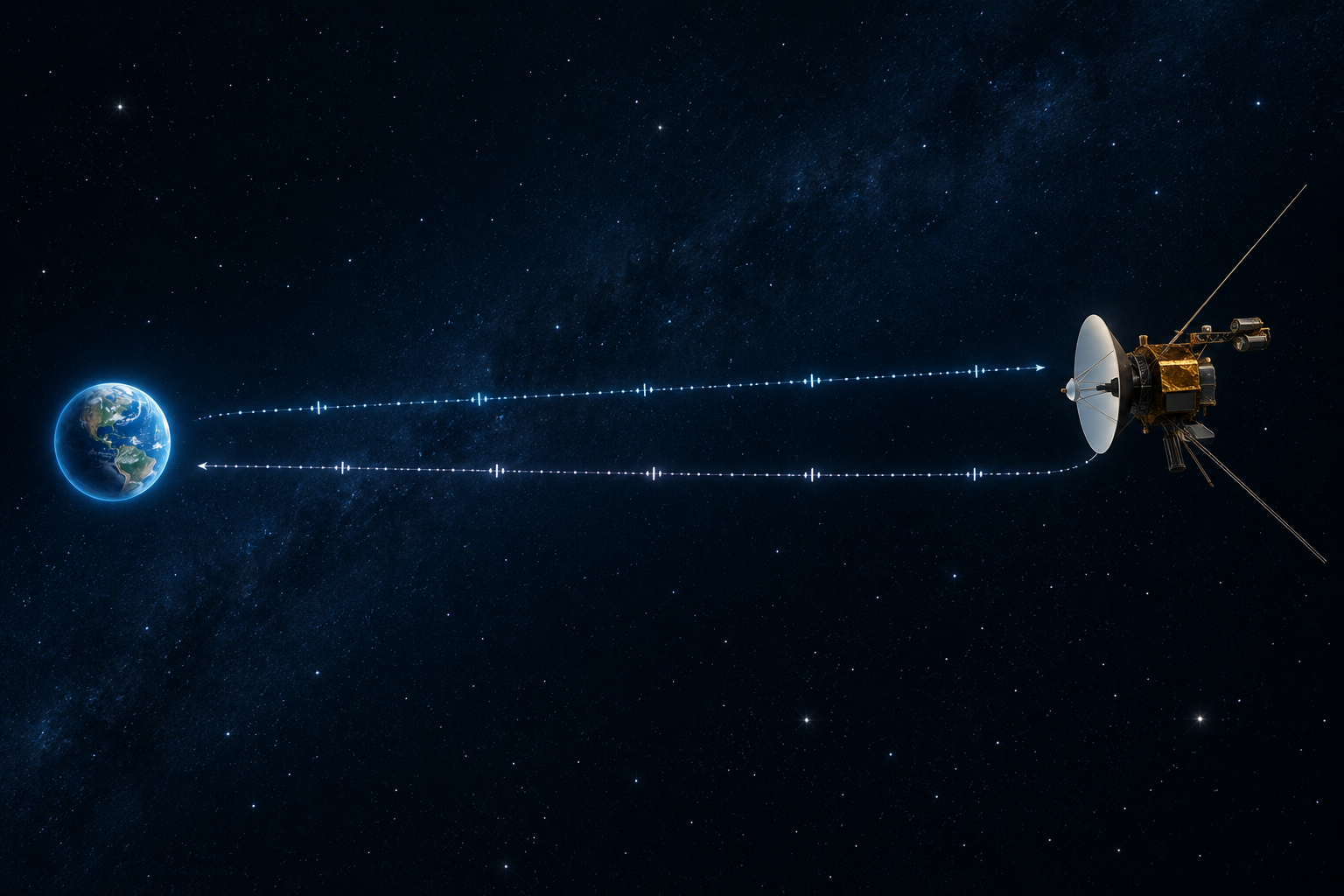
Imagine mission operators send a command when Voyager 1 is one light-day from Earth. The command would take about 24 hours to arrive. If the spacecraft transmitted a reply as soon as it received the message, that response would need about another 24 hours to get back. The signal travel alone would therefore take roughly two days for an out-and-back exchange.
That two-day estimate is not a promise that every exchange takes exactly 48 hours. It excludes time to prepare and send a command, as well as time to receive, process, and interpret returned data. It also assumes Voyager responds immediately. Those practical steps can extend the time before operators have a useful answer or are ready to act again.
The table separates the parts of the trip so the estimate is easier to interpret. It describes signal travel, not the full duration of a mission decision or a guarantee that a reply will be sent.
| Signal path | Approximate travel time | What the estimate includes |
|---|---|---|
| Earth to Voyager 1 | About 24 hours | One-way travel of a command |
| Voyager 1 to Earth | About 24 hours | One-way travel of a reply |
| Out and back | About 48 hours | Signal travel only, assuming an immediate reply |
What the Voyager 1 milestone does—and does not—mark
A clear reference point keeps this striking distance milestone from being confused with a change in mission phase.
NASA defines the projected milestone as one light-day from Earth. That reference matters: distance from Earth and distance from the Sun are not interchangeable measurements. When comparing descriptions, check which point the distance is measured from.
The date does not mark Voyager 1 newly entering interstellar space. The milestone is about how far the spacecraft is from Earth and the resulting communication delay. Nor does a one-light-day distance mean communication suddenly stops; it means radio signals have an exceptionally long journey between the spacecraft and Earth.
A precise projected time can make the milestone sound like an event that will be directly visible at a particular moment. It is better understood as a calculated point in Voyager’s changing position. The date helps readers follow the estimate, while the distance and delay explain why the milestone is notable.
When is Voyager 1 expected to reach one light-day?
NASA gives a projected date and time, which readers should treat as an estimate rather than a completed event.
NASA’s Voyager status page projects that Voyager 1 will reach one light-day from Earth on November 18, 2026, at 2:16:07 a.m. Pacific Standard Time. That corresponds to 5:16:07 a.m. Eastern Standard Time. NASA/JPL’s Night Sky Network also featured the approaching milestone in an item dated October 20, 2026.
As of October 27, 2026, the projected date is still ahead. The stated time is NASA’s projection, not confirmation that the spacecraft has already crossed the distance. If you are reading this after the projected date, check NASA’s current page for an update rather than relying on the date in this article.
A useful way to follow the milestone is to note both the date you check and what the page labels as a current position or projection. That makes it easier to distinguish a live-updating display from an older screenshot or a date quoted in an earlier report.
How to follow Voyager 1’s position
NASA’s interactive resource can help you see the spacecraft’s position and route without treating a single snapshot as permanent.
NASA provides an interactive tool for viewing Voyager 1’s position and route. Use the latest page when checking how close the spacecraft is to the projected milestone, because a position copied into another article may no longer be current.
When you open the resource, confirm that you are viewing Voyager 1 rather than Voyager 2. Check the units and labels: miles or kilometers describe distance, while hours describe signal travel time. If you save or share a screenshot, include the date you viewed it so the snapshot has context.
For a quick follow-along check, open NASA’s Voyager position page, identify Voyager 1, and read the displayed position alongside any milestone information. Then compare the date shown with the projected November 18 milestone. This simple check is more reliable than inferring a current position from a static diagram.
- Open NASA’s Voyager position page.
- Identify Voyager 1 in the interactive display.
- Read the displayed distance and units, and check any milestone information.
- Record the date you viewed the page if you save or share the details.
Frequently asked questions
Is a light-day a measure of time or distance?
Distance. It is how far light travels in 24 hours—about 16.095 billion miles (25.902 billion kilometers), according to NASA.
How long will a radio message take to reach Voyager 1?
At a one-light-day distance, a signal takes about 24 hours to travel one way. A prompt reply would take about another 24 hours to return, excluding preparation and processing time.
When does NASA project Voyager 1 will reach one light-day from Earth?
NASA projects November 18, 2026, at 2:16:07 a.m. Pacific Standard Time. This is a projected date; check NASA’s current Voyager status information for updates.
Does the milestone mean Voyager 1 is entering interstellar space?
No. It describes Voyager 1’s projected distance from Earth and the associated signal delay, not a new entry into interstellar space.
Where can I check Voyager 1’s current position?
NASA’s interactive Voyager position resource shows the spacecraft’s position and route. Check the current page because displayed positions and projections can change.
Sources & further reading
Explore the original sources behind this article. Our editorial perspective is separate from the organizations we reference.
- [S1] Night Sky Network News & Resourcesnightsky.jpl.nasa.gov
- [S2] Voyager 1: What Is a Light-Day - NASA Sciencescience.nasa.gov
- [S3] Where Are Voyager 1 and 2 Now? - NASA Sciencescience.nasa.gov
- [S4] Math Problem: Where is Voyager 1? - NASA Sciencescience.nasa.gov
- [S5] Night Sky Network News & Resourcesnightsky.jpl.nasa.gov