Why a Full Moon Doesn’t Always Mean a Lunar Eclipse
A lunar eclipse requires a full moon, but the Moon must also pass through Earth’s shadow. Its tilted orbit explains why most full moons miss.
Why a full moon is not always a lunar eclipse
The missing ingredient is alignment: the Moon must not only be full, but also pass through Earth’s shadow.
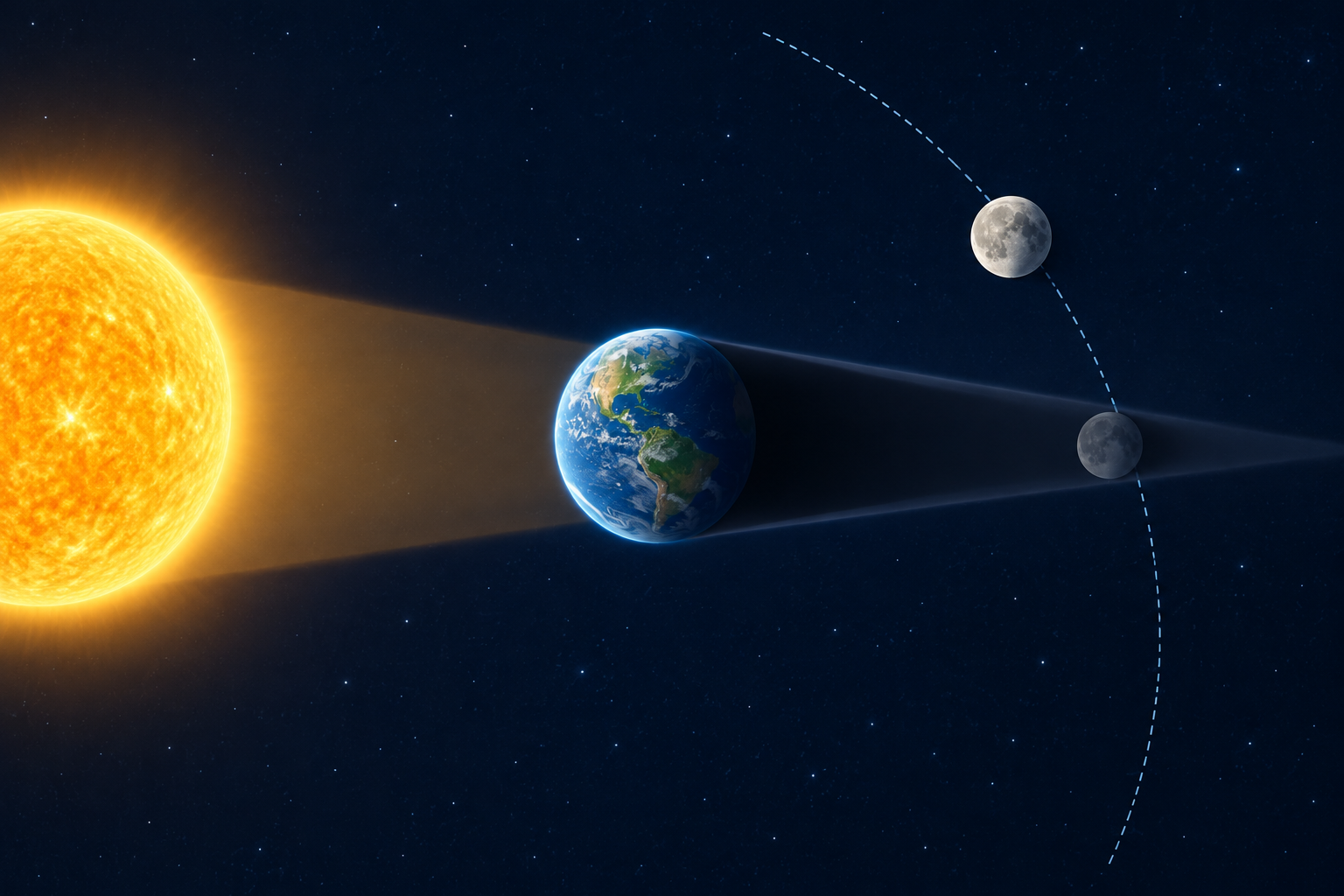
A full moon does not automatically bring a lunar eclipse because the Moon usually passes slightly above or below Earth’s shadow. A lunar eclipse happens when Earth’s shadow falls on the Moon, which requires the Sun, Earth and Moon to line up closely enough.
The simplest way to remember the difference is this: full moon describes a phase; eclipse describes a shadow crossing. The full-moon phase is necessary for a lunar eclipse, but it does not guarantee one.
What a full moon means
The phase depends on how the Moon’s sunlit half faces Earth, not on whether it enters Earth’s shadow.
The Sun illuminates roughly half of the Moon at any given time. As the Moon travels around Earth, we see changing portions of that lit half. At full moon, the Moon is opposite the Sun in the sky, so its sunlit side faces Earth and it appears nearly round.
It is common to picture Earth sitting in a perfectly straight line between the Sun and Moon at every full moon. In reality, the Moon can be slightly north or south of that line and still appear full. If it is outside the path of Earth’s shadow, sunlight reaches it as usual.
That is why a lunar eclipse is not a separate phase that follows the full moon. It is a full moon with an extra condition: the Moon must cross Earth’s shadow. NASA’s overview describes the eclipse as occurring when Earth is between the Sun and Moon and its shadow falls on the Moon.
The Moon’s tilted orbit explains the gap
A modest tilt is enough to make most full moons miss the relatively narrow region of space occupied by Earth’s shadow.
Earth orbits the Sun in a broad, nearly flat plane. Astronomers call this the ecliptic plane. The Moon’s orbit around Earth is tilted by about five degrees relative to it. NASA JPL uses this tilt to explain why a lunar eclipse does not happen at every full moon.
Because of the tilt, the Moon’s path usually carries it above or below the line of Earth’s shadow when it is full. The Moon is still in the full-moon phase; it simply misses the shadow. The tilt is small, but the two orbital paths do not usually put the Moon in the right place at the right time.
The points where the Moon’s orbit crosses the ecliptic plane are called nodes. A full moon near one of those crossings may line up with Earth and the Sun closely enough for an eclipse. The phase and the Moon’s position in its tilted orbit both matter.
A sketch to picture the orbit
Draw a large, flat circle to represent Earth’s path around the Sun. Then add a smaller loop for the Moon’s orbit around Earth, tilted slightly relative to that flat plane. Mark the two places where the smaller loop crosses the plane. A full moon near one of those crossings can pass through Earth’s shadow; at most other full moons, it passes above or below it.
Phase and eclipse alignment are different checks
This comparison separates what the Moon looks like from where it is relative to Earth’s shadow.
The phase tells you which portion of the Moon’s sunlit half is visible from Earth. The eclipse question is about whether the Moon’s path intersects Earth’s shadow. One observation does not answer both questions.
| Situation | What you observe | What the geometry means |
|---|---|---|
| Full moon without an eclipse | The Moon appears nearly fully illuminated. | It is full, but its tilted orbit carries it above or below Earth’s shadow. |
| Lunar eclipse | Earth’s shadow falls on some or all of the Moon. | The Moon is full and passes through Earth’s shadow. |
| New moon | The Moon’s illuminated side mostly faces away from Earth. | This is not the phase for a lunar eclipse. |
Try a simple lamp-and-balls model
A hands-on demonstration makes it easier to see how a full Moon can miss the shadow.
Use a lamp as the Sun, a large ball as Earth and a smaller ball as the Moon. Dim the room if convenient, and avoid looking directly into a bright bulb. Keep the model qualitative: household objects cannot reproduce the real sizes, distances or exact orbital angle.
NASA JPL also offers a paper-plate activity illustrating why a lunar eclipse does not accompany every full moon. Either approach can help a student or curious reader picture the extra alignment needed.
- Place the lamp in a fixed position and set the large ball between it and the smaller ball. The lamp represents sunlight, and the large ball represents Earth.
- Hold the small ball on the far side of the large ball, in the general position for a full moon. Move it a little above or below the straight line from the lamp past the large ball. Notice how it can remain opposite the lamp while missing the shadow.
- Move the small ball closer to that straight line. When it enters the large ball’s shadow, you have modeled the extra alignment needed for a lunar eclipse.
- To represent the orbital tilt, move the small ball around the large one along a slightly slanted loop. At many full-moon positions it will pass above or below the shadow; near a crossing of the tilted path and the reference plane, it can pass through.
What the model cannot tell you
The demonstration explains why eclipses are occasional, but it is not a tool for forecasting a particular event.
A tabletop model simplifies the real system. Earth and the Moon are not the sizes or distances shown by household balls, and Earth’s shadow has a darker central region and a lighter outer region. The model’s main lesson is narrower: the Moon must be full and pass through Earth’s shadow for a lunar eclipse.
It also cannot tell you when the next eclipse will occur or whether it will be visible from your location. A particular event’s visibility depends on its timing and where the Moon is relative to your horizon. For a date-specific answer, consult a current astronomy calendar and local observing information rather than relying on the phase alone.
The practical takeaway
When explaining why eclipses do not happen every month, pair the Moon’s phase with its position in the tilted orbit.
A full moon is necessary for a lunar eclipse, but it is not sufficient. The Moon’s orbit is tilted about five degrees relative to Earth’s orbital plane, so most full moons pass above or below Earth’s shadow. An eclipse is possible when a full moon occurs near a point where the Moon’s orbit crosses that plane.
To explain it to a child or student, ask two questions: Is the Moon full? And is it aligned closely enough to cross Earth’s shadow? A quick sketch or lamp-and-balls model makes the second question visible. For an actual viewing plan, check a current eclipse calendar and local visibility details.
Frequently asked questions
Does a lunar eclipse happen only during a full moon?
Yes. A lunar eclipse occurs at full moon, when Earth’s shadow falls on the Moon. But the full-moon phase alone does not guarantee that the Moon will cross the shadow.
Why does the Moon usually miss Earth’s shadow?
The Moon’s orbit is tilted by about five degrees relative to Earth’s orbital plane. At most full moons, the Moon passes slightly above or below the shadow.
What is a node in the Moon’s orbit?
A node is one of the two points where the Moon’s tilted orbit crosses the plane of Earth’s orbit around the Sun. A full moon near a node may have the alignment needed for a lunar eclipse.
Can I use a flashlight instead of a lamp for the model?
Yes. Use a steady light, a large ball for Earth and a smaller ball for the Moon. The goal is to see how moving the small ball changes whether it enters the large ball’s shadow. The model is not to scale.
Does the model tell me whether I can see an upcoming eclipse?
No. It illustrates the geometry, not a specific eclipse date or local visibility. Check a current astronomy calendar and observing information for your location.
Sources & further reading
Explore the original sources behind this article. Our editorial perspective is separate from the organizations we reference.