How to Watch the 2026 Orionids: Plan Around Your Local Moonset
The Orionids peak overnight October 21–22, 2026. Check your local moonset and weather, then plan for a dark, comfortable spot where you can watch a wide area of sky.
When to watch the 2026 Orionids
Use the peak night as your starting point, then fit your plans to local moonset and sky conditions.
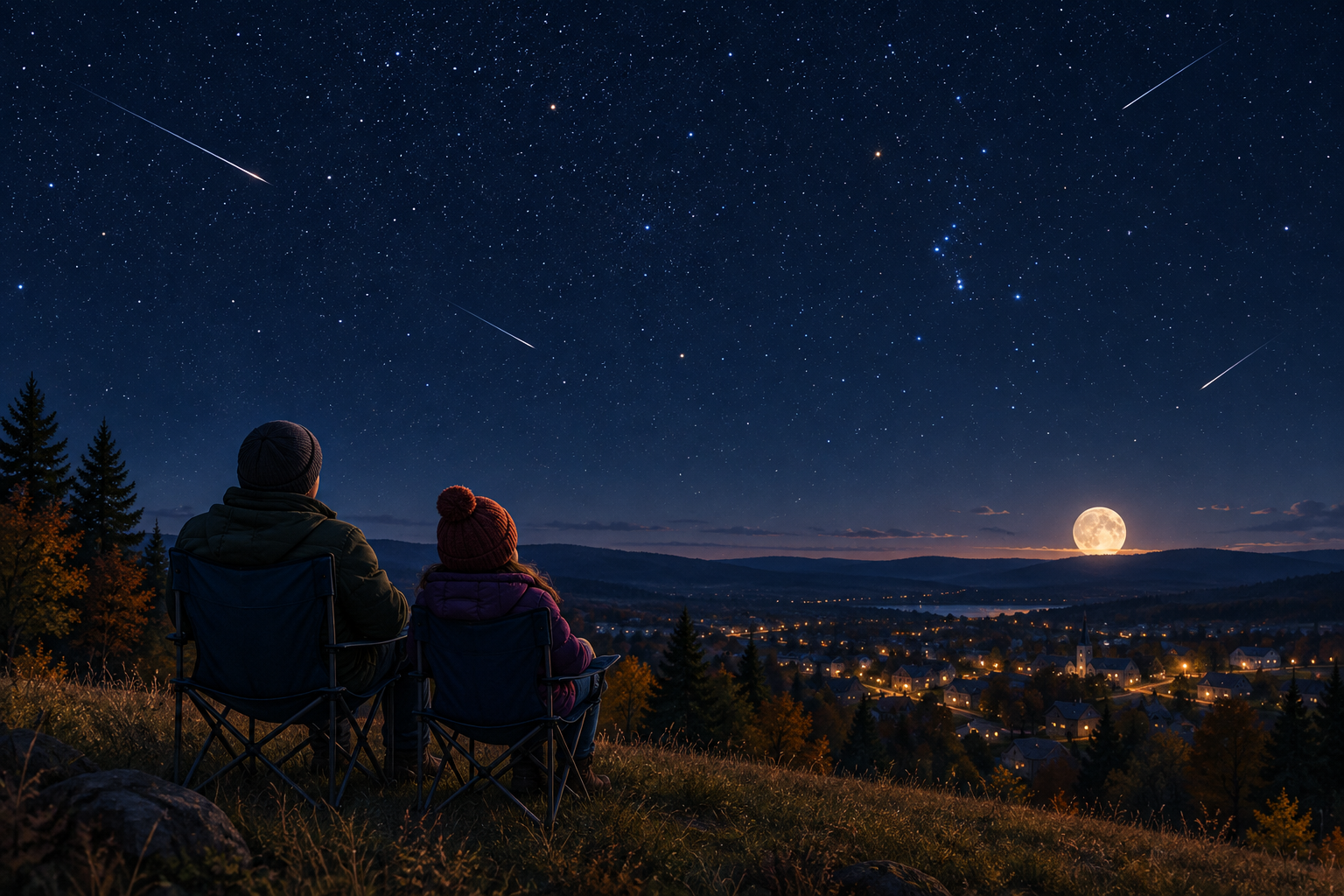
The 2026 Orionids peak overnight from October 21 into October 22. For U.S. skywatchers, a practical plan is to check the Moon’s setting time for the place you will observe and, if skies are clear, watch during the dark hours that remain before dawn. NASA’s October 2026 guidance puts moonset at around 3 a.m. local time, but that is an approximate reference rather than a time that applies everywhere.
Look up moonset for your town or observing site instead of relying on a national forecast or a time from another city. The exact time varies by location. Check the forecast for the hours you can realistically stay outside, too: clouds, haze, nearby lighting, and obstructions all affect what you can see.
- Peak: overnight October 21–22, 2026.
- Potentially better viewing: after local moonset and before dawn, if skies are clear.
- No special equipment is needed.
Why moonset matters for this year’s shower
Moonlight brightens the sky, reducing the contrast that helps you notice faint meteor streaks.
The Moon does not prevent Orionid meteors from appearing. Its light can, however, make faint streaks harder to distinguish from the sky. NASA says moonlight may obscure some fainter Orionids early in the night and points viewers toward the hours after moonset. That makes local timing more useful than simply heading outdoors at the start of the evening.
If you can only watch before the Moon sets, it may still be worth looking, but set your expectations accordingly. You can choose a position where a building, hill, or other safe obstruction keeps the Moon out of your direct view. That may reduce glare in your line of sight, but it cannot remove moonlight across the rest of the sky.
Make a simple viewing plan
A few location and comfort decisions can make a late-night outing more practical.
You can watch the Orionids with your eyes alone. A telescope or binoculars are not necessary for catching meteors, which appear briefly and may streak through different parts of the sky. The aim is to give yourself a wide view and enough time to notice them.
- Check cloud cover and visibility for your observing spot and the hours after local moonset. A nearby town’s forecast may not match conditions at a more distant site.
- Choose a safe, permitted place with an open view and less direct artificial light. Consider how you will get there and return, and check any park or property access rules.
- Look up local moonset and decide whether the after-moonset window is workable. If it is too late for you, an earlier attempt is still possible, with moonlight likely to make faint meteors harder to see.
- Bring warm layers and a chair or blanket so you can look up without standing for a long time. Give your eyes time to adjust to the dark, and avoid repeatedly checking a bright phone screen.
- If you are going with children or other people, agree on a meeting point and return plan before settling in.
Where to look—and a common mistake to avoid
Orion gives the shower its name, but it is not the only part of the sky where meteors can appear.
The Orionids are associated with the direction of the constellation Orion, but you do not need to stare at Orion to see them. Meteors can streak across other parts of the sky. Watching only one small patch can mean missing activity elsewhere, so settle somewhere with a broad, unobstructed view and let your gaze move naturally.
Keep bright lights to a minimum while watching. If you need a flashlight to walk safely, use it briefly and carefully. You may also find it more enjoyable to watch rather than trying to photograph every meteor: a phone camera frames a limited portion of the sky, while your eyes can take in a wider view.
How many Orionids might you see?
Hourly rates help set expectations, but they describe conditions rather than predict an individual viewing session.
NASA’s October 2026 article estimates about 3–6 meteors per hour in suburban areas with ambient light, with a few more in darker areas. NASA’s general Orionids guide and the American Meteor Society describe typical maximum rates of about 10–20 per hour under dark skies. These estimates use different observing conditions; neither guarantees what a particular person will see.
Your count may be lower because of moonlight, clouds, light pollution, trees, or a brief lapse in attention. Even under good conditions, meteors do not necessarily appear at regular intervals. Use published rates as context, not as a target for your outing.
| Estimate | Conditions described | How to use it |
|---|---|---|
| About 3–6 per hour | Suburban areas with ambient light, according to NASA’s October 2026 guidance | A rough reference, not a personal forecast |
| About 10–20 per hour | Typical maximum estimates under dark skies in general shower guidance | A favorable benchmark, not a guaranteed count |
Choose your plan before the night gets late
Decide in advance how you will adapt if the moonset, weather, or your schedule does not cooperate.
The most useful plan is one you can actually follow. If you are willing to stay up, set a time to check the latest local forecast and moonset before leaving, then decide how long you will watch. If the sky is cloudy or the return trip would be unsafe, skip the outing rather than driving to an unfamiliar place in the dark for a poor chance of seeing meteors.
If you cannot stay until after moonset, you can still make a shorter early-evening attempt. Find a safe spot where the Moon is not directly in your view, watch a wide area of sky, and remember that fainter meteors may be lost in the glare. Either way, bring patience: a gap with no visible meteors is normal, and the shower’s peak does not promise an uninterrupted display.
- Before the outing: verify local moonset, weather, and site access.
- Set a realistic start and finish time, especially if watching with children.
- Choose a backup plan, such as observing from a familiar nearby location or staying in if conditions are poor.
- Prioritize a safe route and comfortable viewing over reaching a remote, very dark site.
Frequently asked questions
What night is the 2026 Orionid meteor shower peak?
The Orionids peak overnight October 21–22, 2026. Your best chance depends on local moonset, cloud cover, and viewing conditions.
What time should I watch the Orionids in the United States?
Check the moonset time for your specific location. NASA’s October 2026 guidance gives around 3 a.m. as an approximate time and recommends watching after moonset before dawn, but the time is not universal.
Can I see the Orionids before the Moon sets?
Possibly. The shower can still be visible, but moonlight may make fainter meteors harder to spot. If you watch earlier, try to keep the Moon out of your direct view and expect fewer faint streaks to stand out.
Do I need a telescope, and should I look at Orion?
No telescope is needed. Meteors can streak across a broad area of sky, so do not focus only on Orion; choose a safe spot with an open view and scan broadly.
How many Orionids will I see per hour?
There is no reliable personal count to promise. Published estimates range from about 3–6 per hour in suburban ambient light to typical maximum estimates of about 10–20 under dark skies, but moonlight, weather, location, and viewing conditions affect what you see.
Sources & further reading
Explore the original sources behind this article. Our editorial perspective is separate from the organizations we reference.
- [S1] Disappearing Planets, Dragon Fireballs, Hunter’s Moon Fill October’s Spooky Skies - NASAnasa.gov
- [S2] What's Up: October 2026 Skywatching Tips from NASA - NASA Sciencescience.nasa.gov
- [S3] Orionids - NASA Sciencescience.nasa.gov
- [S4] 2026/2027 Meteor Shower Calendar | American Meteor Societyamsmeteors.org