Why Did My Electric Bill Rise? Compare Billing Days, kWh, and Charges
A higher electric bill does not automatically mean you used much more power. Compare billing days, daily kWh, rates, and other charges to see what changed and what to ask your utility.
Why Did My Electric Bill Rise? Compare More Than the Total
The amount due combines electricity use with billing dates, rates, and account activity, so it cannot identify the cause by itself.
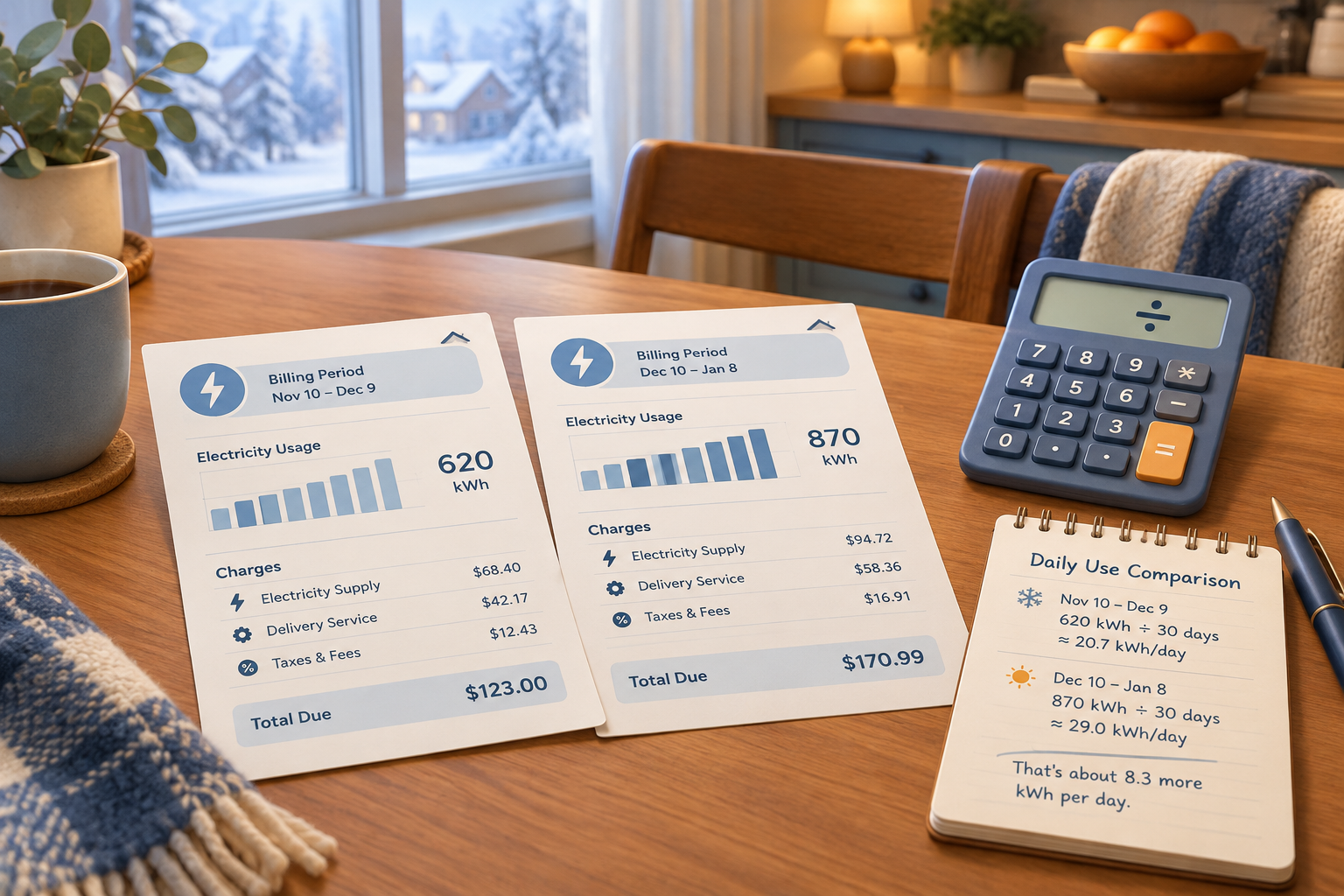
To investigate why your electric bill rose, compare the billing-period dates, electricity use in kilowatt-hours (kWh), applicable rates, and other listed charges on both bills. First check whether the newer statement covers more days. Then compare kWh per day, followed by rates and charges such as fixed fees, taxes, credits, or adjustments.
The U.S. Energy Information Administration explains that published average electricity prices do not necessarily match the rates on an individual customer’s bill. Your account’s own rate and bill details matter. A comparison can narrow down what changed, but it may not establish why your household used more electricity or whether a charge is correct.
The goal is to arrive at a focused question for your utility: was the bill higher because the period was longer, daily use changed, a rate changed, or another line item affected the amount?
Check the Billing Dates and Number of Days
Make the two periods comparable before interpreting differences in electricity use or cost.
Find the start and end dates on each bill and note the number of days in each billing period. Statements that appear to be monthly may cover different lengths of time, so their total kWh or total charges may not be directly comparable. The Department of Energy’s energy-data guidance identifies billing dates, period length, and consumption as useful information to track.
If shown, note whether each meter reading was actual, estimated, or adjusted. A change in reading status is a reason to ask how the utility calculated the bill; it does not, by itself, prove an error. Record any payment, credit, or prior balance separately from the current-period charges.
- Earlier bill: start date, end date, number of days, and reading status.
- Newer bill: the same four details.
- Note any payment, credit, or adjustment that appears on only one statement.
Compare kWh Per Day, Not Just Monthly kWh
A daily-use calculation helps account for billing periods that cover different numbers of days.
Electricity use is commonly measured in kilowatt-hours (kWh). Divide the kWh shown for each period by the number of billing days to calculate average daily use. Compare those figures as well as total kWh. Utility bill layouts differ, but the statement or online account should identify the consumption and period being billed.
For example, suppose an earlier bill shows 600 kWh over 30 days and the newer bill shows 700 kWh over 35 days. Both average 20 kWh per day. The newer statement has more total electricity because it covers five extra days, while average daily use is unchanged. This calculation helps compare periods; it does not explain what happened on any particular day.
If average daily use increased, consider what changed during the period: weather, time spent at home, visitors, equipment, or routines may be relevant. These are possibilities to investigate, not conclusions the bill can prove. Winter weather may affect use in a home with electric heating, but that explanation may not apply to households that heat another way.
- Formula: period kWh ÷ billing days = average kWh per day.
- When practical, compare periods from similar seasons, while keeping weather and household changes in mind.
Separate Electricity Use From the Cost of Each Charge
A higher amount due can reflect current charges, account activity, or a one-time adjustment—not only additional kWh.
Compare current-period charges separately from the total amount due. Depending on your utility and service arrangement, electricity supply and delivery costs may be bundled together or listed separately. Other entries may include fixed charges, taxes, fees, credits, or adjustments. Line-item names and layouts vary, so check the bill’s definitions or ask the provider to explain an unfamiliar item.
Some fixed utility charges may remain even when a household uses fewer kWh. The Federal Trade Commission makes this point in consumer information about utility charges. Check whether a line appears on both statements and whether its amount changed; an unfamiliar line alone is not proof of a billing mistake.
You can divide current-period charges by billing days for a rough daily-cost comparison. You can also compare usage-related charges alongside kWh. Avoid treating total dollars divided by kWh as the exact electricity rate if the total includes fixed charges, taxes, credits, or other items.
| What to compare | Earlier bill | Newer bill | What it may help reveal |
|---|---|---|---|
| Billing days | 30 | 35 | The newer period is five days longer |
| Electricity use | 600 kWh | 700 kWh | Total use is higher |
| Average use per day | 20 kWh/day | 20 kWh/day | Average daily use is unchanged |
| Current charges | $120 | $154 | Cost per day is higher; check rates and listed charges |
| Amount due | Check statement | Check statement | May include a balance or payment activity beyond current charges |
Look for Rate or Plan Changes
If billing days and daily use do not explain the increase, find out which pricing rules applied to each period.
Look for a rate-plan name, a notice of a rate change, seasonal pricing, or charges that vary by time of day. Some customers have time-based rates or separate supplier and delivery charges; others do not. Do not assume your account uses a particular rate structure based on another household’s statement.
The Department of Energy recommends reviewing bill components and historical consumption when evaluating utility rate options. EIA also cautions that average electricity prices do not establish an individual customer’s rate. Check the rate information tied to your own account rather than applying a state or national average to your usage.
If a rate name or calculation is unfamiliar, note the exact wording and ask which rate applied in each period, when any change took effect, and whether the bill reflects a different plan or pricing period. If you recently changed suppliers or service, ask how that arrangement appears on your statement.
Check Credits, Payments, and Other Adjustments
Reconcile the latest period’s charges with the balance the bill says you owe.
The total due can include more than the latest electricity charges. Check for a previous balance, a payment posted after the prior statement, a credit, a fee, or an adjustment. Compare current-period charges with the amount due, and check payment dates against your own records. A payment that has not yet appeared can affect the balance without changing electricity use.
If a bill shows an estimated reading or an adjustment, ask which dates or readings the calculation covers and how it affected the amount. Keep both statements and any relevant payment confirmation. These records can help distinguish a question about electricity use from one about the account balance or billing calculation.
- Mark each line that is new, changed, or unclear.
- Check payment and credit dates against your bank or payment records.
- Ask the utility to explain a reading or adjustment before concluding that an error occurred.
What to Ask the Utility if the Difference Is Still Unclear
A question tied to specific dates, readings, and line items gives the utility a concrete comparison to investigate.
Contact the utility through the phone number or account channel shown on your statement. Have both bills available and describe the periods you compared. For example: “My previous bill covered 30 days at 600 kWh, and this one covered 35 days at 700 kWh. Can you explain which changes account for the higher current charges?”
Ask whether the meter readings were actual or estimated, which rate applied during each period, and what any unfamiliar charge or adjustment represents. If the explanation does not match the statements, ask how to request a review and what account information the utility needs. Keep a note of the date, the explanation, and any next step the representative gives you.
A useful sequence is to write down the dates, days, kWh, and reading status; calculate average kWh per day; compare charges and rates separately from the amount due; then contact the utility with the specific difference. Save the explanation and check a later statement if the utility says an adjustment will appear there. You do not need to determine a single cause before asking for help, and the comparison alone does not establish that the bill is wrong.
- Write down the dates, billing days, kWh, and reading status for both statements.
- Calculate average kWh per day for each period.
- Compare current charges, rates, and other listed items separately from the amount due.
- Ask the utility what changed, using the specific difference you found.
- Save the explanation and check the next statement if a later adjustment is expected.
Frequently asked questions
Why is my electric bill higher if my kWh use stayed the same?
Check whether the billing period was longer, a rate or plan changed, or fixed charges, taxes, fees, or adjustments increased. Compare current-period charges separately from the total due, then ask the utility to explain any remaining difference.
How do I compare electric bills with different billing periods?
Divide each period’s kWh by its number of billing days to find average kWh per day. Compare those figures as well as total kWh, remembering that the calculation does not explain what caused a change in use.
Does a higher electric bill always mean I used more electricity?
No. The total can also reflect a different billing-period length, rates, fixed charges, taxes, account adjustments, or payment activity. Compare the statement’s components before drawing a conclusion.
What should I ask my electric company about a high bill?
Ask which rate applied, whether meter readings were actual or estimated, what changed between the periods, and what an unfamiliar charge or adjustment means. Have both statements and relevant payment records available.
Sources & further reading
Explore the original sources behind this article. Our editorial perspective is separate from the organizations we reference.
- [S1] Does EIA publish electricity sales and price data by state and by utility? - Frequently Asked Questions (FAQs) - U.S. Energy Information Administration (EIA)eia.gov
- [S2] Evaluating Your Utility Rate Options | Department of Energyenergy.gov
- [S3] Step 3. Create a Central Energy Database | Energy Data Management Guideeere.energy.gov
- [S4] Solar Power for Your Home | Consumer Adviceconsumer.ftc.gov