Badminton Doubles Serving Explained: Who Serves, Who Receives, and When to Switch
Use the serving side’s score to choose the service court, then serve with the player already standing there. Follow the rally examples to see when doubles partners switch sides—and when they stay put.
The quick rule for badminton doubles service courts
First identify which side is serving, then use that side’s score to pick the court.
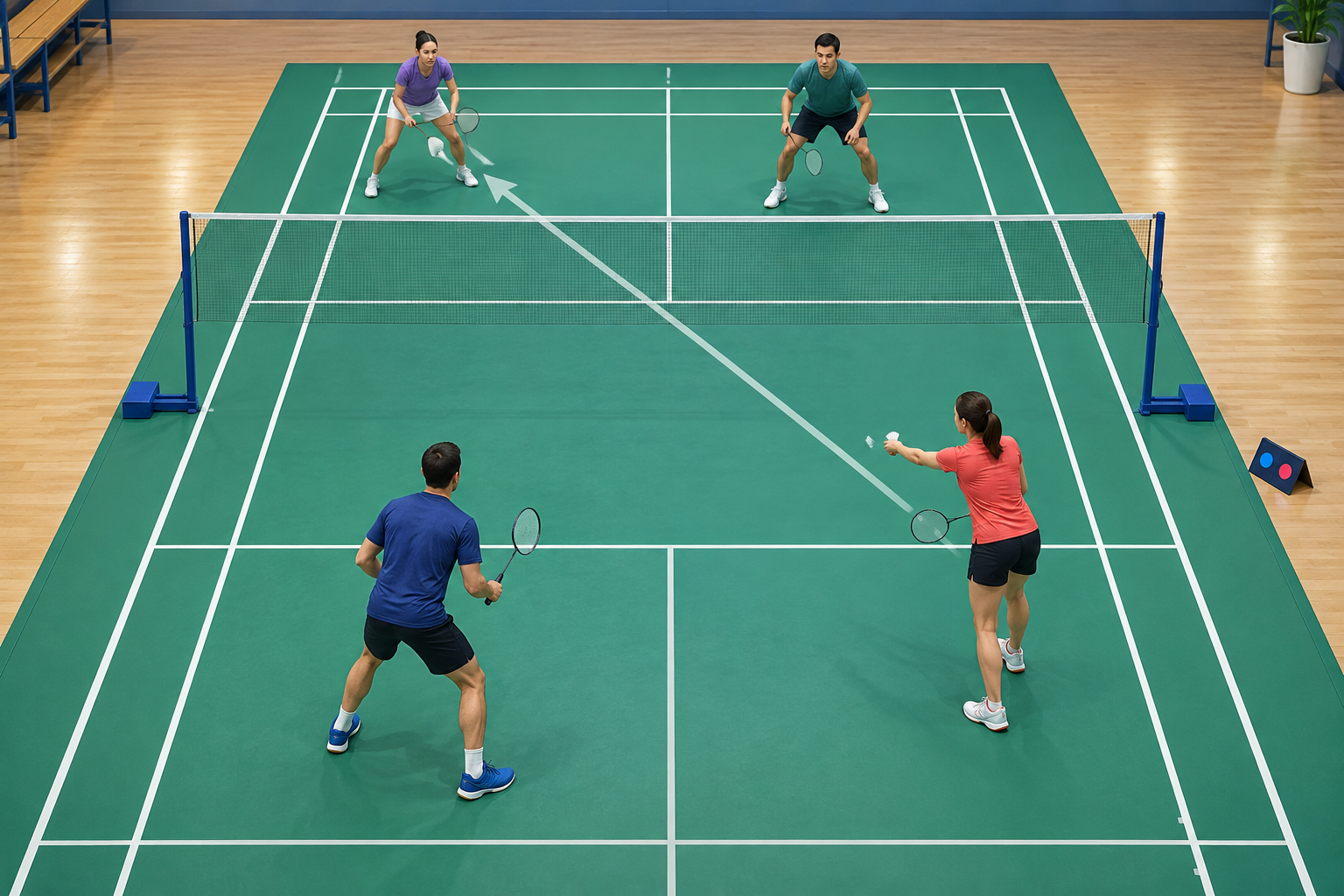
In standard BWF doubles, the serving side serves from the right service court when its score is zero or any even number. It serves from the left service court when its score is odd. The receiver stands diagonally opposite the server.
The score picks the court; it does not name a particular player. Look at who is actually standing in that court. That player serves. This distinction is the key to working out who serves after a rally changes possession.
- Serving side’s score even: serve from the right.
- Serving side’s score odd: serve from the left.
- The receiver is diagonally opposite the server.
Find the server and receiver after a rally
Once you know the serving side’s score, check the players’ positions rather than guessing from the previous shot.
At the start of a rally, the server must be in the court selected by the serving side’s score. The opponent diagonally opposite is the receiver. Their partners stand in the other two service courts.
If the receiving side wins the rally, it scores a point and becomes the serving side. Check its new score, identify the matching court, and the player standing there serves. The player who received the previous serve might be next to serve, but that is not an automatic rule: the score and current positions determine it.
Follow a rally-by-rally example
A short sequence shows how the same server can continue, and how the other pair takes over.
Suppose Team A has A1 and A2, and Team B has B1 and B2. At 0–0, A1 serves from the right. B1 is diagonally opposite and receives. For this example, B1 is standing in B’s left court and B2 in B’s right court.
| Rally result | Score | Next server and court |
|---|---|---|
| Start of game | 0–0 | A1 serves from the right |
| Team A wins the rally | 1–0 | A1 serves again, now from the left |
| Team B wins the next rally | 1–1 | B1 serves from the left, the court matching B’s odd score |
| Team B wins again | 1–2 | B1 serves again from the right, matching B’s even score |
When doubles partners switch courts
A switch happens after a serving side earns a point, not whenever a rally ends.
When the serving side wins a rally, it scores and the same player serves again from the alternate service court. The server and partner therefore exchange which service court they occupy. The side keeps serving until it loses a rally.
When a side loses a rally while serving, its score does not change and its players do not switch service courts because of that loss. The opposing side scores and takes service. Its current positions remain the starting point for deciding who serves: use its score to identify the court, then the player standing there.
So partners do not trade places after every rally. A side changes positions when it wins a point while it is serving. That is different from the opponents taking over the serve.
A between-rally checklist
Use the same four questions every time service changes or the score moves.
A brief pause between rallies is enough to reset your bearings. Check the score and the players’ positions before the next serve.
- Which side won the last rally, and which side is serving now?
- What is the serving side’s score?
- Does that score call for the right court (even) or left court (odd)?
- Which player is standing in that court, and who is diagonally opposite to receive?
Common service-order mix-ups
Most mistakes come from following a player’s identity instead of the score and court positions.
If a serve seems confusing, pause and reconstruct the positions from the last clear point. Avoid making a fresh rotation based only on who served or received previously.
- Using the opponents’ score: the serving side’s score determines its service court.
- Assuming the last receiver automatically serves next: check who is standing in the court selected by the new serving side’s score.
- Switching partners after a lost serve: losing the rally does not make the serving pair swap courts.
- Switching after every rally: partners switch courts when their side wins a rally while serving, not simply because a rally ended.
Check which scoring format your game uses
Service order and the match’s scoring format are related, but the format should be confirmed separately.
This guide describes the doubles service order in the BWF laws version in force from April 26, 2025. Recreational groups and events may use local formats, so ask the organizer which rules apply before play.
There is also a scheduled change to the scoring format: USA Badminton reported on April 28, 2026, that BWF approved a 3×15 system due to take effect on January 4, 2027. That is a reason not to treat one game format as permanent. For matches around or after that date, check the current governing rules and the event’s instructions rather than assuming the local setup matches an older format.
Frequently asked questions
In badminton doubles, does an even score mean the server uses the right court?
Yes. Use the serving side’s score: zero or an even score means the right service court; an odd score means the left.
If my team wins a rally while serving, does the same player serve again?
Yes. The serving side scores a point, and the same server serves again from the alternate service court.
Do doubles partners switch sides after every point?
No. They switch service-court positions when their side wins a point while serving. Losing a rally while serving does not itself make them switch.
Who serves when the receiving team wins a rally?
That team scores and becomes the serving side. Use its score to choose the service court; the player already standing there serves.
Does the player who received the last serve serve next?
Not automatically. The new serving side’s score selects the court, and the player standing in that court serves.
Sources & further reading
Explore the original sources behind this article. Our editorial perspective is separate from the organizations we reference.
- [S1] BWF Statutes, Section 4.1: Law of Badmintonbadminton.dk
- [S2] BWF Approves 3×15 Scoring System - USA Badmintonusabadminton.org