Curling Scoring Explained: How Stones, Ends, and the Hammer Work
Follow a curling end by comparing stones in the house with the opponent’s nearest stone. Learn how points, blank ends, the hammer, and the scoreboard fit together.
Curling scoring, in one simple rule
The nearest opposing stone sets the cutoff for how many points a team can score.
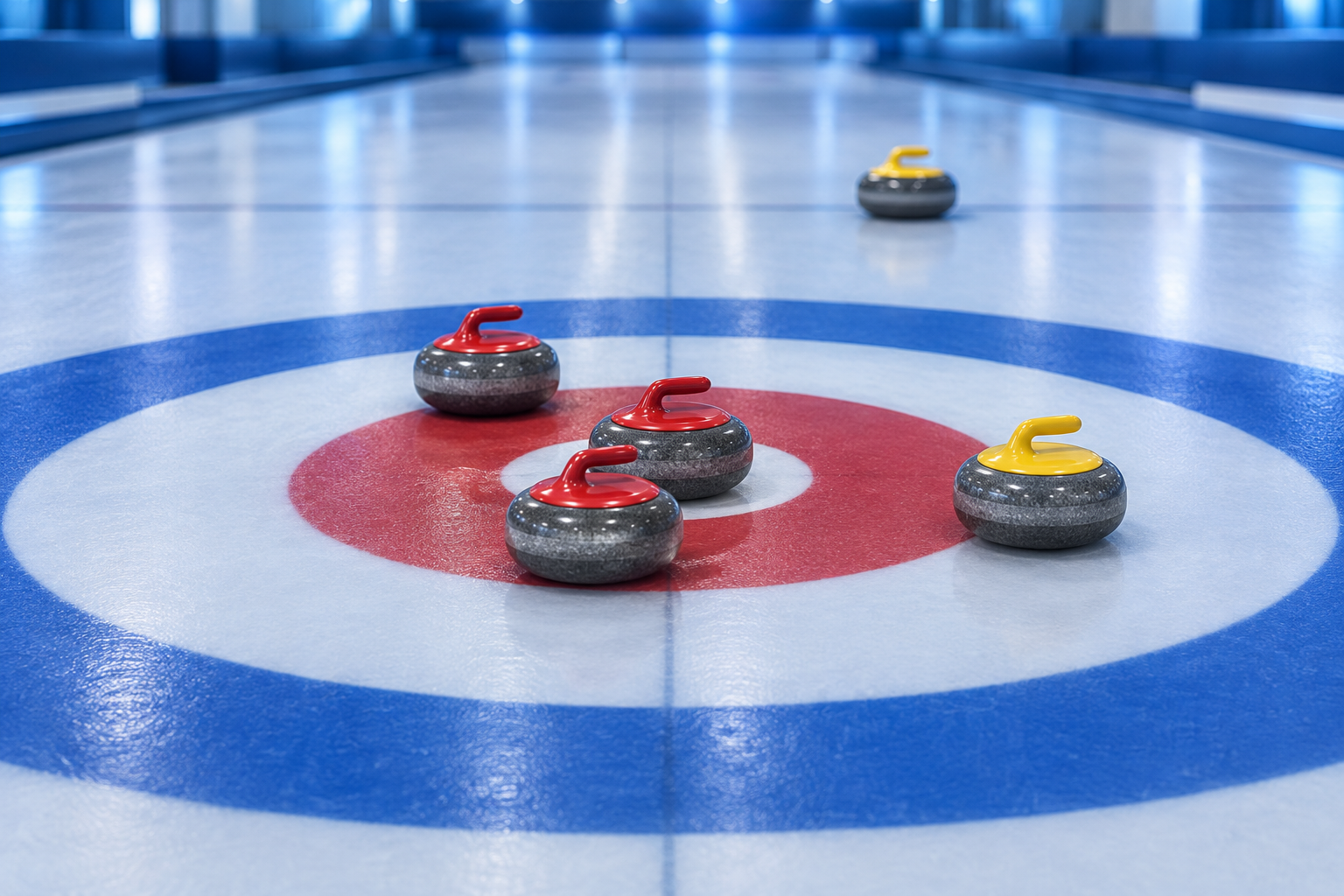
In standard four-player curling, a team scores one point for each of its stones in or touching the house that is closer to the tee than the opposing team’s nearest stone in or touching the house. The house is the target area at the end of the sheet; the tee is the point at its center. Only one team can score in an end, though it can score several points.
The important comparison is not simply which team has more stones in the house. Find the opponent’s closest stone to the tee, then count the other team’s stones that are both in or touching the house and closer to the tee than that opposing stone.
Suppose Red has two stones closer to the tee than Yellow’s nearest stone, while Yellow has three stones in the house. Red scores two points. Yellow’s other stones do not score in that end because they are not closer than Red’s nearest stone. If the distances are too close to judge by eye, the rules provide for measurement.
- Find the house and its center, the tee.
- Identify the opponent’s nearest stone in or touching the house.
- Count your team’s stones in or touching the house that are closer to the tee than that stone.
What an end is—and when stones count
Wait for the end to finish before counting: later deliveries can change which stones are closest.
An end is one round of play. In standard four-player curling, each player delivers two stones during an end, giving each team eight stones to play. Teams alternate deliveries, and play travels in the opposite direction in the next end. Depending on the format or competition, a game may have eight or ten ends.
Only stones in or touching the house can score. A stone elsewhere on the sheet does not count, even if it is close to the tee in a straight-line sense. A stone touching the house boundary qualifies as in or touching the house, but it must still beat the opponent’s nearest stone to earn a point.
A useful viewing habit is to wait until all stones have stopped before deciding who scored. A final stone can knock another stone away, move a stone closer, or change which team has the nearest stone. When the final positions are difficult to distinguish, a measurement can settle the comparison.
A worked example: count the points after the last stone
The nearest opposing stone is the threshold; a team’s other stones can each score if they beat it.
Imagine Red has three stones in the house and Yellow has two. Red’s nearest stone is the closest of all five to the tee. Yellow’s nearest stone is next, and Red’s other two stones are also closer to the tee than that Yellow stone. Red scores three points: all three Red stones beat Yellow’s nearest stone.
Now change the positions. Yellow has two stones in the house, and its nearest stone is closer to the tee than Red’s nearest stone. Yellow’s second stone is farther from the tee than Red’s nearest stone. Yellow scores one point, not two: only Yellow’s closest stone beats Red’s nearest stone.
If Yellow’s second stone were also closer to the tee than Red’s nearest stone, Yellow would score two. The number of points depends on how many of the scoring team’s stones beat the opponent’s nearest stone—not just on which team has the single closest stone.
If one team has no stone in or touching the house, the other team can score with every stone it has in or touching the house. If neither team has a stone in or touching the house when the end concludes, neither team scores; that is a blank end.
- Three Red stones closer than Yellow’s nearest stone: Red scores 3.
- Yellow’s nearest stone is closest, but only one Yellow stone beats Red’s nearest: Yellow scores 1.
- Neither team has a stone in or touching the house: the end is blank.
How to read a curling scoreboard
End-by-end figures show when points were earned; the running total adds those points together.
A typical curling scoreboard displays the points each team scored in each end alongside a running total. The figure under an end is not necessarily the team’s overall score; the total reflects points from that end and all earlier ends. Layouts can vary between broadcasts and venues, so use labels such as “End” and “Total” to tell the entries apart.
For example, Red might score three in the first end and neither team might score in the second. Red’s running total stays at three, while Yellow’s stays at zero. If Yellow scores one in the third, the totals become Red three and Yellow one.
A zero for a team in an end means it did not score in that end. A blank end is more specific: both teams score zero. Keep the hammer separate from the points column, since it tells you who has the last stone in the next end rather than adding anything to the score.
| End | Red points | Yellow points | Red total | Yellow total |
|---|---|---|---|---|
| 1 | 3 | 0 | 3 | 0 |
| 2 | 0 | 0 | 3 | 0 |
| 3 | 0 | 1 | 3 | 1 |
What a blank end means
A blank end leaves the score unchanged, but can preserve the last-stone advantage for the next end.
A blank end is an end in which neither team scores. In practical terms, no stone is left in or touching the house when the end concludes. If a stone is in the house, the team with the nearest stone scores at least one point; its other stones may score too if they are closer than the opponent’s nearest stone.
In traditional team play, the team that had the hammer keeps it after a blank end. The scoreboard does not change, but that team retains the opportunity to deliver the last stone in the following end. Whether a team chooses to pursue a blank depends on the game situation; for a first-time viewer, the useful thing is to track both the score and who keeps the hammer.
Formats can have distinct procedures, so use the event’s rules when watching something other than standard team play.
The hammer: last stone, not a guaranteed point
The hammer marks who delivers last; it is a strategic advantage, not part of the score.
The hammer means having the last stone of an end. Because that stone is delivered after the others, it gives the hammer-holder an opportunity to affect the final positions in the house. It does not guarantee a point: the last delivery may not produce a scoring position, and an end can finish without the hammer-holder scoring.
In traditional team play, scoring passes the hammer to the other team for the next end. If the end is blank, the team that had the hammer keeps it. After the stones stop, first work out who scored and how many points; then check which team has the hammer for the next end.
The scoreboard’s point total and the hammer are separate pieces of information. A broadcast may indicate the hammer with a symbol or label, but that marker is not an extra point.
Mixed doubles and a simple watch-along routine
The scoring comparison remains a useful starting point, but mixed doubles has its own setup details.
Mixed doubles uses pre-positioned stones and other format-specific procedures, so its starting arrangement differs from standard four-player curling. The basic idea of comparing stones in the house is a useful introduction, but do not assume every detail of the four-player setup applies. Check the event’s format explanation for those rules.
For a standard four-player game, use this routine once an end is complete: locate the house and tee, identify the nearest opposing stone in the house, count the other team’s stones that are closer, and add those points to the running total. Then note who has the hammer. It lets you follow the score without trying to judge every stone while it is moving.
The rules referenced here are World Curling’s 2026 rules, whose document text is dated September 1, 2026; that is the document date, not necessarily its publication date. The companion World Curling explainer describes standard play and terms such as ends, blank ends, and the hammer.
- Locate the house and the tee at its center.
- After the final stone stops, find the nearest stone in or touching the house.
- Count the other team’s stones in or touching the house that are closer to the tee than that nearest opposing stone.
- If only one team has stones in the house, count its stones there; if neither team has one, the end is blank.
- Add the points to the running total, then check who has the hammer for the next end.
Frequently asked questions
Can both teams score in the same curling end?
No. Only one team scores in an end. Its stones in or touching the house that are closer to the tee than the opponent’s nearest stone there earn points.
Can a team score more than one point in an end?
Yes. A team can score one point for each of its stones in or touching the house that is closer to the tee than the opponent’s nearest stone in the house.
What if one team has no stones in the house?
If the other team has stones in or touching the house, that team scores for each of its stones there. If neither team has a stone in or touching the house, the end is blank.
What does a blank end do to the score and the hammer?
A blank end adds no points. In traditional team play, the team that had the hammer keeps it for the next end.
Does having the hammer guarantee a team will score?
No. The hammer is the last stone of an end and gives a team an opportunity to influence the final positions, but it does not guarantee points.
Sources & further reading
Explore the original sources behind this article. Our editorial perspective is separate from the organizations we reference.
- [S1] <table id="e1">worldcurling.org
- [S2] What is curling? - World Curlingworldcurling.org
- [S3] WCF - World Curling Federationolympics.com