Volleyball Rotation Explained: Serving Order, Court Zones, and When Players Move
In standard indoor volleyball, the receiving team rotates clockwise when it wins the rally and earns the serve. Learn how to read the six court positions, identify the next server, and tell when players can move into tactical roles.
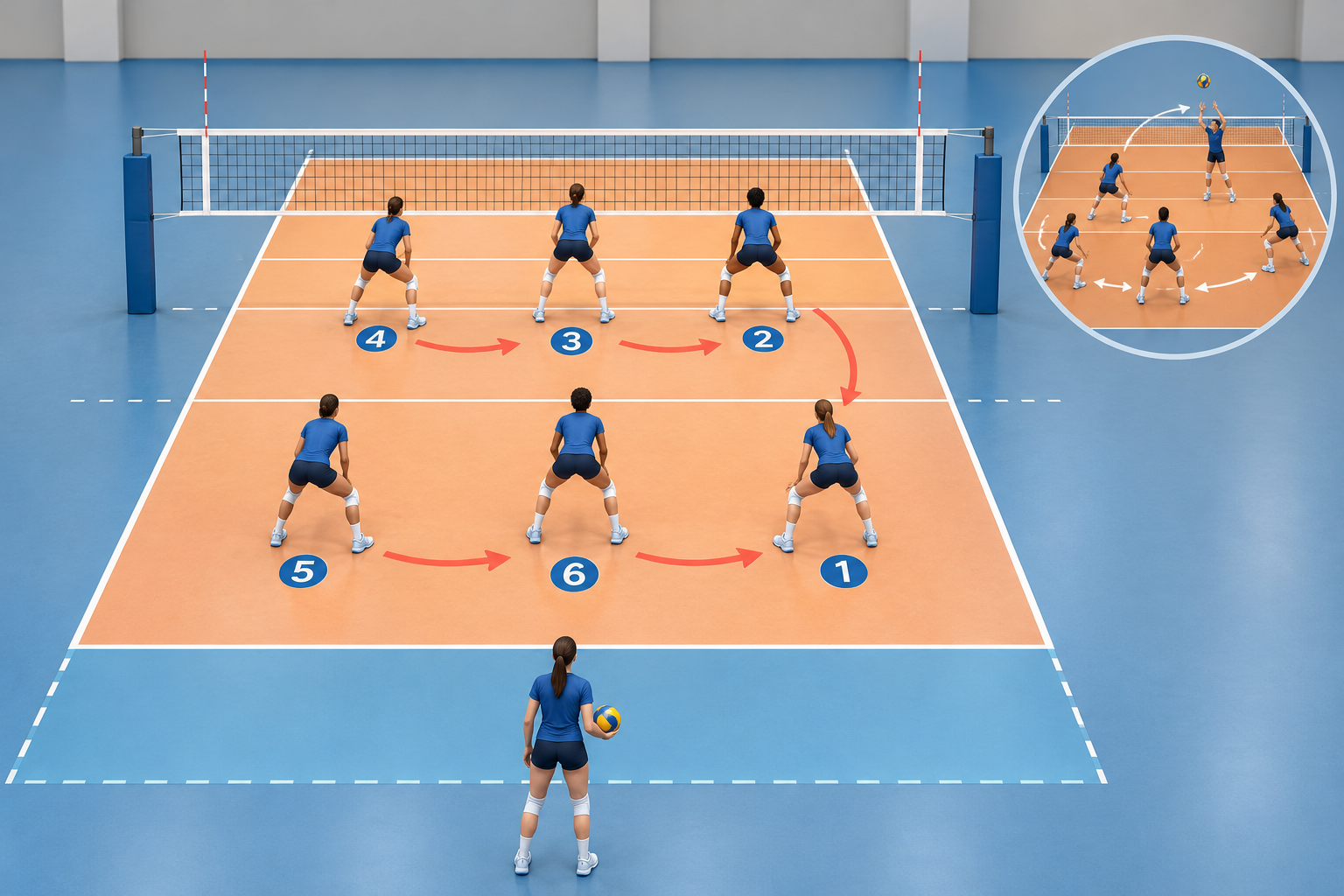
The short version: when volleyball teams rotate
To find the next server, first work out which team was receiving when the rally began.
In standard indoor volleyball, the team that was receiving rotates when it wins the rally and gains the right to serve. Each player moves one place clockwise in the team’s rotational order. The player who moves into position 1 serves next.
If the serving team wins the rally, it keeps the serve and does not rotate. The same player serves again. So a point alone does not mean a rotation: the key change is the receiving team taking over the serve.
This guide follows the FIVB Official Volleyball Rules 2025–2028, which FIVB lists as its current rules edition. School, recreational, and other competitions may have different or additional procedures, so check the rules for your match.
- Receiving team wins: rotate clockwise; the player moving into position 1 serves.
- Serving team wins: no rotation; the same player serves again.
The six volleyball positions, from your team’s perspective
The numbers mark places in the rotational order; they are not permanent player roles.
Imagine standing on your team’s side and looking toward the net. The front row, from your left to your right, is positions 4, 3, and 2. The back row, also from your left to your right, is positions 5, 6, and 1.
Position 1 is the back-right rotational position. It helps you track the serving order, but it is not a small, reserved service box. The server stands behind the end line in the service zone, which extends across the width behind that line. The server can serve from anywhere within that zone, subject to the applicable rules.
Perspective matters when you use a diagram or watch from the opposite side of the gym. What appears on your left when you face the net appears on the other team’s right when viewed from the far end. A court map should therefore make clear whose side it shows.
| Front row, left to right | Back row, left to right |
|---|---|
| Position 4 | Position 5 |
| Position 3 | Position 6 |
| Position 2 | Position 1 |
Follow one clockwise volleyball rotation
Follow the numbered positions rather than trying to memorize where each player stood during the last rally.
When the receiving team wins the rally and takes the serve, all six players rotate one place clockwise. The full movement is position 2 to 1, 1 to 6, 6 to 5, 5 to 4, 4 to 3, and 3 to 2. The player who arrives at position 1 is the next server.
The starting lineup establishes the rotational order, which the team must maintain throughout the set. Players may shift into tactical places after the serve, but those movements do not change the lineup’s serving sequence.
For example, imagine Maya is in position 2 while her team is receiving. Her team wins the rally, so Maya moves to position 1 and serves next. If Maya’s team wins the following rally while serving, it keeps the serve and she serves again without the team rotating.
| Team that wins the rally | Does the team rotate? | Who serves next? |
|---|---|---|
| The serving team | No | The same server |
| The receiving team | Yes, clockwise | The player moving from position 2 to position 1 |
Court positions and playing positions are different
The rotation sets the order players must follow at the serve; tactics determine where they move during the rally.
A player’s rotational position does not necessarily describe where they stay for the whole point. Teams may move into formations suited to their tactics, such as preparing to set, attack, or defend. Under standard FIVB rules, players may move around their court after the serve is hit.
At the service hit, players other than the server must meet the rules’ positional-order requirements. Broadly, each front-row player must be closer to the center line than the corresponding back-row player, and players in the same row must keep the required left-to-right order. The rules assess relative positions, not whether everyone is standing in the exact center of a numbered square.
This is why a team may appear briefly arranged in one pattern before the serve, then move quickly into its preferred playing positions. USA Volleyball describes the distinction as court position versus playing position. Moving after the serve is hit is part of the transition; being out of order at the relevant moment can instead result in a positional fault.
Common rotation confusions and rule variations
The standard sequence is straightforward, but some details depend on the competition.
Teams do not rotate after every rally. The receiving team rotates only when it wins the rally and gains the right to serve. If the serving team wins, it serves again from the same rotational order.
Do not confuse position 1 with the service zone. Position 1 is the back-right rotational place on the team’s court. The service zone is behind the end line and extends across its width, so the server is not restricted to a narrow strip directly behind position 1.
Libero procedures, including whether and how a libero may serve, can differ between rule sets. USA Volleyball notes that competition details may vary; if you are playing, use your league or event’s rules rather than assuming every setting follows the same procedure.
FIVB announced tests for specified 2026 competitions on February 27, 2026. One test permits the receiving team to move after the serving action begins if it was in correct rotational order at the referee’s whistle. That is a test for named competitions, not a universal replacement for the standard rules described here. Check which rules apply to the event you are playing or watching.
- If you lose track of the next server, identify which team was receiving and whether it won the rally.
- If you are playing, check when your competition requires players to be in position and when it permits movement.
- Look up local guidance for libero service and any modified or experimental rules.
A quick checklist for following volleyball rotation
A few questions can help you follow the serving order without tracking every tactical move.
Start with the team currently serving, then watch what happens at the end of the rally. If that team wins, the same server stays in the serving sequence. If the receiving team wins, it rotates and the player moving from position 2 to position 1 serves next.
When you are playing, use the checklist alongside your event’s instructions. When you are watching, orient yourself from one team’s side of the court and keep position 1 in view. You can then follow the serve even if players quickly move into other tactical locations.
- Which team is serving now?
- From this team’s perspective, which player is in position 1?
- If the receiving team wins this rally, who will move from position 2 to position 1?
- Are players in the required relative order when the serve is hit?
- Does this competition have special libero, rotation, or movement rules?
Frequently asked questions
When does a volleyball team rotate?
In standard indoor volleyball, the team that was receiving rotates clockwise when it wins the rally and gains the right to serve. The serving team does not rotate when it wins.
Who serves after a volleyball team rotates?
The player who moves from position 2 into position 1 serves next. The team follows the rotational order set by its starting lineup.
Is position 1 the place where the player serves from?
No. Position 1 is the back-right rotational position on the court. The server serves from behind the end line within the service zone, which extends across the width behind that line.
Do volleyball players have to stay in their numbered positions?
No. Under standard FIVB rules, players must meet the required positional-order conditions when the serve is hit, then may move into tactical positions after the serve is hit.
Do the 2026 FIVB rotation tests apply to every volleyball match?
No. The announced tests apply to specified 2026 competitions. They are not a universal change to the standard rules, so check the rules for the event you are watching or playing.
Sources & further reading
Explore the original sources behind this article. Our editorial perspective is separate from the organizations we reference.