Bathroom Fan Runs, But Is It Venting? A Safe Airflow Check
A bathroom fan that turns on may still leave you unsure whether it moves air outdoors. Try a basic tissue check, look for an exterior outlet only from a safe place, and learn when to ask for maintenance help.
Why check a bathroom fan that turns on?
A running motor is only one part of the question; the fan also needs to move air through an exhaust route that leads outdoors.
A bathroom fan can make its usual sound and still leave you uncertain about what it is doing. The motor starting suggests the unit has power, but it does not confirm how much air is moving or where that air goes.
That matters when a bathroom stays damp after bathing. The U.S. Environmental Protection Agency advises exhausting bathroom moisture outdoors rather than into an attic. A fan that sends air into another enclosed space is not providing the intended outdoor exhaust.
You can make two low-risk observations without taking the fan apart: see whether a small piece of tissue is drawn toward the grille, then look for an exterior vent from a safe, accessible spot. These checks can offer clues, but they cannot verify the condition of hidden ductwork or certify the fan’s performance.
Try a simple tissue check at the grille
Treat the tissue as a lightweight indicator of air movement, not as a measurement or a reason to reach inside the fan.
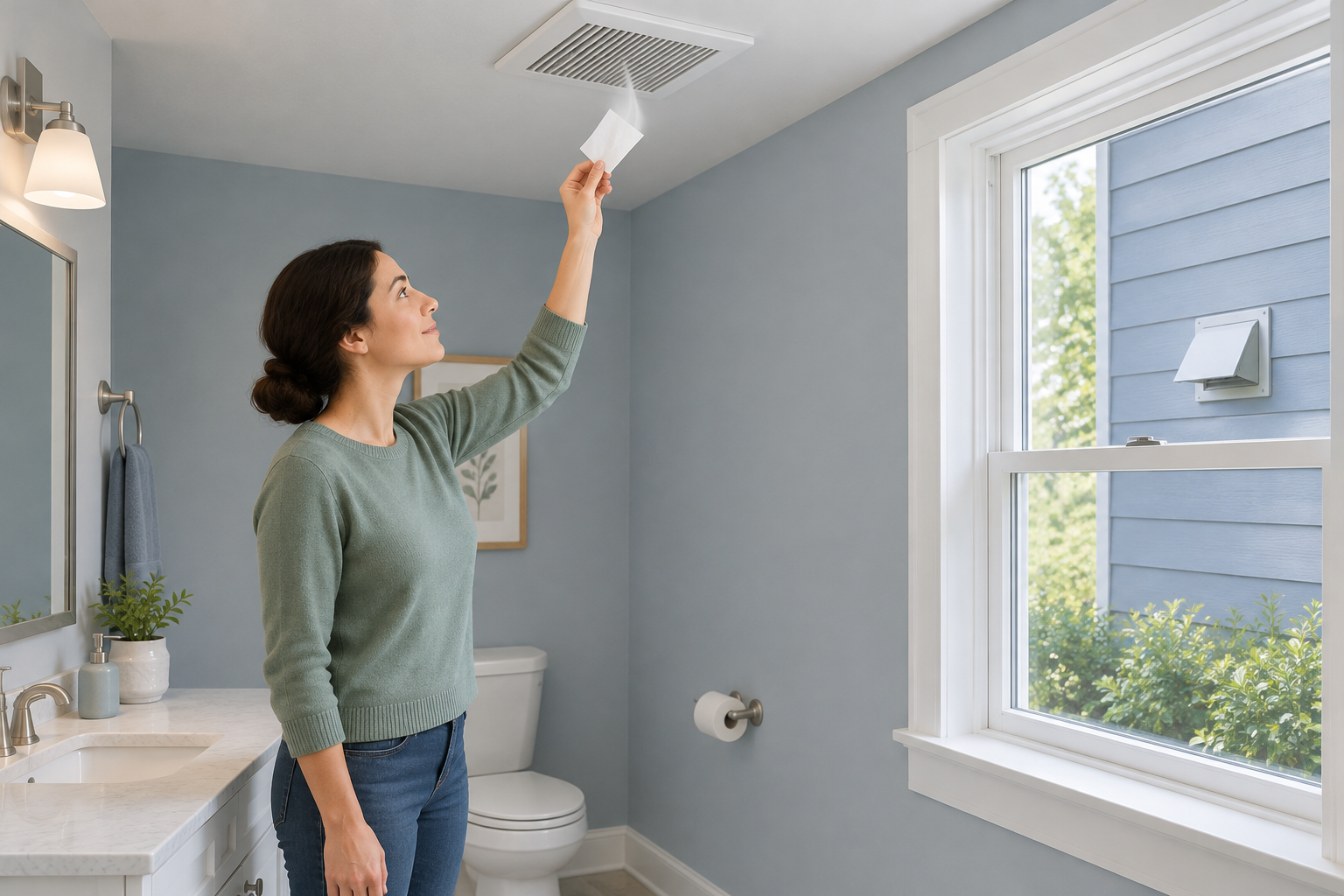
Turn on the fan with its normal control. Hold a small, light piece of tissue near the grille without pushing it into the opening or covering the fan. If the tissue is drawn toward the grille and stays there, that suggests air is moving at the grille.
If the tissue barely moves or falls away, the result is inconclusive. It does not reveal the cause. Dust at the grille, a duct or installation issue, the fan’s condition, or the building’s ventilation arrangement could all be relevant, and this simple check cannot distinguish among them.
The Pacific Northwest National Laboratory’s Building America Solution Center describes the tissue check as a basic airflow check. It is not a measurement of the fan’s installed airflow rate. Appropriate testing equipment is needed to measure installed airflow, so a tissue response cannot establish whether the fan meets a particular standard or is adequate for the room.
- Keep your hands and the tissue outside the grille.
- Do not remove the cover, reach into the fan, or open electrical parts.
- If the fan appears damaged, smells unusual, or develops a new grinding or rattling sound, turn it off and ask for help rather than investigating inside it.
- Turn on the fan using its regular switch.
- Hold a small piece of tissue near the grille without covering it.
- Notice whether the tissue is drawn toward the grille and stays there.
- Treat the result as a clue only; seek maintenance guidance if airflow remains uncertain.
Look for the outdoor outlet from a safe place
A visible exterior termination may add useful context, but its location varies and it may be difficult to identify.
If an exterior vent is clearly visible from the ground or another safe, accessible location, observe it while the bathroom fan runs. Some exterior terminations have a flap or louvers that may move when air is flowing. Movement can be a clue, but it does not prove the full duct route is correct or that airflow is adequate.
An outlet may be on an outside wall or under an overhang; some systems terminate on a roof. Do not climb a ladder, walk on a roof, or enter an unsafe attic to follow the duct. The basic check does not require reaching a roof vent.
A vent can be hard to distinguish from other openings, and an outlet may not be visible from your property. If you cannot identify it confidently, do not guess. In an apartment, the system may be concealed or shared, making a visual check impractical. Ask your landlord or building maintenance where the fan exhausts.
How to interpret the clues
Use observations to decide whether to ask for help, not to make a definitive diagnosis of a hidden system.
The tissue check and exterior observation answer different questions. Tissue movement suggests a response at the grille. A moving exterior flap may suggest activity at a visible outlet. Neither observation confirms the entire path between those points, and an exterior vent may not belong to the bathroom fan you are checking.
If the tissue moves but you cannot find an outlet, the duct route remains unknown. If a flap moves but the tissue does not, the observations may be incomplete or the outlet may serve another system. Treat conflicting or unclear results as unknown rather than as proof that the fan is working—or broken.
| Observation | What it may suggest | What it does not confirm |
|---|---|---|
| Tissue is drawn toward the grille | Air appears to be moving at the grille | Installed airflow rate or correct outdoor exhaust |
| No clear tissue movement | The basic check did not show an obvious draw | The cause of the weak or absent response |
| A visible exterior flap or louver moves | Air may be reaching that outlet while the fan runs | That the outlet belongs to this fan or that the system performs adequately |
| The outlet cannot be seen or identified | A visual check is not possible from your safe vantage point | That the duct is missing, blocked, or incorrectly installed |
When to stop and ask for maintenance help
A safe handoff is appropriate when the observations do not answer the question or moisture remains a recurring problem.
Contact your landlord or building maintenance if the fan shows little apparent draw, you cannot identify where it exhausts, or the room repeatedly remains damp after normal use. Persistent moisture is a reason to investigate ventilation and other possible contributors; it does not, by itself, prove a particular fan or duct fault.
If you own the home, a qualified professional can inspect the fan and duct route and, if needed, measure installed airflow with appropriate equipment. Ductwork and installation can affect performance, so a grille-level check cannot resolve every question.
In a rental, report what you observed rather than opening a shared duct, removing equipment, or changing wiring. A concise request might say: “The fan turns on, but the tissue does not move noticeably, and moisture keeps lingering. Could maintenance check the exhaust path?” Follow your lease and applicable local procedures for maintenance requests.
- Ask for help if the exterior outlet is inaccessible or uncertain.
- Do not climb to a roof vent, enter a hazardous attic, or dismantle electrical equipment.
- Report recurring dampness, visible water damage, or a fan that has developed unusual operation.
Use the fan as intended and follow up
Once you have made the basic observations, follow the unit’s instructions and share any unresolved concerns with the person responsible for maintenance.
Use the fan according to its manufacturer’s instructions and any relevant building guidance. There is no single runtime recommendation here that applies to every fan and building. If moisture keeps lingering despite normal use, tell maintenance rather than assuming that a motor that runs is doing enough.
For a useful follow-up, note whether the tissue moved, whether you could identify an exterior outlet, and whether moisture is a recurring issue. Share those observations with your landlord, building maintenance, or a qualified professional. They provide a clearer starting point without asking you to take on an inspection that may involve wiring, concealed ducts, a roof, or shared equipment.
- Use the fan according to its instructions.
- Write down clear observations and any recurring moisture concerns.
- Contact your landlord, building maintenance, or a qualified professional if the exhaust path or performance remains uncertain.
- Leave inspections or repairs involving wiring, ducts, roof access, or shared building equipment to the responsible person or a qualified professional.
Frequently asked questions
Does a tissue sticking to the fan grille mean the fan is working properly?
It suggests air is moving at the grille, but it does not measure installed airflow or confirm that the duct is connected and exhausting outdoors. Treat it as a basic screening check, not a pass-or-fail test.
Where should a bathroom exhaust fan vent?
Bathroom exhaust should discharge outdoors, not into an attic or another enclosed space. If you cannot identify the outlet safely, ask your landlord, building maintenance, or a qualified professional.
What if the tissue does not move?
That result does not identify a cause. Dust, a blockage, fan condition, ductwork, installation, or the building’s ventilation setup may need further investigation. Do not take the fan or duct apart for this check.
Should I climb up to check a roof vent?
No. Observe an exterior outlet only if it is safely visible from the ground or another accessible place. If it is on a roof or otherwise out of reach, leave the inspection to maintenance or a qualified professional.
How long should I run the bathroom fan after a shower?
A single runtime recommendation does not apply to every fan and building. Follow the unit’s instructions, and contact maintenance if moisture keeps lingering despite normal use.
Sources & further reading
Explore the original sources behind this article. Our editorial perspective is separate from the organizations we reference.