Before You Prune a Fruit Tree This Winter, Check Its Species and Fruiting Wood
Winter pruning is not one-size-fits-all. Identify your fruit tree, learn whether it bears on older spurs or newer shoots, and check local guidance before cutting.
Start with the tree, not the shears
A winter calendar date is not enough to tell you what to cut or when.
Can you prune a fruit tree this winter without removing next season’s fruit? Sometimes—but the answer depends on the tree’s species, its fruiting wood, your local conditions, and the kind of pruning you plan to do. “Fruit tree” is too broad a category for a single reliable schedule.
Before making a cut, establish two things: what kind of tree you have and where it produces fruit. Those details help you recognize whether a shoot might carry next season’s crop and whether local advice recommends pruning now. If you cannot identify the tree, waiting to make non-urgent cuts is usually wiser than guessing.
This guide is for backyard fruit trees in the United States. Seasons and weather vary widely across the country, so use the examples below as a decision aid—not as a national pruning calendar or a complete pruning recipe.
Identify your fruit tree before pruning
Use records and past observations to make a more reliable identification than winter appearance alone.
A leafless tree may offer few dependable clues to a beginner. Start with evidence you already have: a plant tag or nursery record, a note from a previous owner, photographs of the tree in leaf or bloom, or pictures of the fruit it produced. If you rent, ask the property owner or manager whether they know the tree’s variety or planting history.
Compare those clues with a trusted identification resource from a nearby university extension service or local fruit-growing organization. Your region matters: local references are more likely to address species and growing conditions relevant to your area. If the tree has never produced fruit, identification may take more investigation; do not treat a guess based on one feature as certainty.
Record the likely species and, if known, the cultivar. Then check guidance written for that tree and your location. If sources disagree, or you are uncertain about the identification, hold off on substantial pruning and ask a local extension service or qualified arborist for advice.
- Look for labels, receipts, planting plans, or notes from a former owner.
- Review your own photographs of the leaves, blossoms, and fruit.
- Compare several features with a local extension resource rather than relying on the tree’s winter outline.
- Keep a photo and note the date if you need to ask an extension service or arborist to help identify it.
Find out where the tree bears fruit
Fruiting wood is the part of a tree that produces flowers and fruit; it differs among species.
Once you have a likely identification, learn whether the tree commonly bears fruit on older spurs or on newer shoots. A spur is a short, compact fruiting structure on a branch. Knowing the general pattern can help you avoid removing productive wood simply because it looks small or unimportant.
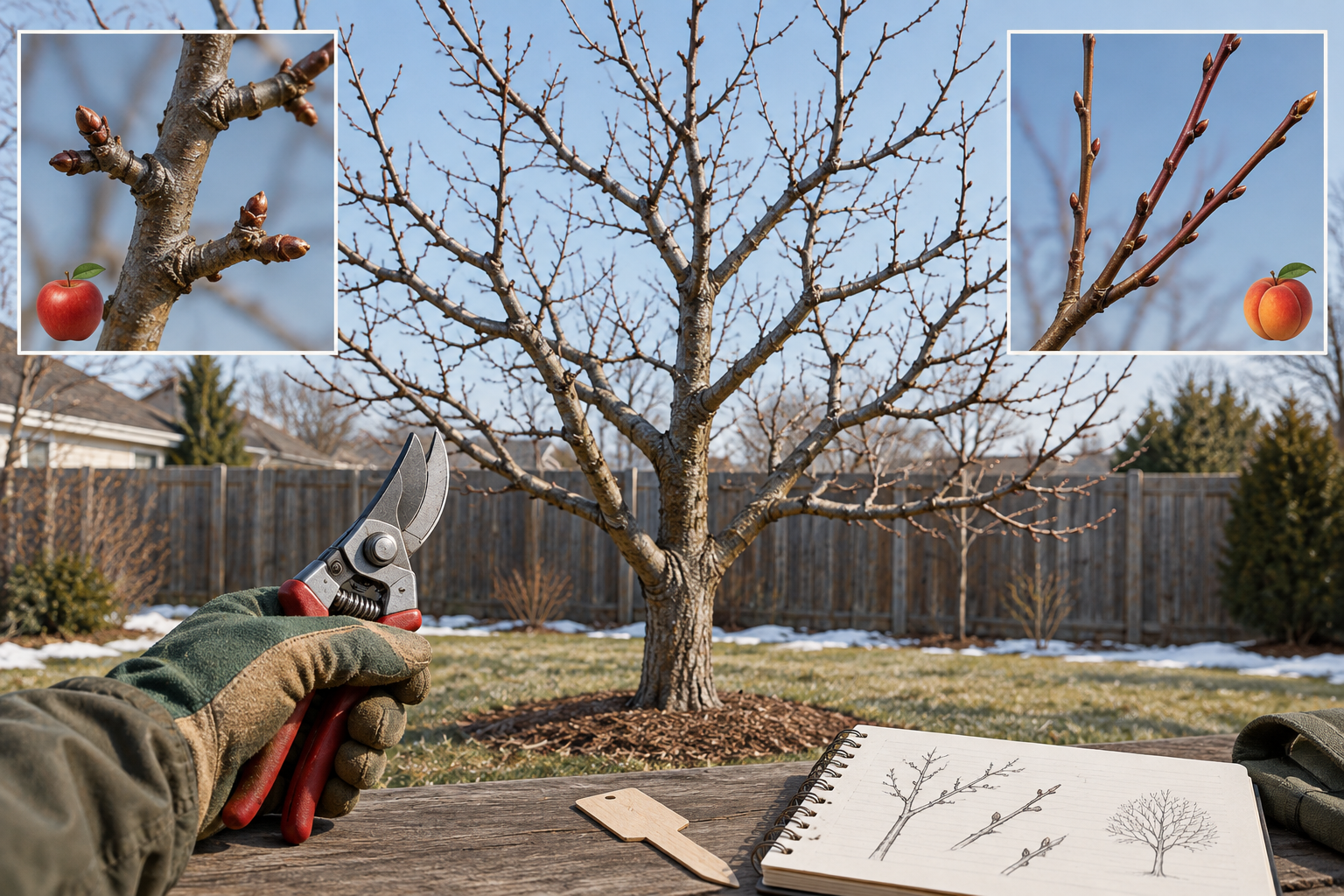
Apples usually produce fruit on spurs or shoots growing from older wood. Peaches, by contrast, bear on one-year-old shoots—the growth made during the previous growing season. That difference matters: a cut that removes a peach’s recent shoots may remove wood that could otherwise bear fruit, while apple guidance needs to account for its spur-bearing structure.
These are broad species distinctions, not a way to identify every productive branch by sight. Tree age, growth, variety, and past pruning can affect what is present. Oregon State University Extension’s home-orchard guide distinguishes these apple and peach patterns and also treats sweet cherries as a species with particular pruning considerations. Do not apply the apple or peach example to a cherry without checking cherry-specific guidance.
- Apple: commonly bears on spurs or shoots from older wood.
- Peach: bears on one-year-old shoots.
- Sweet cherry: check species-specific guidance rather than borrowing an apple or peach approach.
| Tree type | Fruiting-wood clue | What to check before cutting |
|---|---|---|
| Apple | Usually bears on spurs or shoots from older wood. | Local apple guidance on timing and which branches to remove. |
| Peach | Bears on one-year-old shoots. | How to recognize and retain suitable new fruiting shoots under local guidance. |
| Sweet cherry | Pruning considerations are species-specific. | A cherry-specific recommendation for your region and tree condition. |
Check timing for your species and region
Use a local recommendation that accounts for the species and conditions, not a general rule about winter.
Winter does not begin, end, or affect trees in the same way everywhere in the United States. Climate, current weather, species, cultivar, and the tree’s condition can all matter. That is why a recommendation for an apple tree in one state should not be treated as a schedule for a peach or cherry somewhere else.
Apple pruning shows how specific the advice can be. University of Minnesota Extension recommends pruning apple trees in late winter or early spring, after the coldest weather has passed and before growth begins. That is guidance for apples in the context covered by the university—not a nationwide date range for every fruit tree.
Before you act, search for current guidance from a university extension service serving your area and make sure it addresses your tree species. Check for advice about the relevant season and conditions, then compare it with what you see on your tree. If a cold spell, active growth, or uncertainty about the tree’s health makes the recommendation hard to apply, wait and ask for local guidance rather than trying to force the calendar.
Decide whether to make a small cut or pause
The scale and purpose of the job matter as much as the season.
A limited, clearly understood task is different from reshaping a mature tree. Before pruning, name the specific problem you intend to address and check whether local guidance supports doing so now. If your goal is simply to make the tree look neater, consider whether the cut can wait until you have identified the tree and reviewed its pruning recommendations.
Be particularly cautious with a young tree. University of Minnesota Extension warns against heavy pruning, especially on young apple trees. More generally, a large renovation should not be treated as a quick winter cleanup. Oregon State University Extension advises spreading renovation of old, neglected fruit trees over several years rather than trying to reshape them all at once.
These cautions do not mean every tree should be left untouched. They mean the amount of pruning should fit the tree and the plan. If several large branches need attention, the tree has extensive damage, or you are unsure which cuts are appropriate, seek guidance before starting.
- Proceed only when you can identify the tree and explain the purpose of each planned cut.
- Avoid turning a quick cleanup into heavy reshaping, particularly on a young tree.
- For a neglected tree, consider a staged renovation plan rather than removing a large amount at once.
- Pause if the work involves extensive damage, uncertain disease, or branches you cannot reach safely from the ground.
Use this pre-pruning checklist
A short review can prevent a convenient date or an attractive shape from driving the decision.
Before picking up pruning tools, walk through these checks. They are intended to help you decide whether to proceed, not to replace a species-specific pruning guide.
- Identify the tree as confidently as you can, using labels, records, photos, and a local reference.
- Confirm the fruiting-wood pattern for that species. Ask whether the branches you are considering might carry next season’s fruit.
- Find local extension advice for the same species and check its recommended timing and scope.
- Write down the specific purpose of each cut. If you cannot explain why a branch needs to be removed, pause.
- Assess the tree’s age and condition. Treat young trees, extensive damage, and long-neglected trees with extra caution.
- Consider access before beginning. If the work requires a ladder, involves large branches, or feels unsafe, do not improvise; get qualified help.
Know when to get local help
Uncertainty is a good reason to pause before making a major or hard-to-reverse cut.
Ask a local extension service or qualified arborist if you cannot identify the tree, cannot find guidance that fits your region, or are unsure whether a particular branch is productive. An arborist is especially useful when the tree is large, badly damaged, or requires work beyond safe reach. For concerns that may involve disease, seek advice from a local source familiar with fruit trees in your area.
If the tree is neglected, avoid trying to restore its shape in one session. The Oregon State University Extension guide recommends spreading renovation over several years. A measured plan gives you a chance to make decisions based on the tree’s response and to avoid treating every old or awkward branch as an immediate problem.
Your next step is simple: identify the tree, consult a local species-specific resource, and decide whether the work can wait. If the evidence is incomplete, waiting on major pruning is more useful than making a confident cut based on a general winter rule.
Frequently asked questions
Can I prune my fruit tree in winter?
Possibly, but winter is not a universal pruning window. The right timing depends on the species, your local climate and conditions, and the tree’s state. Check local, species-specific extension guidance before pruning.
Will winter pruning remove next season’s fruit?
It can remove productive wood if you cut branches that would otherwise bear fruit. Apples usually fruit on spurs or shoots from older wood, while peaches bear on one-year-old shoots. Identify the tree and learn its fruiting pattern before deciding which branches to cut.
When should I prune an apple tree?
University of Minnesota Extension recommends late winter or early spring for apple trees, after the coldest weather has passed and before growth begins. That recommendation is not a nationwide schedule for all fruit trees; check guidance for your location.
What if I do not know what kind of fruit tree I have?
Look for planting records, labels, and photographs of the leaves, blossoms, or fruit, then compare them with a local extension resource. If you remain uncertain, pause before making major cuts and ask a local extension service or qualified arborist.
Can I reshape an old, neglected fruit tree all at once?
That is generally not a good default plan. Oregon State University Extension advises spreading renovation of old, neglected fruit trees over several years. Get species- and condition-specific guidance before beginning a major renovation.
Sources & further reading
Explore the original sources behind this article. Our editorial perspective is separate from the organizations we reference.
- [S1] Pruning and training apple trees | UMN Extensionextension.umn.edu
- [S2] Training and pruning your home orchard | OSU Extension Serviceextension.oregonstate.edu