How to Care for a Potted Amaryllis, From Planting to After the Blooms Fade
Pot an ordinary amaryllis bulb with its upper third above the mix, water carefully as it grows, and keep its green leaves after flowering. Here’s how to care for it without expecting a set bloom date or guaranteed rebloom.
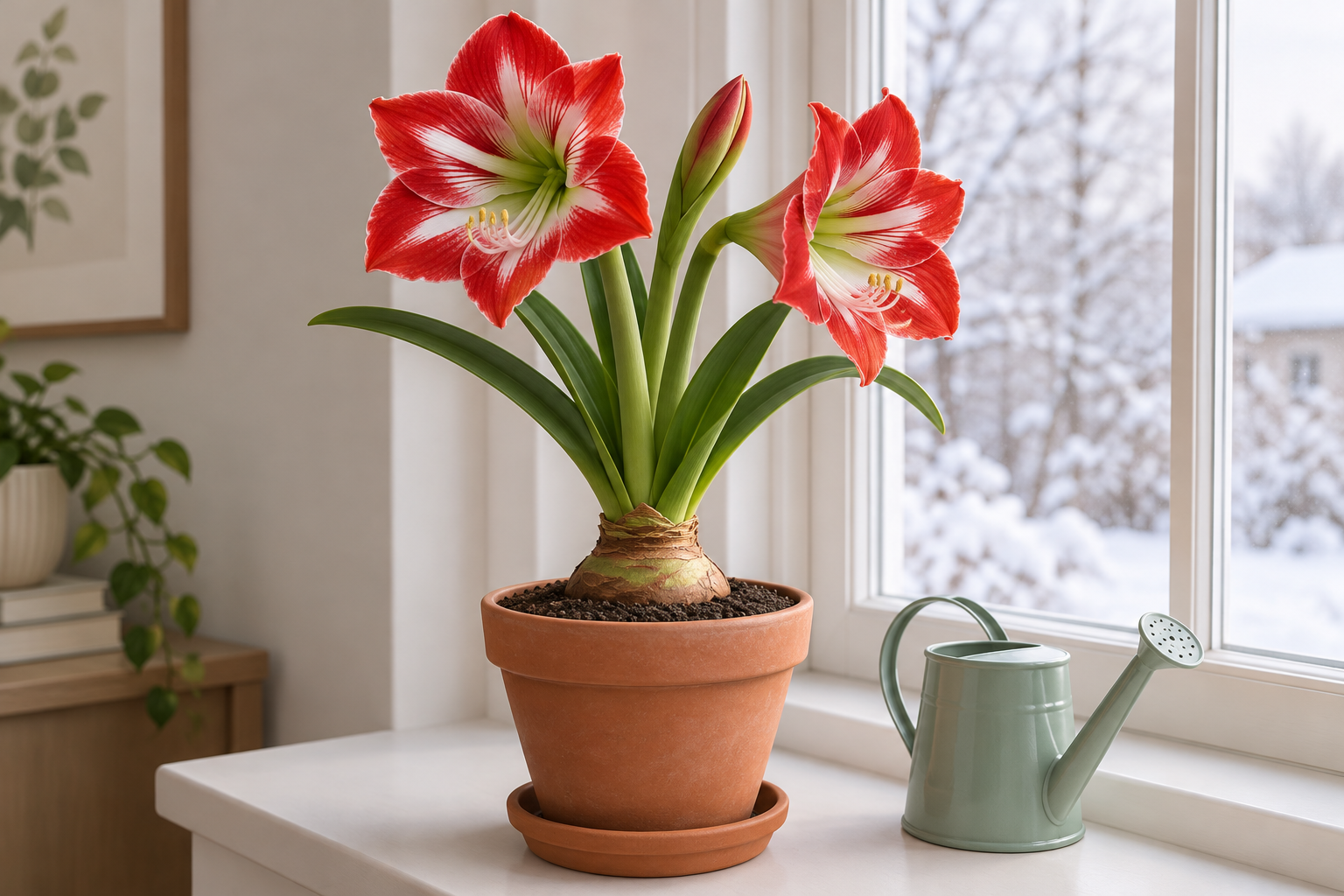
Pot the bulb with its upper third exposed
An ordinary potted amaryllis needs a stable container that lets extra water escape.
Start with a firm bulb without obvious damage. If you have a kit, check its instructions and inspect the pot: it should have drainage holes. If the planted pot sits inside a decorative cachepot, take it out to water and let it drain before returning it. Do not leave the pot standing in collected water.
Set the bulb in the potting mix with roughly its upper third above the surface. Burying it completely is not the recommended planting depth. These basic checks—firm bulb, drainage and exposed upper third—come from University of Minnesota Extension guidance.
This article covers an ordinary bulb planted in potting mix. Waxed bulbs and some decorative products may be designed for different handling, so follow their specific care directions rather than applying ordinary potting and watering advice automatically.
- Look for a firm bulb without obvious damage.
- Use a pot with drainage holes.
- Leave about the upper third of the bulb above the potting mix.
Water carefully and give it a bright place
Adjust care as the plant grows instead of following a rigid watering calendar.
Water sparingly at first. As shoots and leaves develop, increase watering, but avoid keeping the mix persistently wet. Check the soil and pot drainage before adding more water; slow growth alone is not a reason to keep pouring water into the pot. Empty the saucer or outer pot if water collects there.
Put the growing plant in a bright indoor location. A window with good natural light is a practical choice. If the stalk leans toward the window, turn the pot a little every few days so the plant receives light from different directions. A stake can help support a top-heavy stalk; attach it loosely so it does not pinch the stem.
University of Minnesota Extension advises watering cautiously at first and increasing as growth develops, while avoiding overly wet mix. Its amaryllis guidance also covers light and positioning. Conditions vary from home to home, so check the plant and soil rather than assuming one watering interval fits every room.
- Water lightly at first and more as growth develops.
- Make sure excess water drains away.
- Choose a bright spot; turn a leaning pot periodically if useful.
While the amaryllis is growing and blooming
Expect some variation in timing, and treat the plant’s appearance—not a holiday deadline—as your guide.
A forced bulb may flower in about six to eight weeks, but that is an estimate, not a scheduled delivery date. University of Wisconsin–Madison Extension gives this general range for forcing bulbs. The actual timing can vary with the bulb and growing conditions.
If flowers do not appear within that window, do not assume the bulb has failed just because a date has passed. Keep the plant in a bright spot, water according to its growth, and avoid leaving the mix soggy. A bulb kit or specialty product may also have instructions that differ from those for a standard potted bulb.
Once flowers open, you can move the pot if you want to improve how it fits your space or display. If the stalk is heavy, support it gently rather than trying to force it upright.
- Use six to eight weeks as a broad estimate, not a guarantee.
- Keep checking soil moisture and drainage as the plant grows.
- Support a leaning or heavy stalk gently if needed.
After the flowers fade, keep the green leaves
The end of flowering is not the end of the plant’s active growth.
Remove the faded flowers. Keep healthy green leaves in place so the plant can continue growing and storing energy. Cutting the foliage simply because the blooms are gone removes growth the bulb can use during its next cycle.
Continue to care for the plant while the leaves are green: give it a bright location, water as needed, and keep the potting mix from staying persistently wet. The foliage may remain after the flowers fade; that alone does not mean something is wrong. University of Minnesota Extension recommends removing spent flowers while retaining green foliage after blooming.
If your goal is to keep the bulb, leave the leaves until they naturally yellow or dry. Avoid cutting healthy foliage to make the plant look dormant. If you do not want to keep it, you can discard it after flowering instead; keeping it is an option, not an obligation.
- Remove spent blooms, not healthy green leaves.
- Keep the plant in a bright place while foliage remains green.
- Continue careful watering without leaving the mix wet.
Decide whether to keep it growing or manage a rest period
You can keep an amaryllis for another cycle without assuming that dormancy is mandatory.
University of Minnesota Extension says an amaryllis does not need a dormant period in order to bloom again. Other extension guidance describes a rest period as one approach to reblooming. The recommendations differ, so it is more accurate to treat dormancy as an option—particularly for managing timing—rather than a universal rule.
If you are a beginner and do not need to aim for a particular season, the straightforward choice is to keep the plant growing and retain its green leaves. If you want to try a rest-period method, use the complete instructions from the extension guidance you select. Minnesota Extension describes an eight-to-twelve-week rest period for timing purposes, but that interval does not guarantee a later bloom or a particular date.
Do not treat the rest period as a cue to cut healthy leaves without checking the method’s instructions. The approaches can differ, and this guide does not prescribe one universal dormancy routine.
| Your preference | General approach | What to keep in mind |
|---|---|---|
| Keep the plant growing | Remove spent flowers, retain green leaves, and continue careful care. | Minnesota Extension says dormancy is not required for another bloom; rebloom is still not guaranteed. |
| Try to manage the timing | Follow a complete extension-guided rest-period method; Minnesota Extension describes an eight-to-twelve-week period for timing purposes. | Extension recommendations differ. A rest period does not promise a specific flowering date or guarantee flowers. |
A quick check when something seems off
Use the bulb, foliage and soil as clues before changing your routine.
If the potting mix stays wet, check whether the drainage holes are clear and empty any standing water. Repeatedly adding water to a slow-growing bulb can leave the mix persistently wet, which is the condition this care routine aims to avoid.
If the stalk leans, turn the pot toward the light or use a loose support. If the flowers are late, remember that the six-to-eight-week estimate is not a deadline. And if the blooms have faded but the leaves remain green, keep the foliage rather than treating it as a problem.
For a kit, waxed bulb or other decorative version, compare what you see with the maker’s care instructions. A product-specific setup may not follow the same routine as a bulb planted in potting mix.
- Wet mix: check drainage and remove standing water.
- Leaning stalk: rotate the pot or add gentle support.
- Green leaves after flowering: keep them while the plant continues growing.
- Specialty or waxed bulb: follow the product’s instructions.
Frequently asked questions
How long does it take an amaryllis to flower?
About six to eight weeks is a general estimate cited by University of Wisconsin–Madison Extension for forcing bulbs. It is not a deadline; timing can vary with the bulb and its growing conditions.
Should I cut the leaves off after my amaryllis flowers?
Keep healthy green leaves after the blooms fade. Remove the spent flowers, but leave the foliage so the plant can continue growing and storing energy.
Does an amaryllis need to go dormant to bloom again?
Not necessarily. University of Minnesota Extension says dormancy is not required for another bloom, while other extension guidance describes a rest period as one approach. A rest period may be used to manage timing, but it does not guarantee rebloom.
Can I water a waxed amaryllis bulb like a potted bulb?
Do not assume so. This guide covers ordinary bulbs planted in potting mix. Waxed bulbs and decorative products may have different care requirements, so follow the instructions supplied with the product.
Sources & further reading
Explore the original sources behind this article. Our editorial perspective is separate from the organizations we reference.
- [S1] Growing and caring for amaryllis | UMN Extensionextension.umn.edu
- [S2] Forcing Bulbs – Wisconsin Horticulturehort.extension.wisc.edu
- [S3] Amaryllis Care | University of Maryland Extensionextension.umd.edu