Different Baking Pan? How to Check the Swap Before You Bake
A different pan may work, but compare its inside dimensions, depth, shape, and material before baking. Then use the recipe’s doneness cues and start checking at a sensible time rather than guessing a new bake time.
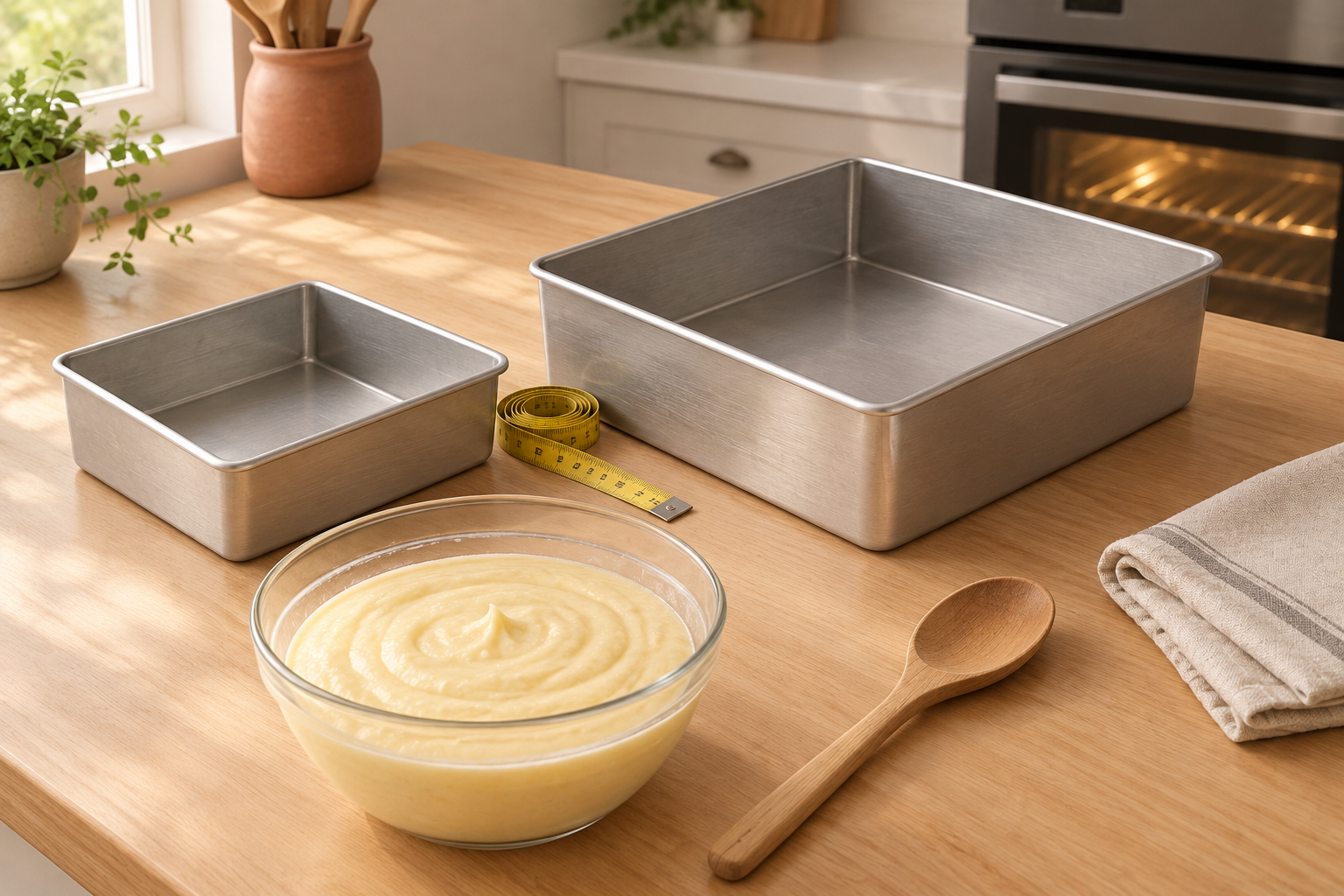
Can you use a different baking pan?
The swap may be reasonable, but the recipe and the pan’s full dimensions—not just its label—should guide the decision.
Often, yes: you can use another pan if its shape, dimensions, depth, and capacity suit the recipe. Before improvising, check whether the recipe itself lists an alternative. A tested option is a safer starting point than a general conversion chart.
If the recipe gives no substitute, compare the pan you have with the one it specifies. A change can make the batter shallower or deeper, raise the risk of overflow, alter browning, and affect how long the bake takes. There is no single revised time that works for every recipe and pan combination.
This guide focuses on cakes, bars, and quick breads. Be more cautious with recipes that depend on a particular pan for their rise or structure, and return to the recipe’s instructions when the result matters.
Measure the pan you have
Start with the inside of the pan, then look beyond its width and length.
Measure across the inside edges, not from the outside rim. For a square or rectangular pan, record the inside length and width. For a round pan, measure the inside diameter. Also note the usable depth and the pan’s shape: a round pan and a square pan with similar surface areas do not have identical edges or corners.
Do not rely on a pan’s printed size or a familiar name alone. Actual dimensions can vary, and two pans with similar openings may have very different heights. If you are unsure of capacity, check the manufacturer’s information or compare how much water each pan holds, without assuming that an area calculation gives the answer.
Material and construction matter too. A different metal, coating, or other pan construction can affect how a bake cooks. Penn State Extension notes that sheet-pan material and coating can influence cooking time and flavor, so treat a material change as another reason to pay attention to the recipe’s cues.
- Recipe pan: inside length or diameter, inside width if applicable, depth, shape, and material.
- Available pan: the same details, measured or checked against reliable product information.
- Recipe instructions: any listed alternative, fill guidance, visual cues, or warnings about changing pans.
Use area as a first check—not a capacity conversion
A basic calculation can reveal a large size difference, but it cannot tell you exactly how the batter will behave.
For a square or rectangular pan, multiply inside length by inside width to estimate its base area. Compare the available pan’s area with the recipe pan’s. This is useful for spotting a substantial change, but it is only a rough comparison: it does not include pan depth, shape, or the amount of batter the pan can hold.
For example, an 8-by-8-inch pan has a base area of 64 square inches. A 9-by-9-inch pan has an area of 81 square inches, about 27 percent more. That tells you the 9-inch pan has a wider base; it does not prove that the recipe will bake identically or tell you an exact new baking time.
King Arthur Baking uses area comparison as a starting point when resizing recipes, while emphasizing that bake time and doneness still need attention. Treat the math as a screening tool, not a promise of equal results.
| What you compare | What it helps you notice | What it does not establish |
|---|---|---|
| Inside length and width | Whether the base area is substantially different | The pan’s total capacity or exact batter depth |
| Pan depth and capacity | Whether the batter may sit higher or lower | A guaranteed baking time or texture |
| Shape and material | Whether the pan differs in form or construction | That the recipe will behave just as it did in the specified pan |
Check the batter depth and room to rise
How full the pan looks before baking is a practical warning sign, but follow the recipe’s own guidance rather than a universal fill rule.
A smaller or shallower pan can leave less room for batter to expand. If the mixture appears close to the rim, or clearly deeper than the recipe’s expected fill, overflow becomes a concern. Do not assume that a pan with a similar opening has enough capacity; its depth matters.
A wider pan can spread the same batch into a thinner layer. That may change how quickly the center sets and how much surface browns. A deeper layer may take longer to cook through. These are tendencies, not exact predictions: batter, pan material, oven behavior, and recipe method all play a part.
Use any fill guidance included with the recipe or pan. If there is no guidance and the batter seems too high, do not try to solve the problem by guessing at a temperature or time. Choose a more suitable pan, or use a second pan only if the recipe and baking setup make that practical.
Adjust your checks, not the finish time by guesswork
Keep the recipe’s temperature and cues as your reference, then pay closer attention as the bake approaches doneness.
A pan change does not come with a reliable universal time adjustment. A larger pan that makes the batter shallower may finish sooner; a smaller pan that makes it deeper may take longer. King Arthur Baking describes this relationship but also points to checking for doneness rather than relying only on the clock.
Use the recipe’s visual or other doneness cues, such as the appearance of the surface or the recommended test for that bake. If the batter is noticeably shallower than intended, begin checking earlier than the recipe’s stated end time. If it is deeper, be prepared for it to need longer—but do not assume that it will.
Avoid changing several variables at once. Unless the recipe directs otherwise, keep its oven temperature as your baseline so you can judge the pan change without also introducing a temperature change. Use the recipe’s stated time as a reference point, not a guarantee.
- Before baking: compare the expected batter depth with the pan you are using.
- During baking: note the recipe’s cues and look for them as the bake progresses.
- Near the stated finish time: check doneness rather than removing the pan automatically.
- If the center is not ready: continue in short intervals and check again, taking care not to overbake the edges.
Know when not to swap casually
Some cakes are particularly dependent on their recipe’s pan and method, so an approximate size match may not be enough.
Tall-rising cakes such as chiffon and angel food are poor candidates for casual pan changes, according to King Arthur Baking. Their structure and rise depend on more than matching a pan’s base area, so use the specified pan or an alternative explicitly tested for that recipe.
Also pause if a swap changes more than one major feature at once—for example, moving from a shallow square pan to a deep round one, or changing both shape and material. With cakes, bars, and quick breads, such a change may affect depth, edges, and timing in different ways.
If you need a dependable result for a gathering or special occasion, it may be better to choose a recipe written for the pan you have. That avoids trying to compensate for several unknowns at once.
A practical pre-bake checklist
Use this short sequence to decide whether to proceed and what to monitor.
Before mixing or pouring, work through the following checks. They will not guarantee an identical result, but they can help you catch the most important mismatch before the pan goes into the oven.
- Look for an alternative pan listed in the recipe and use it if available.
- Measure the available pan inside and compare its dimensions, depth, shape, and material with the specified pan.
- For straightforward square or rectangular pans, compare base areas as a rough check; do not treat the result as a capacity conversion.
- Consider how the batter will sit and whether the pan leaves appropriate room, using recipe-specific guidance rather than a universal fill rule.
- If the pan is a poor match or the cake is delicate and tall-rising, choose a tested pan or a different recipe.
- If you proceed, use the recipe’s temperature and doneness cues. Start checking earlier when the batter is shallower, and continue checking as needed if it is deeper.
Frequently asked questions
Can I use a 9-by-9-inch pan instead of an 8-by-8-inch pan?
Possibly, but the 9-by-9-inch pan has about 27 percent more base area. The same batter may sit shallower, and the bake could finish sooner. Check the recipe’s guidance, consider pan depth and material, and use its doneness cues rather than relying on a fixed time adjustment.
Does a similar pan area mean the pans have the same capacity?
No. Area compares the base, not the pan’s depth or full volume. Shape also matters. Compare inside dimensions and depth, and check the pan’s capacity separately if you need to know how much batter it can hold.
Should I change the oven temperature when I use a different pan?
Do not change it just to compensate for a pan swap unless the recipe directs you to. Keep the recipe’s temperature as your baseline and monitor doneness, since pan size and material can affect the bake.
Should I start checking earlier with a larger pan?
If the larger pan makes the batter noticeably shallower, an earlier check is sensible because a thinner layer may bake sooner. There is no dependable universal number of minutes to subtract, so use the recipe’s cues and check progressively.
Can I change the pan for angel food or chiffon cake?
Do not make that swap casually. These tall-rising cakes are poor candidates for changing pans. Use the specified pan or an alternative tested for the particular recipe.
Sources & further reading
Explore the original sources behind this article. Our editorial perspective is separate from the organizations we reference.
- [S1] Why the size of your baking pan matters so much | King Arthur Bakingkingarthurbaking.com
- [S2] How to reduce a recipe | King Arthur Bakingkingarthurbaking.com
- [S3] The Sheet Pan: A Multiuse Kitchen Toolextension.psu.edu