Drafty Room? Three Simple Checks to Find Air Leaks Before You Buy Weatherstripping
A draft is a clue, not a diagnosis. Inspect door and window edges, try a paper test, and check other likely leak areas before choosing a repair or asking for help.
Find air leaks by treating a draft as a clue
A few checks can help you decide what to do next without assuming the nearest window is the source.
To find likely air leaks before buying weatherstripping, start with a visual check of closed doors and windows, then try the paper test at several points along their seals. Compare the results, note the locations, and consider other safe, accessible areas if the draft remains unexplained. A draft alone cannot tell you where air is entering or whether a particular opening is the home’s main source of leakage.
The practical benefit is a clearer decision: you may identify a loose seal at a movable door or window, discover that you need to ask your landlord about a repair, or realize that the source is not obvious enough for a do-it-yourself fix. ENERGY STAR recommends visual checks and describes a paper test for windows and doors as a way to flag a possibly loose seal.
- Check and record one opening at a time.
- Separate what you observed from what you suspect.
- Keep the first inspection to places you can see and reach safely.
Inspect door and window edges for visible clues
Look for a physical sign of a problem before deciding what material to buy.
Close each door or window as you normally would. Slowly inspect where the moving part meets its frame. Look for a visible gap, cracked or flattened weatherstripping, a loose section, or a door or window that does not sit evenly. On an exterior door, check the bottom edge as well as the sides and top.
Check several openings rather than stopping at the first suspicious spot. Record a specific observation, such as “bedroom window, lower latch side: seal looks compressed.” That is more useful than a general note that the room feels cold. A worn-looking seal is a reason to investigate, not proof that it is the only source of a draft.
Do not force a stuck door or window, remove components, or cover hardware during this check. If you see water damage, a broken part, or a gap you cannot inspect safely, note it and contact the person responsible for repairs.
- Inspect the frame and the edge of the moving part while the opening is closed.
- Note visible damage, an uneven fit, or a gap and its exact location.
- Do not alter the opening just to make the inspection easier.
Try the paper test on closed openings
The test compares how firmly a seal holds paper; it is a first-pass clue, not a measurement.
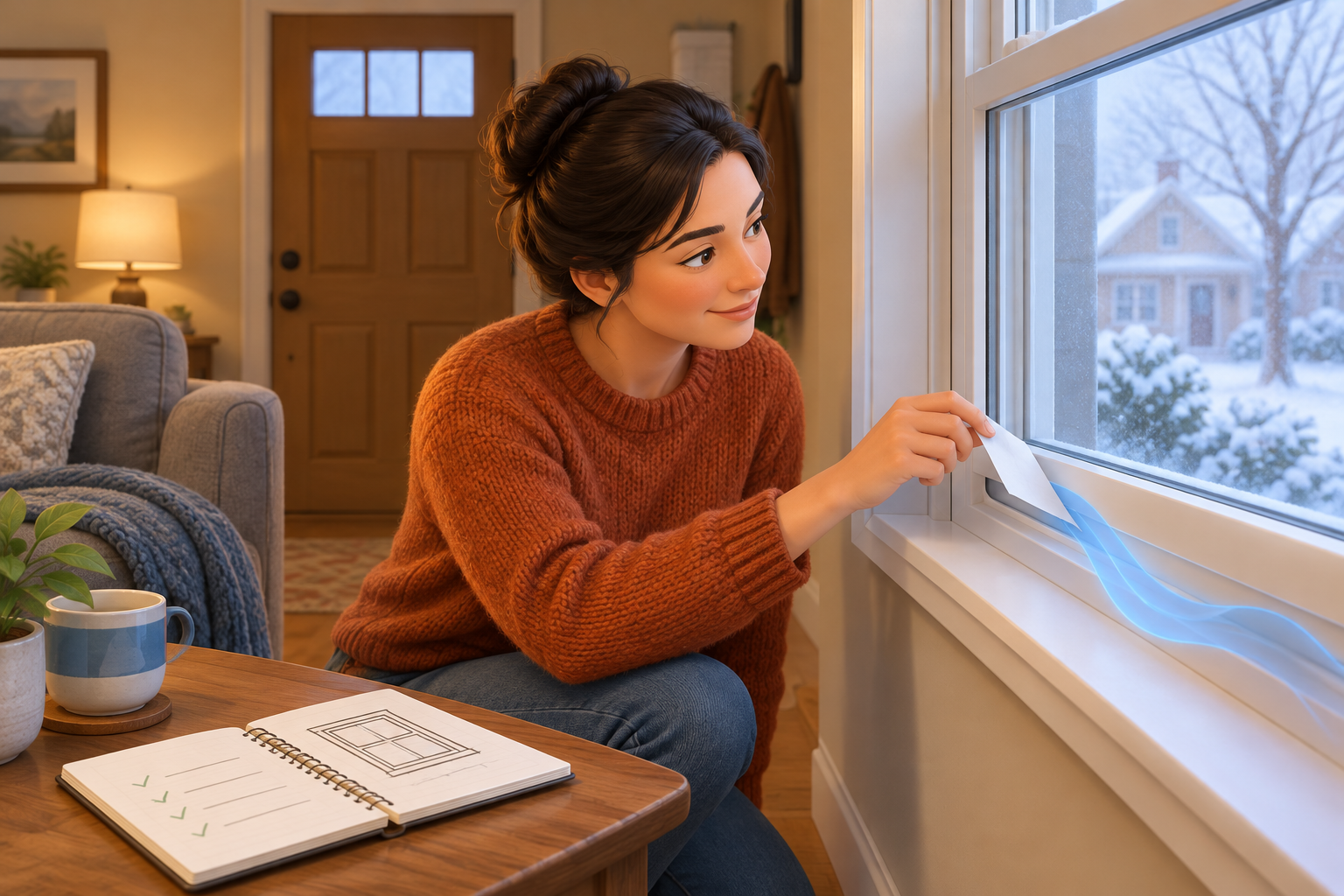
Place a sheet of ordinary paper across the seal, close the door or window on it, and gently try to pull it out. If it slides out easily, the seal may be loose at that point. Repeat at several locations around the same opening—for example, at a corner and near the latch—and then compare with another door or window. ENERGY STAR describes this check for closed windows and doors.
Write down where the paper slips out easily and where it holds. For instance, if paper grips along most of a window but pulls free at its lower corner, record that difference. Do not force an opening that is difficult to operate.
The result does not measure airflow or energy loss, and it cannot establish that the tested opening is the home’s biggest leak. Conditions during the test may also differ from the moment you felt a draft. Treat it as one observation to help guide your next step, not a product recommendation.
- Test multiple points around each opening.
- Record the precise spot where paper pulls out easily.
- Compare results across openings before drawing a conclusion.
Check beyond the draftiest window
A noticeable draft may not be the only leak, and its source may be outside the room’s obvious openings.
If doors and windows do not explain what you feel, broaden your notes to other places where air might enter. ENERGY STAR notes that significant leaks may be hidden in attics and basements. This is a reason to consider those areas—not a reason to climb into an unsafe space, move insulation, or investigate somewhere you cannot access safely.
Limit a basic check to visible, accessible areas. If the draft seems to come from a concealed space, or you cannot determine the source, describe where and when you notice it and consider asking a qualified home-energy professional for an assessment. A simple paper test is not designed to diagnose hidden leakage.
- Look only in areas you can access safely.
- Record persistent drafts even when no visible gap is apparent.
- Do not explore or alter hidden building systems as part of a basic check.
Choose a response that fits the finding
The location and type of joint matter more than the fact that a room feels drafty.
Weatherstripping is generally used where parts move against each other, such as an operable door or window. Other gaps or surfaces may call for a different air-sealing material. The Department of Energy distinguishes weatherstripping for movable joints from caulk and other materials used elsewhere, so identify the location and whether the joint moves before choosing a product.
If you own the home and find a visible, accessible issue on a movable joint, check the opening and product instructions to see whether weatherstripping is appropriate. Do not assume one product suits every gap, surface, or type of movement; anything installed should not interfere with normal operation.
If you rent, check your lease and ask the landlord or property manager before installing or removing material. The Department of Energy includes weatherstripping around movable windows and doors among options renters may consider, but your property’s approval and repair arrangements still matter.
Do not block or seal vents, flues, or other openings associated with combustion equipment. Air-sealing work involving combustion appliances, as well as harder-to-find leaks, can warrant assessment by a qualified professional. If you suspect a problem in one of these areas, stop at observation and seek appropriate help.
| Observation | What it may suggest | Next step |
|---|---|---|
| Paper pulls out easily at one point on a closed door or window | The seal may be loose at that location | Record the spot and check whether the joint moves before considering weatherstripping. |
| Visible damage or a gap you cannot inspect safely | A repair or further assessment may be needed | Note the location and contact the responsible person or a qualified professional. |
| Draft remains, but doors and windows show no clear issue | The source may be elsewhere or concealed | Check only safe, accessible areas; consider a professional assessment if the cause remains unclear. |
| Suspected leak near combustion equipment or an intentional vent | A safety-sensitive area | Do not block it; ask a qualified professional for guidance. |
Keep a short room-by-room record
A compact log makes comparisons easier and gives a landlord or professional a useful description of the issue.
Use a note on your phone or a sheet of paper, with a separate entry for each opening or location. Record what you saw and what happened in the paper test, then list a possible next step without presenting a guess as a confirmed diagnosis.
For example: “Living room, patio door, paper pulls out easily at lower corner; seal looks worn.” If the result is inconsistent or nothing looks unusual, record that too. An inconclusive check can be a reason to pause before buying supplies rather than trying repairs at random.
- Location: room and opening or area.
- Visual finding: gap, worn seal, damage, or no obvious clue.
- Paper test: where you tested and whether paper pulled out easily.
- Next step: compare another opening, ask the landlord, or request an assessment.
Frequently asked questions
Does the paper test prove that a window or door is leaking?
No. If paper pulls out easily when held by a closed opening, the seal may be loose at that point. The test is a clue, not a measurement or complete diagnosis; repeat it at several points and compare openings.
Should I use weatherstripping on every gap I find?
No. Weatherstripping is generally for movable joints, such as operable doors and windows. Other gaps may need a different repair, and vents or combustion-related openings should not be sealed casually.
Can renters install weatherstripping themselves?
Check your lease and ask your landlord or property manager before making changes. Share the location and what you observed, then ask about approval and who should arrange the repair.
What if I still feel a draft after checking my doors and windows?
Check only other safe, accessible areas; significant leaks may also be hidden in attics or basements. If the source remains unclear, is hidden, or is near combustion equipment, ask a qualified professional for an assessment.
Sources & further reading
Explore the original sources behind this article. Our editorial perspective is separate from the organizations we reference.
- [S1] Locating Air Leaks | ENERGY STARenergystar.gov
- [S2] What to Look For: DIY Checks and Inspections | ENERGY STARenergystar.gov
- [S3] Consumer Guide to Air Sealing the Homeenergy.gov
- [S4] Renters | Department of Energyenergy.gov