How to Choose a Fresh Christmas Tree and Keep It Safe at Home
Measure your space, check a real tree’s condition, and set it up in a stand that fits. Then make daily watering and safe placement part of your holiday routine.
Measure your space before shopping for a Christmas tree
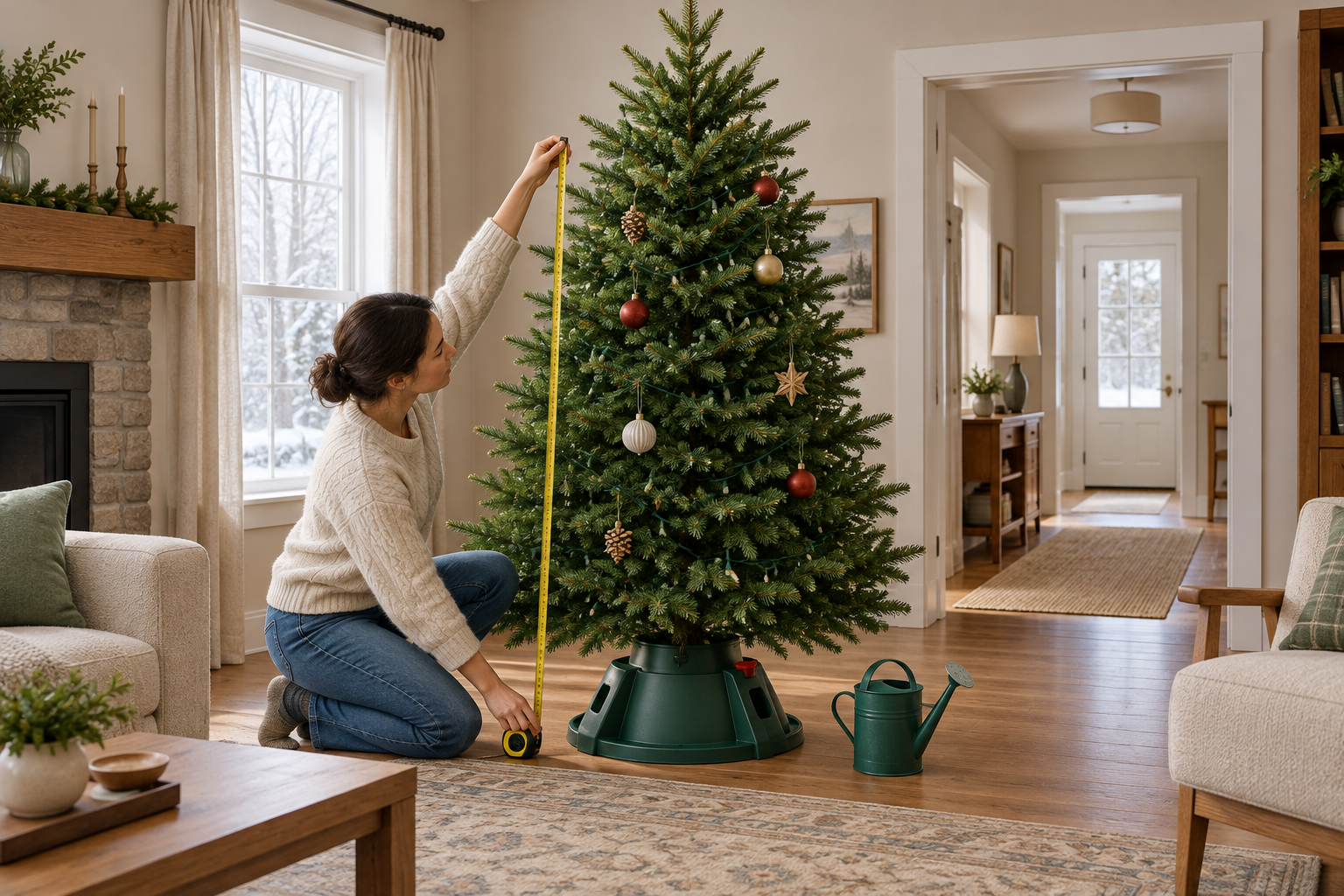
A few measurements help you choose a tree that fits the room, stand, and route into your home.
Measure the ceiling height where the tree will stand, leaving room for a topper if you plan to use one. Check the available floor space too: a tree can fit beneath the ceiling but still spread too far into a walkway or crowd nearby furniture.
Consider how you will get the tree from the entrance to its final spot. Measure narrow doorways or tight turns if they may be a problem. The National Christmas Tree Association recommends measuring the display space before shopping; its selection advice also suggests considering the tree’s width, not only its height.
Check the stand you plan to use. Its opening needs to fit the trunk, and the tree needs to be secured according to the stand’s instructions. Leave enough room to reach the water reservoir after the tree is in place.
- Write down the maximum height and width that work in the room.
- Check the stand’s trunk capacity and instructions.
- Make sure you can reach the stand to check and refill its water.
Check the tree’s freshness and condition
Visible checks can help you avoid a tree that already shows signs of dryness, but they cannot promise how long it will last indoors.
The National Christmas Tree Association recommends checking that a tree’s outer branches are pliable and avoiding trees with excessive needle loss or other signs of dryness. Use these as condition checks rather than a guarantee of how the tree will perform in your home.
Gently assess a few outer branches for flexibility. If they feel brittle, or the tree has widespread dryness or substantial needle loss, consider choosing another. Look over the tree from more than one side, including its shape and any visible areas that appear damaged or dry.
If the tree is netted, ask the seller whether you can inspect it before buying or what options are available if its condition is not what you expected. A tree’s appearance at the lot is useful information, but care and conditions at home also matter.
- Check the outer branches for pliability.
- Avoid trees with excessive needle loss or multiple signs of dryness.
- Inspect the shape and condition from more than one side.
Ask the seller useful questions
A brief conversation can clarify your setup and what to do with the tree after the holidays.
Ask when the trees arrived at the lot and whether the seller can suggest a variety for your local conditions or display space. Treat the answer as one part of your decision, alongside your own check of the tree’s condition and fit.
Ask whether the seller can make a fresh cut or advise you on preparing the trunk for the stand. If you need help transporting or securing the tree, ask what support is available and follow any relevant vehicle and tie-down instructions.
If you want to recycle the tree, ask where to check local arrangements. Collection and drop-off rules vary, so verify current instructions with your city, county, waste provider, or community program rather than assuming a service is available.
- When did these trees arrive at the lot?
- Which varieties might suit my space or local conditions?
- Can you make a fresh cut or advise me on preparing the trunk?
- Where can I check current local recycling instructions?
Set up the tree and handle the fresh cut carefully
Use a stand that fits securely, and keep in mind that the two cited organizations give different fresh-cut measurements.
Use a stand that fits the trunk and follow its instructions for securing the tree and filling the reservoir. The National Christmas Tree Association advises keeping the trunk base submerged and checking the water daily. Set the tree where you can reach the reservoir without having to move it.
The fresh-cut measurements in the sources consulted differ. The National Fire Protection Association recommends cutting two inches from the trunk base; the National Christmas Tree Association recommends about half an inch. These are separate recommendations, not a single agreed measurement. Ask the seller how to prepare your tree and take account of the guidance relevant to your setup.
If the seller makes the cut, ask when the tree should be placed in water and what to do if there will be a delay. Once the tree is in the stand, check that it is upright and secure, then confirm that the trunk base is covered with water.
| Source | Fresh-cut guidance | What to keep in mind |
|---|---|---|
| National Fire Protection Association | Cut two inches from the trunk base | Ask the seller how to apply this guidance to your tree. |
| National Christmas Tree Association | Cut about half an inch from the trunk base | This differs from NFPA’s recommendation. |
Place the tree away from heat and exit paths
Choose a location that stays clear of heat sources and leaves household routes to exits unobstructed.
NFPA advises keeping a Christmas tree at least three feet from heat sources. Consider fireplaces, radiators, heat vents, candles, and other nearby sources of heat when choosing a spot.
Keep the tree out of exit paths. Check that it does not block a doorway or narrow a route people may need to use. Think about how the space will work once gifts, visitors, and other seasonal decorations are there.
Recheck the placement if you rearrange furniture or add decorations. If the tree has to be moved, make sure it remains upright and secure in its stand afterward.
- Keep the tree at least three feet from heat sources.
- Keep doorways and exit routes clear.
- Recheck the space after moving furniture or decorations.
Make daily watering and light checks a routine
A simple recurring check makes it easier to notice whether the tree still has water and whether lights are switched off when needed.
Check the stand’s water level every day and make sure the trunk base remains submerged. Add water as needed, following the stand’s instructions. Both the National Christmas Tree Association and NFPA include daily watering in their care or safety guidance.
Attach the water check to an existing habit, such as a morning routine. Make sure the stand remains accessible after decorating; a reservoir that is difficult to reach is easier to overlook.
NFPA recommends turning off tree lights before leaving home or going to bed. Build that step into your departure and bedtime routines. Follow the light manufacturer’s instructions as well.
- Check the water level daily and keep the trunk base submerged.
- Turn tree lights off before leaving home and before bed.
- Pay attention to changes in the tree’s condition over time.
Remove a dry tree and check local disposal options
NFPA advises removing a Christmas tree when it is dry; local rules determine how to dispose of or recycle it.
Do not keep a dry tree indoors just to extend the decorating season. NFPA advises removing it when it is dry. That guidance does not depend on a particular calendar date: assess the tree’s condition and act accordingly.
Before setting the tree out, check current instructions from your local waste provider or community program. Find out whether the tree must be undecorated, where it can be dropped off, or whether collection is available. Arrangements vary by location.
Follow local directions for the tree and its stand, lights, and decorations. If you are unsure whether an item belongs in a recycling collection, check with the program rather than assuming.
Frequently asked questions
How can I tell whether a real Christmas tree is fresh?
Check that the outer branches are pliable and avoid trees with excessive needle loss or other signs of dryness. These checks help assess condition, but they do not guarantee how long the tree will remain fresh indoors.
How often should I water a real Christmas tree?
Check the stand’s water level daily and keep the trunk base submerged. Follow the stand’s instructions and make sure the reservoir is accessible.
How far should a Christmas tree be from a heat source?
NFPA advises keeping a Christmas tree at least three feet from heat sources. Keep it clear of fireplaces, radiators, heat vents, candles, and other nearby heat sources.
How much should I cut from the trunk before putting it in the stand?
The guidance cited here differs: NFPA recommends cutting two inches from the trunk base, while the National Christmas Tree Association recommends about half an inch. Ask your seller for guidance; neither measurement should be presented as a universally agreed figure.
When should I take down a real Christmas tree?
NFPA advises removing a tree when it is dry. Check your local waste provider or community program for current disposal or recycling instructions.
Sources & further reading
Explore the original sources behind this article. Our editorial perspective is separate from the organizations we reference.
- [S1] Selection Tips | National Christmas Tree Associationrealchristmastrees.org
- [S2] Care tips | National Christmas Tree Associationrealchristmastrees.org
- [S3] content.nfpa.org