How to Choose and Use a Home Blood Pressure Monitor: A Practical Checklist
Choose a validated upper-arm monitor with a cuff that fits, take readings under consistent conditions, and keep a log to discuss with your healthcare professional.
Start with your healthcare professional’s instructions
Agree on a practical plan before you begin collecting readings.
The best home blood pressure monitor is an automatic upper-arm model that has been validated for the intended user and comes with a correctly sized cuff. To get useful readings, prepare and position yourself consistently, take two measurements one minute apart, and record them for your healthcare professional to review.
Before starting, ask how often to measure, at what times, and how to share the results. The right schedule can depend on why you are monitoring and your individual care plan. If you have already been given instructions, follow those rather than adding extra checks or changing the schedule on your own.
Ask which arm to use if your care team has given you a preference. If you are buying a monitor for a child, someone who is pregnant, or a person whose arm size or shape makes cuff fit difficult, ask a healthcare professional which device is suitable. A log is useful information for a care discussion; it is not a diagnosis.
Choose a monitor that fits the person using it
Check the device, the evidence behind it, and the cuff as separate buying decisions.
The American Heart Association recommends an automatic, cuff-style upper-arm monitor. Check that the model has been validated for the intended user, and select a cuff that fits the circumference of the person’s upper arm. Use the measurement method and size range provided by the manufacturer; do not assume that one cuff size suits everyone.
ValidateBP’s device list is a practical place to look for models reviewed against its validation criteria. Check the live listing and the exact model number before buying, since models and listing details can change. A product shown on a shopping page is not necessarily validated, and a listing should not be treated as a guarantee that every reading will be accurate.
FDA authorization and inclusion on ValidateBP’s list are distinct checks, not interchangeable labels. The FDA also warns against relying on unauthorized devices or wearable software features that claim to measure or estimate blood pressure. If accurate readings are important to your care, ask a healthcare professional about a suitable device rather than relying on a watch or app-only estimate.
A quick device comparison
Use this comparison to narrow your options, then verify a specific model and cuff before purchasing.
| Device type | What to check | Practical guidance |
|---|---|---|
| Automatic upper-arm cuff monitor | Validation for the intended user and a cuff size that fits | The recommended starting point for most people choosing a home monitor. |
| Wrist or finger monitor | Whether a healthcare professional has recommended it for your situation | Do not assume it is an equivalent substitute for an upper-arm cuff monitor. |
| Watch, ring, or app-only estimate | Whether the device is authorized for measuring blood pressure and appropriate for your care | Do not rely on an unauthorized feature for blood pressure readings. |
Prepare before you measure
A short, repeatable routine helps make readings more comparable.
Avoid eating or drinking for 30 minutes before a measurement. Empty your bladder, then sit quietly for at least five minutes. If you have just been active or are rushing, take time to settle before starting rather than measuring immediately.
Choose a quiet place where you can sit comfortably and keep your arm supported. Follow the monitor’s instructions for applying the cuff and operating the device. If you are uncertain about how to use a particular model, ask your healthcare professional to demonstrate it or check your technique at an appointment.
Position your body and cuff consistently
Small changes in posture or cuff placement can make it harder to compare readings.
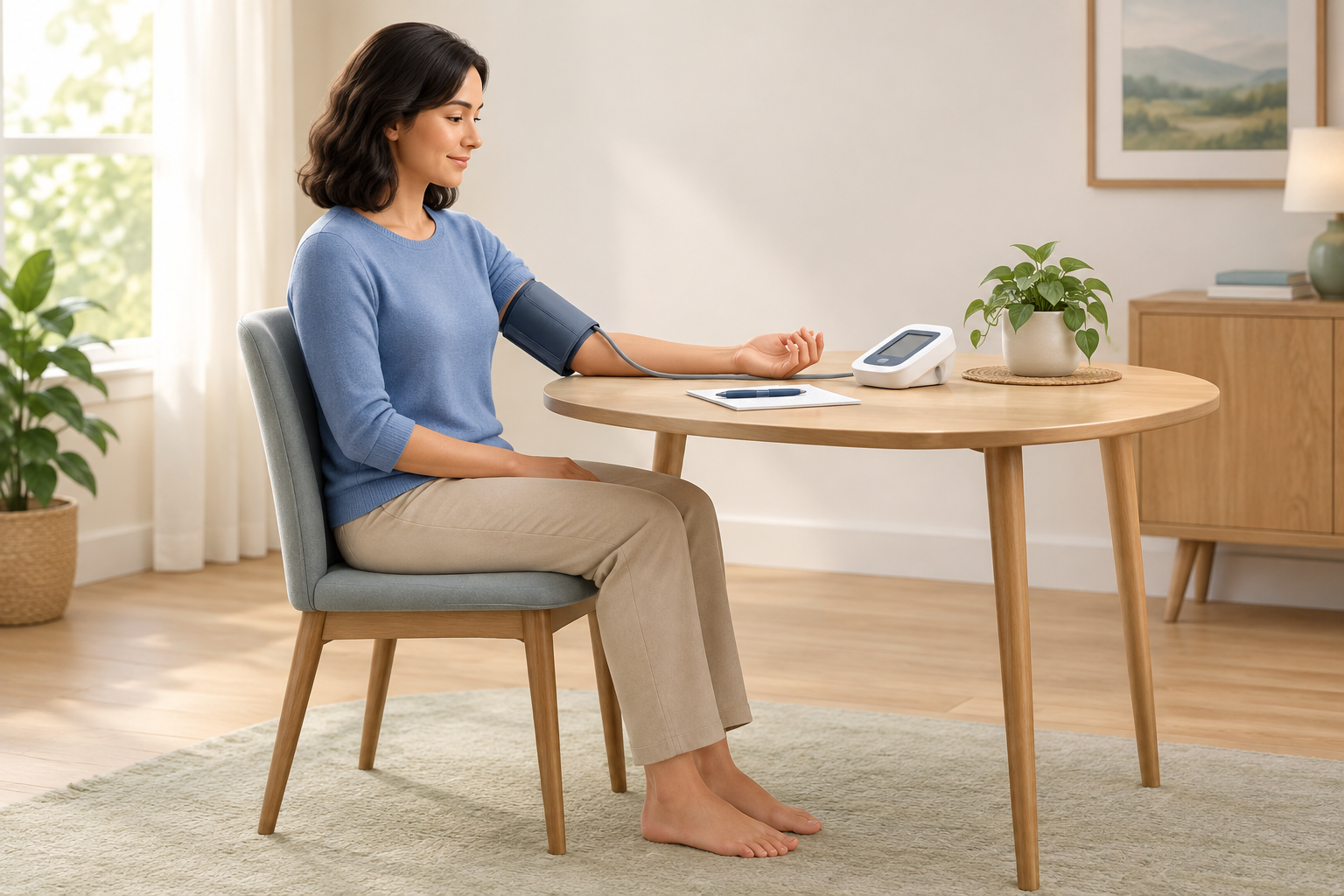
Place the cuff on a bare upper arm, following the device instructions for its position and fit. Do not put it over clothing. Sit with your back supported and both feet flat on the floor. Rest your arm on a table or another support so the cuff is at chest height; do not hold your arm up unsupported.
Keep still and do not talk during the measurement. Use the same arm and a similar setup each time unless your clinician tells you otherwise. If the cuff slides, feels too tight or loose, or does not match the arm-size range specified for it, pause and resolve the fit rather than treating the result as dependable.
Take two readings and keep a useful log
Record the measurements as they appear instead of relying on memory or a single result.
After your first reading, wait one minute and take a second. Write down both results and the date and time. If your device stores readings, check that you know how to find them and whether the stored record includes the details your healthcare professional requested.
For example, a simple entry might read: “Tuesday, 8:00 a.m. — first reading: [displayed result]; second reading: [displayed result].” Add brief context only if it is relevant to your care plan, such as a missed scheduled measurement. Do not discard a reading just because it differs from what you expected.
Use the measurement schedule recommended by your healthcare professional. More readings are not automatically more useful, and repeatedly checking because a number worries you can make the log harder to interpret. Ask your clinician what to do if you miss a scheduled session or the monitor displays an error.
- Prepare: avoid food and drink for 30 minutes, empty your bladder, and sit quietly for at least five minutes.
- Position: apply the cuff to a bare upper arm, sit with your back supported and feet flat, and support the cuffed arm at chest height.
- Measure: stay quiet and still while the monitor runs.
- Repeat: wait one minute, then take a second reading.
- Record: save both readings with the date and time, using the schedule your healthcare professional gave you.
Bring the monitor and log to an appointment
A care-team check can identify device or technique issues that a written log cannot show.
Bring your monitor and the readings you have recorded to a medical appointment. Your healthcare professional can review how you apply the cuff, check whether the device suits your needs, and compare its readings with measurements taken in the clinic. Take the monitor’s instructions with you if you have questions about setup or stored readings.
If results seem inconsistent, first check the basics: cuff size and placement, a bare arm, quiet rest, posture, and whether you took the readings one minute apart. Note what happened rather than repeatedly measuring to try to produce a preferred number. Your clinician can help decide whether the device, technique, or schedule needs attention.
Understand what a reading can—and cannot—tell you
Use home measurements as information to discuss, not as a basis for self-directed treatment changes.
A single high reading is not, by itself, a diagnosis. Blood pressure readings need to be interpreted in context, and your healthcare professional can explain what your results mean for you. Do not start, stop, or change medication based on this guide or on one home measurement; ask your clinician how to respond to your readings.
If a reading seems unexpectedly high, make sure you are seated and positioned properly and repeat it according to the urgent guidance below where applicable. Keep the result in your log. Avoid delaying a recommended appointment or care conversation because later readings look different.
When a very high reading needs urgent attention
Use the American Heart Association’s specific repeat-reading and symptom guidance.
If your reading is above 180/120 mm Hg, wait at least one minute and measure again. If the repeat reading remains above that level, contact a healthcare professional immediately.
If a reading above 180/120 mm Hg occurs with symptoms such as chest pain, shortness of breath, weakness, or difficulty speaking, call 911. Do not wait to see whether another routine reading changes the result.
Frequently asked questions
What kind of home blood pressure monitor should I buy?
For most people, the recommended starting point is an automatic upper-arm cuff monitor validated for the intended user, with a cuff that fits. Check the current ValidateBP list and ask a healthcare professional if you are unsure which device is appropriate.
How many readings should I take each time?
The American Heart Association advises taking two readings one minute apart and recording them. Follow your healthcare professional’s instructions about how often and when to measure.
Can I use a smartwatch to check my blood pressure?
Do not rely on an unauthorized wearable feature or software estimate to measure blood pressure. The FDA advises people whose care depends on accurate readings to ask a healthcare professional about an appropriate authorized device.
What should I do if my reading is above 180/120 mm Hg?
Wait at least one minute and measure again. If the reading remains above 180/120 mm Hg, contact a healthcare professional immediately. If it occurs with symptoms such as chest pain, shortness of breath, weakness, or difficulty speaking, call 911.
Sources & further reading
Explore the original sources behind this article. Our editorial perspective is separate from the organizations we reference.