How to Keep a Fall Nature Journal: Track One Tree With Weekly Photos
Choose a tree you can revisit, take photos from a consistent spot, and add short dated notes to follow its fall changes—no species identification or special equipment required.
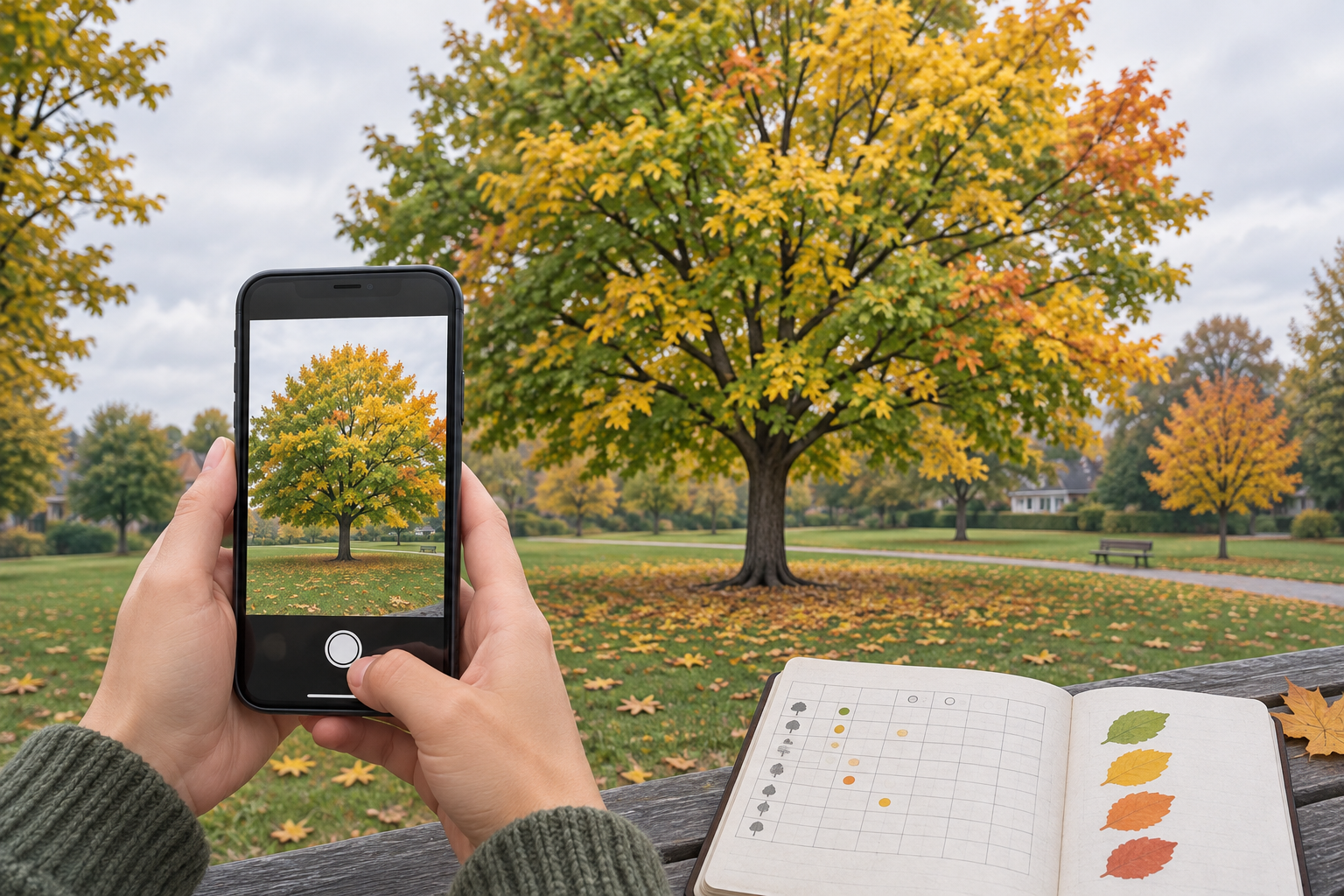
How a fall nature journal helps you track one tree
A short, repeated record can reveal changes that are easy to miss during a single walk.
To track seasonal changes in a tree, revisit the same tree regularly, photograph it from a consistent viewpoint, and write a brief dated note about what you see. A phone camera and a notebook or notes app are enough. You do not need to identify the species or follow a formal scientific protocol.
Your journal is a personal record of one tree at the times you observe it. Over several visits, you may notice changes in leaf color, gaps in the canopy, or the number of leaves remaining. It is not a forecast, and observations of one tree cannot establish what is happening across a neighborhood or explain why the tree changed.
Phenology is the study of recurring seasonal events in plants and animals. The National Park Service describes observation walks and seasonal wheels as ways to record and represent these changes. You can use the same basic idea on a smaller scale: return to one tree and keep a simple timeline of what you notice.
Choose a tree you can safely revisit
Convenience and a repeatable view matter more than choosing a remarkable tree.
Pick a tree you can visit without making a special trip: perhaps one in your yard, along a regular walking route, or in a public place where observation is allowed. A nearby tree you can return to is a better subject than a distant one you might visit only once.
Choose a spot where you can see the tree clearly and return without crossing barriers, entering private property, blocking a path, or touching branches. If the tree is on someone else’s property, observe from a place you are permitted to be. You can take useful photos from a sidewalk or other appropriate public vantage point.
Give the tree a simple label such as “Tree by the library steps” or “Tree A.” Identification is optional. If you later learn the species, add the name as a note and mark it as a confirmed identification only if you are confident. The Bureau of Land Management’s phenology-wheel activity also recommends choosing a tree or shrub that is easy to revisit and recording observations over time.
Build a repeatable photo and note routine
A consistent method makes comparisons easier, even when your journal is informal.
Once a week is a manageable starting point. USA-NPN’s observation guidance recommends regular visits, at least weekly, and more often during periods of rapid change. That is guidance for its observation program, not a requirement for a personal journal. Visit more often if you are curious and it is convenient; if you miss a week, continue with your next observation instead of guessing what happened.
At your first visit, choose a repeatable place to stand. For example, take a wide view from the same sidewalk corner, with the whole crown visible. Keep the distance and direction roughly alike on later visits. If you have to change your position, note where you stood so you do not mistake a different view for a change in the tree.
Record the date with each photo. Your phone may save a date in the image details, but writing it in your notes makes the entry easy to find. Add a few words while the observation is fresh. Use whichever format you will keep using: a pocket notebook, a phone notes app, or a simple spreadsheet.
- Choose one accessible tree and a safe spot from which to observe it.
- Take an opening photo showing the whole tree, and note your viewpoint.
- Return about once a week; take a similar photo and record the date and a few observations.
- Continue while the seasonal changes interest you. If you miss a visit, leave the gap rather than inventing an entry.
What to record at each visit
A few recurring prompts are enough to make entries useful and comparable.
Keep your notes descriptive rather than precise. You do not need to measure the percentage of colored leaves or count every leaf. Broad phrases such as “mostly green,” “yellow patches near the outer branches,” or “many leaves gone” are clear enough for a personal record.
If it helps you remember the context, add a short note about conditions or anything else you noticed. Weather notes are optional; they do not prove what caused a change. A compact entry might include:
- Date of the visit
- Photo, or the photo’s filename if you keep images separately
- Visible leaf color and where it appears
- Rough description of how much foliage remains
- Optional context, such as wind, recent rain, or an unusual observation
| Date | Photo | Leaf color | Foliage remaining | Optional context |
|---|---|---|---|---|
| October 3 | Whole tree from the sidewalk | Mostly green | Full | Clear and calm |
| October 10 | Same viewpoint | Yellow patches near outer branches | Some gaps | Windy |
| October 17 | Same viewpoint | Mixed green and yellow | Many leaves still present | Light rain earlier |
Describe leaf color without guessing at the cause
Record what you can see separately from any explanation you might consider.
A yellow or brown leaf does not, by itself, show that a tree is following a typical fall pattern. USA-NPN guidance distinguishes leaves changing color from leaves that are fully dried or dead, and notes that yellowing or browning can have causes other than seasonal fall color. A journal entry should capture the appearance without turning it into a diagnosis.
For example, write “brown leaves on several lower branches” rather than “the tree is stressed by drought” unless you have evidence beyond the photo. If green leaves remain while others have changed or fallen, note both. Uneven change is still a useful observation.
Fall timing and appearance vary by place and by tree. Do not treat a date or color pattern observed elsewhere as a deadline for your tree. Your strongest comparison is between your own entries, made from a similar viewpoint over time.
Make a timeline or seasonal wheel
A visual arrangement can make the sequence of observations easier to review.
After several visits, put the photos in date order and add one short note beneath each. A simple timeline is often enough: “mostly green,” “yellow patches,” then “many leaves gone.” Looking at the images together may help you notice shifts that were hard to spot from one week to the next.
If you prefer a hands-on activity, divide a circle into sections for your visits. Add a small sketch, a leaf-color swatch, or a phrase to each section. It does not have to be artistic or scientifically precise. The National Park Service and Bureau of Land Management describe seasonal-wheel activities as ways to represent observations; for a personal journal, use the format that makes your own notes easiest to review.
At the end of the season, add a brief reflection: What appeared to change first? Did the whole canopy change at once, or in patches? Which visit surprised you? Keep these as observations or questions, not conclusions about all trees in your area.
Understand what one tree can—and can’t—tell you
A personal journal is a record of a particular tree and your visits, not a regional study.
Your entries can show what you observed in one tree on particular dates. They cannot, by themselves, establish a regional trend, predict what will happen next year, or identify why the tree changed. Visits may miss changes that occur between them, and differences in light, distance, or camera angle can make photos harder to compare.
If you would like to contribute observations to a research program, consult USA-NPN’s Nature’s Notebook and follow its current instructions and species-specific definitions. A personal notebook is a useful way to practice noticing, but formal data collection may use more precise observation rules than the informal descriptions in this guide.
For your next step, choose a tree, take a first photo, and write down what you see. Keep the routine simple enough to repeat. The value of the journal comes from returning and observing—not from making every entry perfect.
Frequently asked questions
How often should I photograph my tree in fall?
Once a week is a manageable starting point. You can visit more often when changes seem rapid or less often if that fits your schedule. Keep the date with each entry, and continue after missed visits rather than guessing what happened.
Do I need to identify the tree species?
No. A nickname and a consistent observation spot are enough for a personal journal. You can add a species name later if you identify it, but mark an uncertain identification as a guess.
What should I record if the leaves turn brown?
Describe what you see, including which parts of the tree are affected and whether leaves appear dry or remain attached. Yellowing or browning can have causes other than typical fall color, so a photo journal alone cannot establish the cause.
Can one tree’s journal show whether fall is changing across my region?
No. A record of one tree documents your observations of that individual; it does not establish a regional trend. For formal observations, consult an established program and follow its current methods.
Sources & further reading
Explore the original sources behind this article. Our editorial perspective is separate from the organizations we reference.