How to Record a Family Oral History: A Practical Phone Guide
Plan a thoughtful conversation, record clear audio or video on your phone, and agree how the story will be saved and shared.
Start with one story-sized focus
A clear focus makes it easier to plan a warm, manageable conversation.
To record a family oral history, choose one person and one part of their life to explore, agree on how the recording may be used, and use your phone to capture a relaxed conversation. You do not need to create a formal archive to preserve a meaningful family story; a little preparation can help you make a recording that is easier to understand and care for later.
“Tell me your whole life story” can feel like a big assignment. Try a narrower invitation instead: memories of a first home, a family recipe, a childhood friend, a move to a new place, or how a holiday tradition began. A focused conversation may still wander into related memories, but it gives both of you a comfortable place to begin.
Think about the likely length and energy of the conversation. You could plan one sitting and leave room for a break, or record several shorter conversations if that suits your relative better. Let the narrator’s comfort and interest—not a target number of minutes—guide the plan.
- A place: “What do you remember about the house where you grew up?”
- A tradition: “How did our family usually celebrate this occasion?”
- A turning point: “What do you remember about your first day at that job?”
Discuss the plan and permissions first
Agree on the boundaries before a phone is recording.
Before the interview, explain why you want to record, who you hope will listen, and where you expect to keep the file. Ask whether your relative is comfortable with audio, video, or either—and whether there are subjects they would rather avoid. Oral History Association guidance treats preparation, informed consent, intended use, preservation, and access as connected parts of responsible oral-history work. You can use those principles as a thoughtful family framework without turning a casual conversation into an institutional project.
Be specific about sharing. “It’s just for the family” could mean different things to different people: a private copy for one relative, a file in a shared folder, or a clip in a family group chat. Ask who may access it and whether any part may be posted publicly. Consent to record does not by itself mean consent to publish or circulate the recording.
Make it easy to change course. Tell your relative they can decline a question, ask for a pause, or end the interview. Agree what you will do if they later want a section kept private. If a recording is shared more widely, you may not be able to retrieve every copy or control how it is passed on. If you plan public distribution, clarify permissions; questions about legal rights or releases may require advice from an appropriate professional.
Prepare flexible questions, not a script
Prompts help you listen; they should not dictate the story.
Write down a handful of open-ended questions, then leave space to follow the answer. The Library of Congress Veterans History Project presents sample questions as guides that interviewers can adapt to a person’s experiences, not as a fixed script. That approach works well for a family conversation too: choose questions that fit the person and your focus, and skip anything that feels awkward or intrusive.
Questions that invite description often lead to richer memories than prompts answered with a simple yes or no. Ask one at a time and give your relative a moment to think. Useful follow-ups include “What happened next?”, “What did that place look or sound like?”, and “Who else was there?” You can also ask, “What do you remember most clearly?”
Avoid correcting a memory in the middle of a story. If details differ from what you have heard, first let the account unfold. You can ask neutrally, “How do you remember the timing?” or make a note to check the detail later. A family interview captures one person’s recollections; it need not settle every disagreement or establish every date as fact.
- “What was an ordinary day like for you then?”
- “Can you describe the people who were part of that?”
- “Is there a detail you think younger relatives might not know?”
- “Is there anything else you’d like to add before we finish?”
Set up your phone and recording space
A short test can reveal problems before they affect the interview.
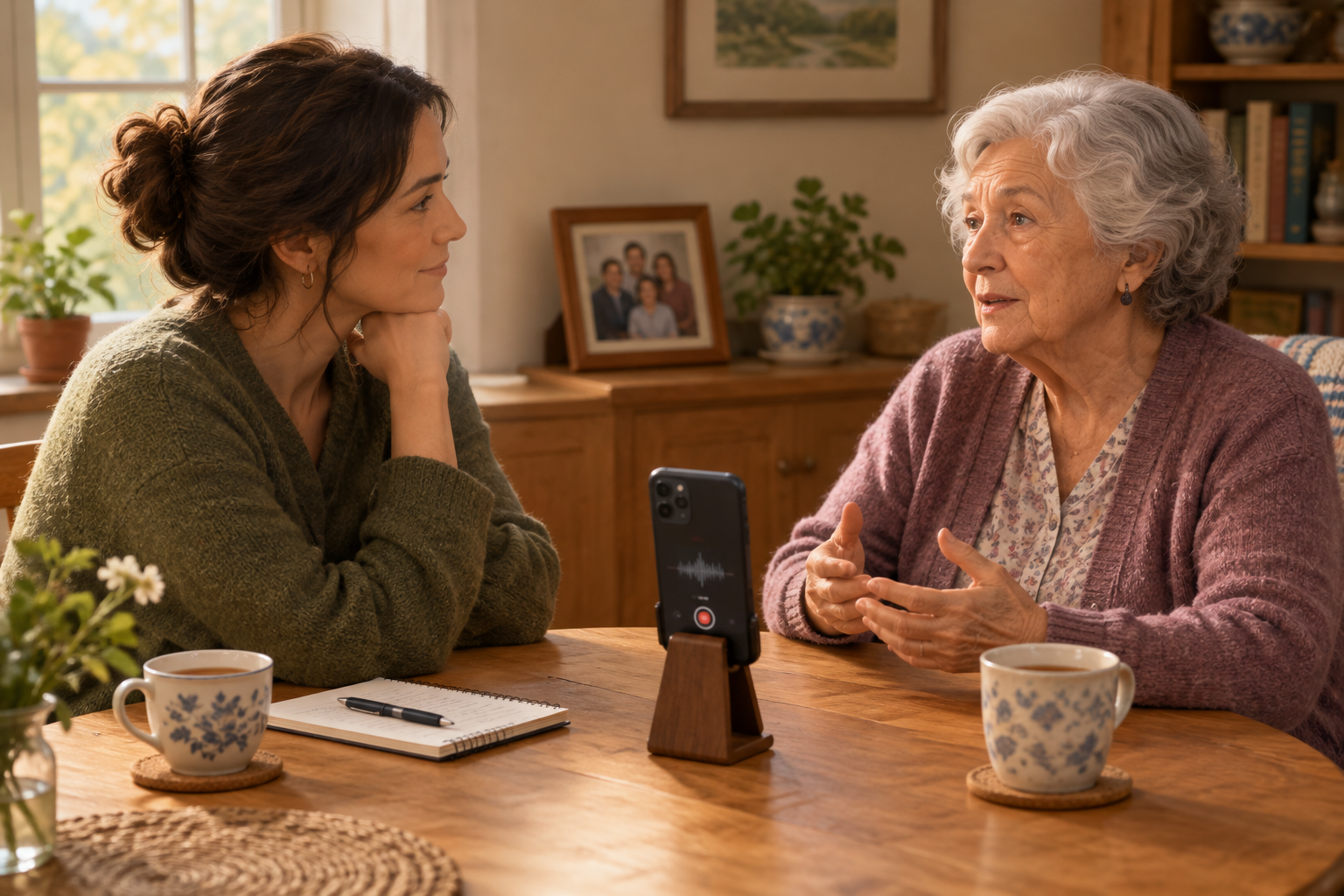
You do not need a particular phone or app. Use a recording option you can operate comfortably, and check that there is enough battery and storage for the conversation. Choose a room where both of you can sit comfortably and where nearby television, music, fans, or interruptions are limited. A familiar, quiet setting is often more useful than a formal-looking one.
Place the phone on a stable surface close enough to capture both voices clearly, without making it an obstacle between you. If you are recording video, frame the speaker comfortably and check that the light falls on their face rather than coming strongly from behind. If the phone is likely to be handled or moved, try a supported position that avoids bumps and rustling.
Make a brief test recording from the places where you expect to sit. Listen back for low volume, echoes, background noise, or a voice that is hard to distinguish. Adjust the phone or seating and test again. Start the interview only after you know how to begin, pause, and stop the recording.
| Format | May suit you if… | Before you choose |
|---|---|---|
| Audio | You want to focus on the conversation or keep the file simple to share privately. | Check that both voices are clear and that the narrator is comfortable not being on camera. |
| Video | Facial expressions, gestures, or demonstrations are important to the story. | Check framing, light, storage space, and who may see the image as well as hear the words. |
Listen, follow the story, and respect pauses
Your attention matters more than getting through every prepared question.
Begin by confirming that your relative is ready and that the phone is recording. You can say a short identifying introduction—your names, the date, and the general topic—if they are comfortable having that information captured. Then ask one question and listen without rushing to fill each pause.
Follow an interesting detail with a gentle prompt rather than jumping to your next prepared question. If your relative becomes tired or wants to move on, offer a break or stop. The Oral History Association’s best-practice guidance recognizes an interviewee’s ability to decline questions, pause, or end an interview. In a family setting, respecting that choice is more important than completing an outline.
Afterward, ask whether there is anything they want clarified, excluded from a shared copy, or discussed before anyone else listens. Avoid making promises about deleting every copy if you have already shared a file. Agree on the next step while you are both clear about what was recorded and who may access it.
Save, label, and back up the recording
A recording is more useful when future listeners can identify it and open it.
As soon as practical, save the recording in a place you can find again. Keep the original file unchanged when possible, especially if you plan to trim pauses or make a shorter listening copy. Editing can make a file easier to use, but the original preserves the full conversation and context.
Give the file a descriptive name, such as “Mara_Lee_first_home_2026-10-19,” using a format that makes sense to your family. Add a short note with the speakers’ names, recording date, general subject, and any agreed access limits. Do not rely on a filename alone to preserve context: a separate note can explain names, places, or family terms that may otherwise be unclear to a future listener.
Keep another copy in a separate location, such as a second device or a storage service you trust, while considering who can access it. Check that the copy opens and plays. If the story matters to several family members, tell the agreed people where the recording is kept and how to request access. Review the arrangement if circumstances or the narrator’s wishes change.
- Keep the original recording and label any edited listening copy clearly.
- Record who is speaking, when it was recorded, and what it covers.
- Store a separate backup and check that it plays.
- Limit access to the people and uses you agreed on.
A simple plan for your first interview
Use this sequence to turn an idea into a respectful, findable recording.
You can prepare a useful family interview without elaborate equipment or a long questionnaire. Start with one subject, make the expectations clear, and protect time for the conversation itself. Once you have saved the file and confirmed the sharing plan, you have a practical foundation for future stories too.
- Choose one person and a focused theme, place, tradition, or period of life.
- Ask whether they want to take part, then explain the purpose, format, likely audience, storage plan, and any sharing you have in mind.
- Write a short list of open-ended prompts and possible follow-ups; leave room to change direction.
- Choose a comfortable, quiet space, check the phone’s battery and storage, and make a test recording.
- Record at the narrator’s pace. Offer a pause, skip, or stop without pressure.
- Save and label the original, make a separate backup, test it, and follow the agreed access limits.
Frequently asked questions
How long should a family oral-history interview be?
There is no required length for a family conversation. Plan around the narrator’s comfort and the focus you chose. One shorter conversation—or a few sessions—may work better than trying to cover a whole life at once.
Do I need special equipment to record family stories?
No special equipment is required for a basic interview. A phone can work if it has enough battery and storage and captures clear speech. Make a test recording in the same space and listen back before the conversation.
What are good questions to ask a relative?
Use open-ended prompts tied to a specific subject, such as “What do you remember about your first home?” or “How did this family tradition begin?” Follow up with “What happened next?” and let the person choose what to discuss.
Can I share the recording with the family or post it online?
Ask first and agree on the intended audience and uses. Permission to record is not automatically permission to share publicly. Once a file has been distributed, you may not be able to retrieve every copy; clarify permissions and seek appropriate professional advice if you have legal questions about public distribution.
Sources & further reading
Explore the original sources behind this article. Our editorial perspective is separate from the organizations we reference.