How to Read an NBA Box Score: Key Stats and What They Don’t Tell You
Learn to read an NBA box score from the final score to shooting splits, rebounds, assists, and plus-minus—while keeping each statistic in context.
Start with the score and game context
Before interpreting an individual line, get your bearings: what was the result, and how did the game unfold?
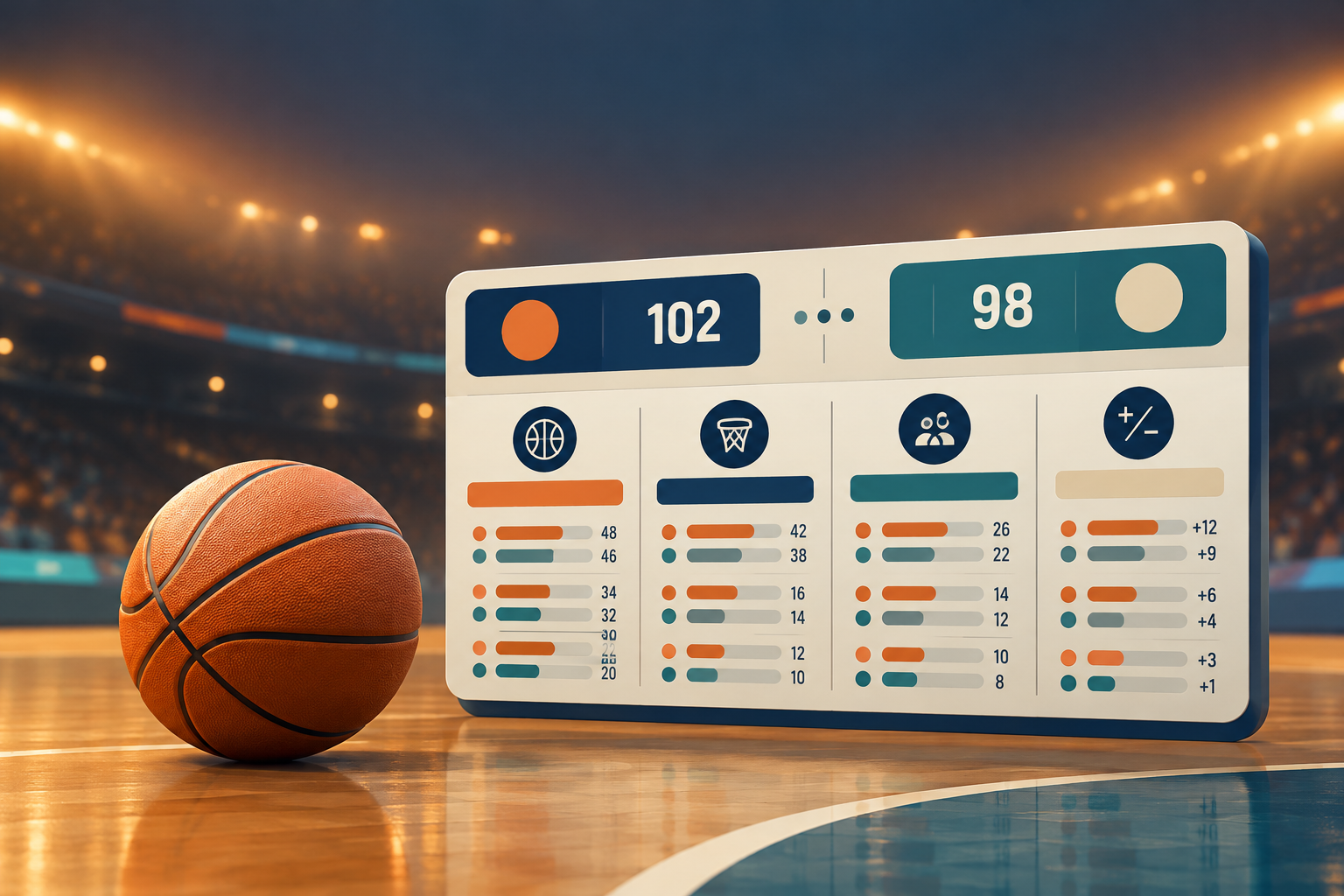
An NBA box score is a compact record of a game. It usually includes the final score, a score-by-quarter breakdown, team totals, and player statistics. Sites may arrange or label these parts differently, so focus on what each number represents rather than expecting every screen to look identical.
Read the final score first, then compare the quarter totals. A team that led throughout played a different kind of game from one that fell behind early and rallied late. The quarter breakdown does not explain why the score changed, but it helps you place a player’s numbers in context. The Jr. NBA guide describes these common box-score sections and columns. (See the linked reference for the Jr. NBA guide.)
- Final score: the points each team finished with.
- Quarter scores: each team’s points in each period, often with overtime shown separately.
- Team totals: combined figures such as shooting, rebounds, assists, and turnovers.
Decode the shooting line: makes, attempts, and percentages
Shooting figures make the most sense when you read the count and the rate together.
FGM–FGA means field goals made–field goals attempted. A line of 8–15 means the player made eight shots from the field on 15 attempts. FG% is field goals made divided by field goals attempted. The NBA Stats glossary defines it this way; a player’s percentage is more informative when you can also see how many shots produced it.
Three-pointers usually appear separately as 3PM–3PA and 3P%. Those made threes are also included in field goals made and attempted, so do not add the three-point totals to FGM–FGA as if they were separate shots. Free throws are another separate line: FTM–FTA and FT%, for free throws made and attempted and their percentage.
For example, 2–5 from three is 40%, while 2–2 is 100%. The second percentage is higher, but it comes from fewer attempts. Neither line alone tells you whether the shots were easy, contested, timely, or part of a team play.
- FGM–FGA: field goals made and attempted.
- FG%: field goals made divided by field goals attempted.
- 3PM–3PA and 3P%: three-pointers made and attempted, and the corresponding percentage.
- FTM–FTA and FT%: free throws made and attempted, and the corresponding percentage.
Read points alongside rebounds, assists, and turnovers
These numbers describe different parts of a player’s box-score contribution; they are not interchangeable measures of overall performance.
PTS means points scored. In a standard box score, points come from two-point field goals, three-pointers, and free throws. You can check whether a scoring total fits the shooting line: each made three is worth three points, other made field goals are worth two, and each made free throw is worth one.
REB means rebounds. Some displays split rebounds into offensive and defensive totals. An offensive rebound follows a missed shot by the player’s own team; a defensive rebound follows a miss by the opponent. The total is useful, but it does not show every detail of positioning or the effort involved in a play.
AST means assists. The NBA glossary describes an assist as a pass that leads directly to a made basket. TOV means turnovers: possessions in which the offense loses the ball to the defense. An assist count can reflect playmaking, while a turnover count records lost possessions; neither explains the full sequence or difficulty of the player’s decisions.
- PTS: points scored.
- REB: rebounds, sometimes split into offensive and defensive rebounds.
- AST: assists credited for passes leading directly to made baskets.
- TOV: turnovers, when the offense loses the ball to the defense.
Recognize defensive stats and personal fouls
Steals, blocks, and fouls add useful detail, but a small number of recorded events cannot describe every defensive assignment.
STL means steals, and BLK means blocked shots. They record particular events: a steal is credited when a defender takes the ball from the offense, while a block is credited for stopping or deflecting a shot. A defender can also affect a possession by staying in front of an attacker, forcing a difficult pass, or helping a teammate—work that may not appear as a steal or block.
PF means personal fouls. The number shows how many personal fouls were charged to the player, not the full circumstances of those calls. Read it as one part of the line, especially when considering minutes played or whether the player could remain on court, rather than as a stand-alone judgment about discipline or defense.
- STL: steals credited to the player.
- BLK: blocked shots credited to the player.
- PF: personal fouls charged to the player.
Interpret plus-minus without turning it into a grade
Plus-minus is a team score comparison tied to a player’s time on court, not a direct measure of individual cause.
Plus-minus, often shown as +/−, records the point differential while a player is on the floor. If a player’s team scores 30 points and allows 25 during that player’s minutes, the player’s plus-minus for that stretch is +5. A negative number means the opponent outscored the player’s team during those minutes.
That is what the statistic records; it does not establish that the player caused the margin. Teammates, opponents, substitutions, and the timing of scoring runs all shape what happens while a player is on court. A player may have a positive plus-minus without scoring many points, or a negative one despite making productive plays.
Use it as a prompt to look more closely, not as a verdict. Compare the player’s minutes and other stats, consider the game flow, and—if you want a deeper evaluation—look beyond the basic box score. The NBA Stats FAQ describes advanced statistics as a more in-depth way to examine a box score, reinforcing that basic totals are a starting point rather than a complete account of performance.
Practice with a fictional player line
A made-up example shows how the columns fit together without suggesting that a single stat line tells the whole story.
The following line is fictional. It illustrates how to read common NBA box-score columns; it is not a record of a real player or game.
| MIN | FGM–FGA | FG% | 3PM–3PA | 3P% | FTM–FTA |
|---|---|---|---|---|---|
| 32 | 8–15 | 53.3% | 2–5 | 40.0% | 4–4 |
Use a quick routine for your next box score
A short sequence helps you move from reading numbers to asking more grounded questions about what they show.
Continue the fictional line with 22 points, 7 rebounds, 6 assists, 3 turnovers, 1 steal, 0 blocks, 2 personal fouls, and +5. The scoring total is consistent: six two-point makes produce 12 points, two threes produce 6, and four free throws produce 4, for 22 altogether.
Start with MIN, or minutes played, to understand how much court time the line covers. Then compare the attempts with the makes and percentages. Read points alongside free throws and threes, then scan rebounds, assists, and turnovers. Finally, check defensive stats and plus-minus in the context of the result and the player’s role. A box score records selected events and totals; it cannot, by itself, show every screen, rotation, missed assignment, or tactical choice.
Use this checklist when a line seems impressive, disappointing, or puzzling:
- What was the final score, and how did the quarter-by-quarter result develop?
- How many minutes did the player play, and what role might they have had?
- How many shots did the player make, and how many attempts produced that total?
- Which events do the stats record—and what relevant context do they leave out?
- If plus-minus stands out, what happened to the team’s score while the player was on court?
Frequently asked questions
What does FGM–FGA mean in an NBA box score?
It means field goals made–field goals attempted. A line of 8–15 means the player made eight field-goal shots on 15 attempts. Three-pointers are included in those field-goal totals and are also commonly listed separately.
How do you calculate FG% and 3P%?
FG% is field goals made divided by field goals attempted. 3P% is three-pointers made divided by three-pointers attempted. Read each percentage together with its attempt count, since a rate based on few attempts can give limited context.
What does plus-minus mean in basketball?
It is the point differential for a player’s team while that player is on the court. It records what happened to the team score in those minutes, but does not prove that the player personally caused the margin.
Does a high point total mean a player had a good game?
It shows that the player scored many points, but does not settle the broader question. Consider attempts, shooting percentages, turnovers, minutes, the player’s role, and the game context before assessing the performance.
Do all NBA box scores use the same layout?
No. Different sites may arrange or label columns differently. The common stat meanings remain useful, but check the specific display’s headings or legend if a label is unfamiliar.
Sources & further reading
Explore the original sources behind this article. Our editorial perspective is separate from the organizations we reference.
- [S1] How to Read a Box Score - NBA.com: Jr. NBAjr.nba.com
- [S2] Stat Glossary | Stats | NBA.comwww-ng.nba.com
- [S3] FAQ | Stats | NBA.comnba.com