How to Find Your Home’s Main Water Shutoff Before a Leak
Find the valve that controls water to your home before an emergency. Learn where to look, how to distinguish it from fixture valves, and when to ask a landlord, plumber, or utility for help.
Why find the main water shutoff before a leak?
Knowing the valve’s location in advance can make it easier to respond promptly if a pipe or fixture fails.
If a pipe breaks or a plumbing connection begins leaking, stopping the water supply can limit how much water continues entering the affected plumbing. The American Red Cross advises turning off water at the main valve if pipes are damaged and contacting a plumber for help. The practical challenge is that the valve may be in an unfamiliar or inconvenient place, and not every valve is yours to operate.
Take a few minutes to locate the likely shutoff, confirm who it serves, and make a plan for getting help if you cannot identify it. This guide is for U.S. renters and homeowners, but locations, building arrangements, and local utility rules differ.
- Find the likely valve while there is no active leak.
- Do not treat a valve’s appearance or location as proof that it controls only your home.
- If water is already leaking, prioritize safety and contact the property manager, utility, or a plumber as appropriate.
Where to look for the main water shutoff
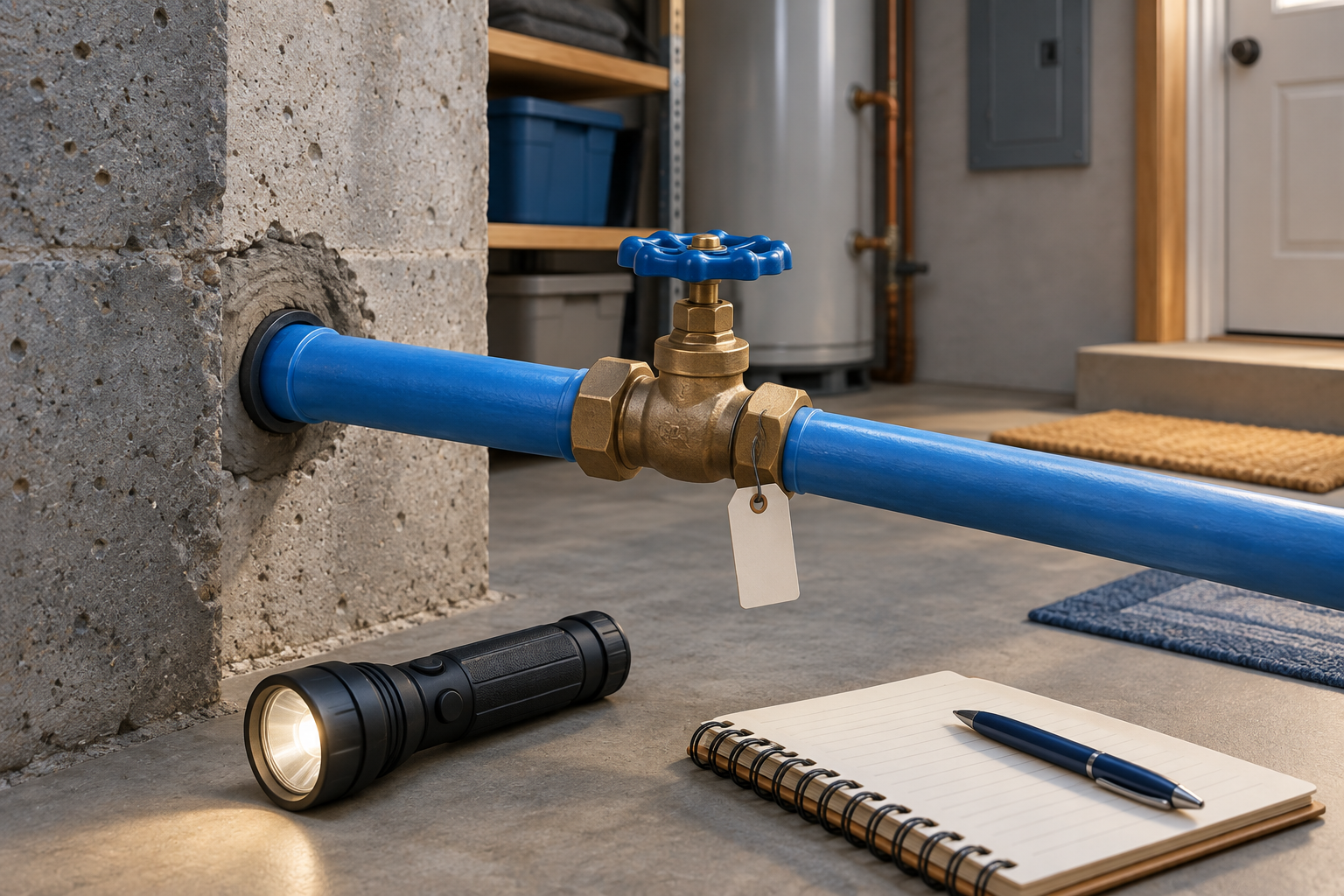
Start at the point where the water service enters the home, then check nearby accessible areas and records.
There is no single location that applies to every house. The San Francisco Public Utilities Commission (SFPUC) lists possible places near where the water line enters the home, around the exterior, and in areas such as a garage or basement. Some older homes may not have a working shutoff valve. A pipe’s route and the age or layout of the property can affect where to look.
Begin by checking accessible utility areas where plumbing enters the building. Look near the foundation or perimeter, in a basement or crawl-space access area if it is safe to enter, and in a garage or utility room. Do not enter a confined, flooded, or otherwise hazardous space just to search for a valve. If you have a home inspection report, plumbing plan, or property records, check whether they identify the service entry or shutoff.
An outdoor valve or meter box may be part of the water service, but the rules for accessing or operating it are not universal. SFPUC, for example, instructs its customers not to access its water meters and offers assistance locating the property shutoff. Follow your own utility’s instructions rather than copying a procedure meant for another city.
- Start near the water line’s entry point.
- Check only areas you can access safely.
- Use property records as clues, not as a substitute for confirming which valve serves your home.
Tell the main shutoff from a fixture valve
A valve’s job matters more than its shape: some valves serve one appliance, while others control a much larger part of the plumbing.
Small valves beneath a sink or behind a toilet generally serve that fixture. A valve beside a washing machine or another appliance may control only that connection. These local valves can be useful for a problem at that fixture, but they are not necessarily the home’s main shutoff.
The main shutoff is intended to stop water to the home or to the section of a building it serves. It is often near the service entry, but there may be more than one valve along the supply line, and the arrangement varies. Do not rely on a handle’s color, shape, or position alone to identify its function. If the pipe route is unclear, ask a plumber or property manager to confirm it.
Use the comparison below as a starting point, not as a way to identify an unmarked valve with certainty.
| Valve type | Typical purpose | What to verify |
|---|---|---|
| Fixture shutoff | Controls water to one sink, toilet, or appliance | Check which fixture or connection it serves |
| Home main shutoff | Controls the water supply to a home | Confirm it serves your residence, not a shared area |
| Meter or utility shutoff | May be part of the service outside the home | Ask the water utility whether customers may access or operate it |
Check permission before operating a valve
The right next step depends on whether you own the home, rent it, or share plumbing with other residents.
If you rent, ask your landlord or property manager to identify the main shutoff and explain what you are permitted to operate. The Indian Wells Valley Water District specifically advises renters to ask their landlord. This is especially useful when a valve is concealed, unmarked, or in a locked utility space.
In a condominium, apartment building, or other multi-unit property, do not test a valve unless management confirms that it serves only your unit and gives you permission. A valve that appears close to your home may control shared plumbing or affect a neighbor’s water. The water district warns against testing a valve in a multi-unit complex for this reason.
For a single-family home, confirm that the candidate valve is the home’s own shutoff before considering a test. If you cannot establish what it serves, do not experiment. A plumber or the local water utility can help clarify the arrangement.
How to check an identified valve cautiously
A test should be limited to a clearly identified valve that you are allowed to operate; stop if anything seems wrong.
There is no need to test an uncertain valve. If you own a single-family home and a plumber, property record, or other reliable information confirms the valve serves only your home, you may consider a cautious check. Follow any instructions from the valve manufacturer or your local water provider. If the valve is old, corroded, damaged, or difficult to reach, ask a plumber to assess it instead.
Before operating it, tell anyone in the home that the water may be interrupted. Do not use a wrench, extension, or extra force to turn a handle. If it resists, makes an unusual sound, begins leaking, or otherwise appears damaged, stop and contact a plumber. The water district’s guidance is explicit: do not force a valve that will not turn.
If you do operate a confirmed valve, use the method recommended for that valve and check whether water flow changes at an appropriate fixture. Restore the valve only according to its instructions, then check for normal flow and any new signs of leakage. If you are not sure how to operate or restore it, do not proceed alone; have a plumber show you.
- Do not test a valve that may serve multiple units.
- Do not force a stiff or stuck valve.
- Stop if the valve leaks, looks damaged, or behaves unexpectedly.
Label the valve and make it easy to find
Once the correct valve is confirmed, a simple label and shared household plan can save time later.
Mark the confirmed shutoff with a clear label that says what it controls. Avoid labeling a valve based on a guess. If there are several valves, note the confirmed main shutoff separately from fixture valves and any utility-controlled equipment.
Tell the other adults in the household where it is and how to get to it. If the valve is in a garage, basement, or utility area, keep the route accessible and avoid storing heavy items in front of it. A photo in a household maintenance folder can help someone find the location, but it should supplement—not replace—a visible label.
For a rental or shared building, ask management whether they can provide a building-specific emergency procedure and share it with everyone who may need it.
- Label only after confirming what the valve serves.
- Keep access clear and share the location with household members.
- Record the property manager, plumber, and water utility contact details where they are easy to find.
If you cannot find or operate the shutoff
A missing, inaccessible, or stuck valve is a reason to get qualified help—not to force a workaround.
If you cannot identify a home shutoff, contact your landlord or property manager if you rent or live in a managed building. For a homeowner, the City of Tampa advises contacting a licensed plumber when the valve cannot be found. A plumber can identify the plumbing layout and assess whether a valve needs attention.
If you suspect the relevant shutoff is in or near a meter box, contact your local water utility and follow its instructions. Do not assume that customers are allowed to open the box or operate a utility-side valve; policies and responsibilities differ by location. SFPUC’s guidance is one example of a utility that tells customers not to access its meters.
If a pipe is damaged and water is actively flowing, seek help promptly. The Red Cross advises shutting off water at the main valve if pipes are damaged and calling a plumber. If the valve is stuck, unclear, or not yours to operate, tell the person responding exactly what you know and where the water is coming from rather than attempting repairs.
- Renter or multi-unit resident: contact management.
- Homeowner who cannot find the valve: contact a licensed plumber.
- Questions about meter-box access: contact your local water utility.
A short preparation checklist
Turn the search into a small maintenance task you can finish before a leak occurs.
Set aside time to locate the likely valve and confirm its purpose. The goal is not to perform plumbing repairs; it is to know what the valve controls and whom to call if you cannot safely operate it.
- Look near the water line’s entry point and check accessible areas such as a basement, garage, utility space, or exterior.
- Review home records or ask management if the location is not obvious.
- Confirm that the valve serves only your home and that you are permitted to operate it.
- Do not test a shared-building valve or force a stuck one.
- Ask a plumber or utility for guidance if the valve is unclear, inaccessible, or near a meter.
- Label the confirmed valve, keep the area clear, and tell household members where it is.
Frequently asked questions
Where is the main water shutoff usually located?
It varies. Start near where the water line enters the home, then check accessible areas such as a basement, garage, utility space, or exterior. If you cannot identify it confidently, ask a plumber or property manager.
Can I test the main shutoff in my apartment?
Do not test it unless property management confirms that the valve serves only your unit and gives you permission. A valve in a multi-unit building could interrupt water to other residents.
What should I do if the shutoff valve is stuck?
Do not force it or use a tool to gain leverage. Stop and contact a plumber or property manager. If you rent, ask management to arrange the appropriate help.
Can I turn off the water at the meter?
Do not assume you may access or operate the meter shutoff. Meter-box rules vary by utility; contact yours and follow its instructions.
What if I cannot find a main shutoff valve?
Renters should contact their landlord or property manager. Homeowners can contact a licensed plumber; the City of Tampa also recommends a plumber when the valve cannot be found. Ask your local utility about meter access or its role in locating the property shutoff.
Sources & further reading
Explore the original sources behind this article. Our editorial perspective is separate from the organizations we reference.
- [S1] Home Water Shutoff Valvesfpuc.gov
- [S2] How to Check for Leaks | City of Tampatampa.gov
- [S3] Locate Your Water Shutoff Valve - Indian Wells Valley Water Districtiwvwd.specialdistrict.org
- [S4] Checking Your Home's Utilities | Disaster Recovery | Red Crossredcross.org