Fried Turkey for Thanksgiving: Compare Your Options Before You Choose
Want fried turkey for Thanksgiving? Compare buying it prepared, choosing a non-oil appliance, and using an oil fryer—with the safety tradeoffs and doneness checks clearly explained.
Fried turkey for Thanksgiving: compare your options first
The main choice is how to get the meal you want without overlooking the risks of operating a consumer oil fryer.
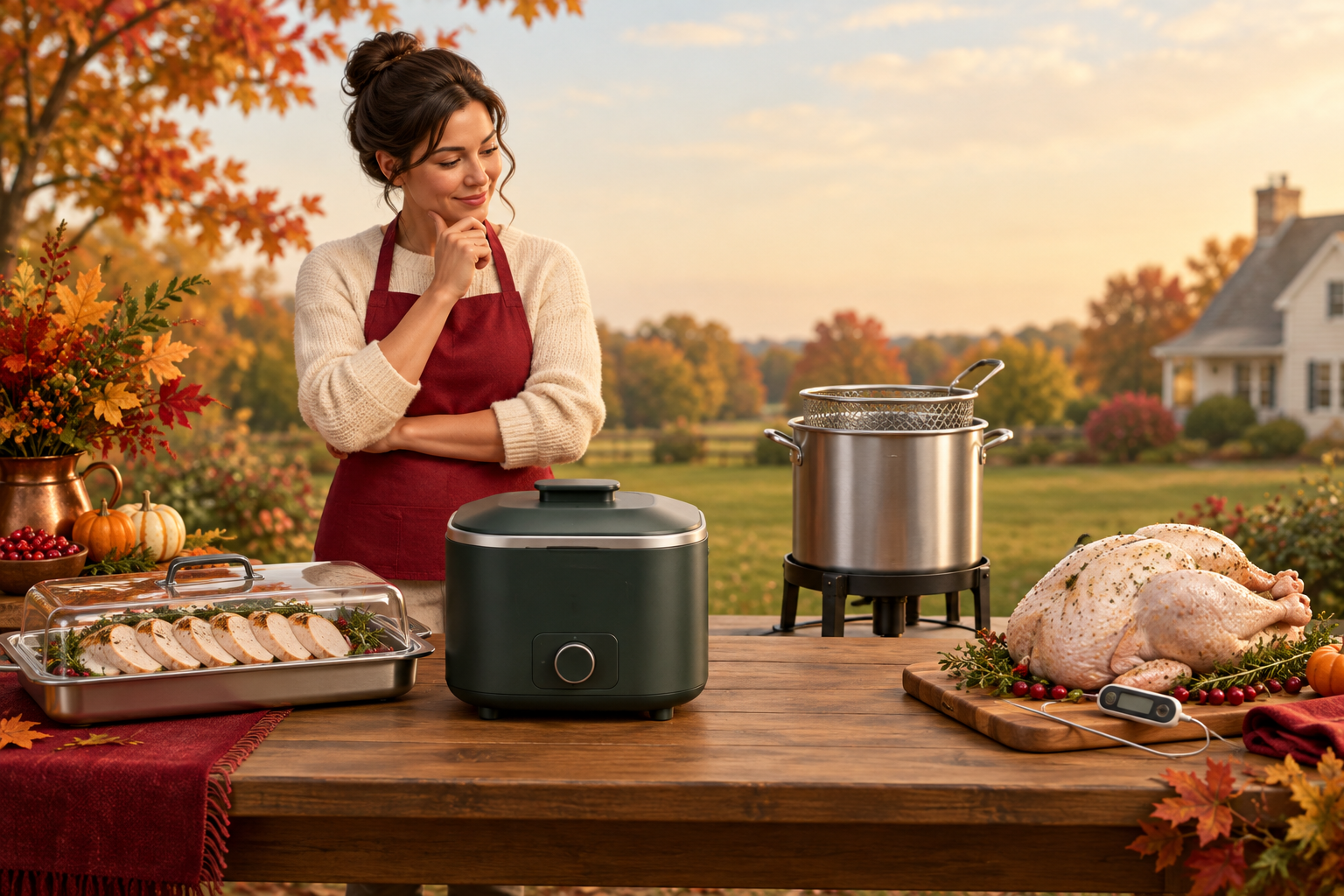
If you want fried turkey for Thanksgiving, compare buying it prepared with cooking at home in an appliance that does not use oil before considering a consumer oil fryer. The National Fire Protection Association (NFPA) strongly discourages consumer use of oil-based turkey fryers. Its suggested alternatives include buying fried turkey from a grocery store, restaurant, or similar food business, or considering a fryer that does not use oil.
That guidance is worth considering before you buy equipment or plan the day’s cooking schedule. A prepared turkey may suit someone who wants the meal without operating a fryer. A non-oil appliance may appeal to a cook who wants to prepare the turkey at home, but its operation and requirements depend on the specific model. An oil fryer brings the additional hazards of handling a large amount of hot oil.
Local businesses may not offer whole fried turkeys, and orders, pickup times, and appliance requirements vary. Confirm the details directly. If you cannot confirm a workable option—or cannot meet an appliance’s instructions—choose a different main dish or cooking method rather than improvising.
- Want fried turkey without operating an oil fryer? Ask local food businesses about availability, order deadlines, pickup, and handling directions.
- Prefer to cook at home? Compare specific non-oil appliances and read their instructions instead of assuming all models work alike.
- Still considering an oil fryer? Take NFPA’s strong discouragement seriously; the precautions below are not a guarantee of safety.
How the three fried-turkey options compare
Use this comparison to identify what you need to confirm before making your holiday plan.
The options differ in where the cooking happens, what you need to arrange, and which instructions apply. For instance, a prepared turkey shifts the planning toward ordering and pickup; cooking at home means checking the appliance, its placement requirements, and how you will verify doneness. No option should be assumed to work on a schedule or in a space that has not been checked.
| Option | What to confirm | Main consideration |
|---|---|---|
| Buy fried turkey from a food business | Availability, order deadline, pickup timing, and storage or serving directions | You avoid operating a consumer oil fryer, but need to plan around the business’s schedule and instructions. |
| Use a non-oil appliance | The exact model’s instructions, capacity, placement requirements, and safety information | It avoids the oil-fryer method, but is not automatically risk-free or interchangeable with other appliances. |
| Use a consumer oil fryer | NFPA’s recommendation, the model’s instructions, and whether the outdoor setup can meet USFA’s precautions | NFPA strongly discourages this option; precautions can reduce certain risks but cannot make it risk-free. |
Why oil-based turkey fryers raise safety concerns
The key hazards involve hot oil, the stability of the setup, and what can happen when a bird is not fully thawed.
An oil fryer combines a heavy appliance, a whole turkey, and a large amount of hot cooking oil. The U.S. Fire Administration (USFA) identifies hazards that include tipping, oil overflow, hot surfaces, and splatter from a partially frozen turkey. A spill or splash can expose people to hot oil and create a fire or burn hazard.
These concerns explain why the NFPA recommendation belongs at the center of the decision, rather than being treated as a footnote. USFA’s precautions are guidance for reducing particular risks if someone proceeds; they do not cancel NFPA’s strong discouragement of consumer oil fryers or establish that any setup is safe.
If you still consider an oil fryer, check the setup carefully
Treat the precautions as minimum risk-reduction checks, not a promise that the method is safe.
USFA advises placing a fryer on a stable, level surface outdoors, at least 10 feet from the home and not under eaves. It also advises ensuring the turkey is fully thawed. Those steps address some known hazards, but they do not remove every risk associated with hot oil. NFPA’s recommendation to avoid consumer oil fryers remains unchanged.
The manufacturer’s instructions for the exact fryer matter too. Requirements may differ by model, so do not substitute another product’s directions or a general online recipe. If you cannot meet the instructions, the location is unstable or crowded, or any requirement is unclear, do not improvise; select another cooking option.
- Check that the outdoor location is stable and level, at least 10 feet from the home, and not under eaves.
- Confirm the turkey is fully thawed before use; a partially frozen bird can cause splatter.
- Read the specific fryer’s complete instructions, including its setup and capacity requirements.
- If the space or instructions do not work for your situation, change the plan instead of squeezing the appliance into an unsuitable spot.
Check turkey doneness with a thermometer, not a timer
The cooking method and food-safety check are separate decisions: use a thermometer to verify the finished bird.
The U.S. Department of Agriculture’s Food Safety and Inspection Service (USDA FSIS) says a whole turkey should reach at least 165°F (74°C) in the innermost part of the thigh and wing and the thickest part of the breast. Measure those locations with a food thermometer; do not use the bird’s appearance or an estimated cooking duration as a substitute.
Cooking time varies, and a general time estimate cannot confirm that each required part has reached the recommended temperature. Follow the appliance’s instructions for its cooking process, then take the temperature readings. If any reading is below 165°F, continue cooking according to those instructions and check again.
Make a practical Thanksgiving plan before the day
Confirm your preferred option early, then make sure the logistics and a backup plan do not depend on guesswork.
Start by deciding whether you want to order a prepared turkey or cook at home with a particular non-oil appliance. If you are considering an oil fryer despite NFPA’s advice, first determine whether you can meet both USFA’s precautions and the exact appliance instructions. For example, if your only available outdoor area is close to the house or uneven, that is a reason to change methods—not to place the fryer wherever it fits.
Once you have chosen, confirm the details that could change the schedule. Ask a food business about its availability and pickup directions, or check the appliance’s instructions and requirements well before cooking day. Plan for a food thermometer and enough time to check every required location. Keep a backup meal option that does not depend on the same fryer or order.
For most cooks, a useful next step is to check local prepared-turkey options and the instructions for any non-oil appliance under consideration. If neither works, choose another cooking method. Whatever the route, verify doneness by temperature: a thermometer can check the turkey, but it cannot make an unsuitable fryer setup safe.
Frequently asked questions
Does NFPA recommend using an oil-based turkey fryer at home?
No. NFPA strongly discourages consumer use of oil-based turkey fryers. It suggests buying fried turkey from a food business or considering a fryer that does not use oil.
Is a non-oil turkey fryer completely safe?
Do not assume any appliance is risk-free. Models differ, so check the specific unit’s instructions, capacity, placement requirements, and safety information.
What precautions does USFA give for someone considering an oil fryer?
USFA advises using a stable, level outdoor surface at least 10 feet from the home and not under eaves, and ensuring the turkey is fully thawed. These measures address certain risks; they do not guarantee safety or change NFPA’s recommendation.
What temperature should a whole turkey reach?
USDA FSIS says to check for at least 165°F (74°C) in the innermost thigh and wing and the thickest part of the breast using a food thermometer.
Can I rely on a cooking-time estimate to know the turkey is done?
No. Follow the specific appliance’s cooking instructions, then use a food thermometer to verify the temperature in the required locations.
Sources & further reading
Explore the original sources behind this article. Our editorial perspective is separate from the organizations we reference.
- [S1] Thanksgiving safety tips | NFPAnfpa.org
- [S2] Turkey Fryer Fire Safetyusfa.fema.gov
- [S3] What is the internal temperature and cooking time for turkey?ask.fsis.usda.gov