Fuyu or Hachiya? How to Tell When a Persimmon Is Ready to Eat
Common Fuyu persimmons are usually eaten firm, while Hachiyas should soften until their flesh is very tender. Learn how to use labels and shape as clues, ripen a firm Hachiya, and save its ripe pulp.
Fuyu or Hachiya: the quick answer
The most useful distinction is the texture each type should have when you eat it.
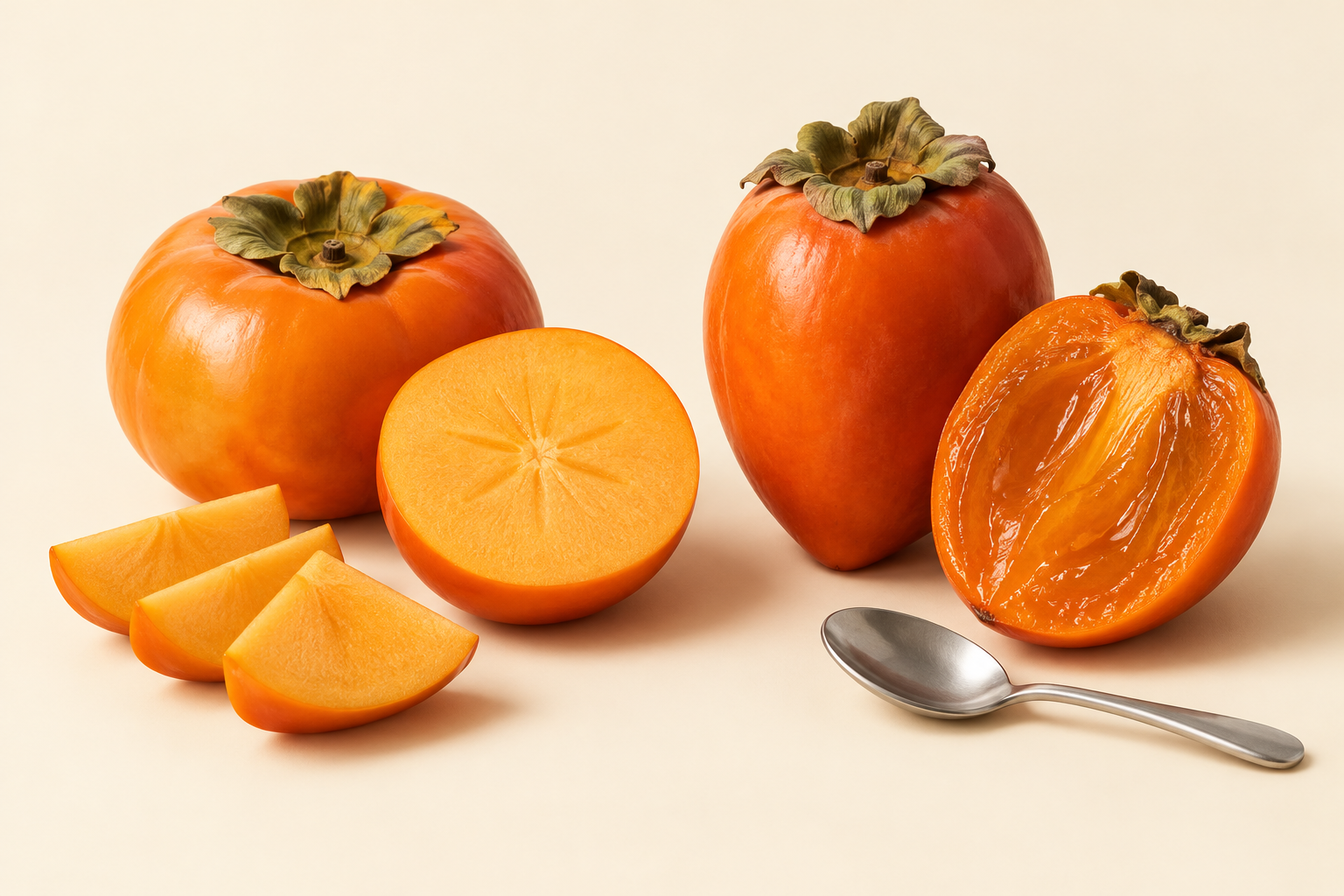
Common Fuyu persimmons can be eaten while firm and crisp. Common Hachiyas should ripen until extremely soft, with flesh that is translucent and jelly-like. A firm Hachiya can be strongly astringent, creating a dry, puckering sensation, so it is worth identifying the fruit before taking a bite.
If you are shopping for a crisp snack or slices, look for a labeled Fuyu. If you have a firm Hachiya, set it aside to soften. These are the usual eating stages for the two common types, not a guarantee that every persimmon fits a simple visual rule. UC ANR describes this Fuyu–Hachiya distinction and the very soft texture of ripe Hachiya flesh.
- Fuyu: commonly eaten firm and crisp.
- Hachiya: wait until very soft before eating the flesh.
- Unsure of the variety? Use the label if available; treat appearance as a clue, not proof.
Fuyu vs. Hachiya: typical clues and uses
Pair a fruit’s shape with its eating texture, and check the variety label whenever you can.
The familiar visual difference can help at a market: Fuyus are often flattened or tomato-shaped, while Hachiyas are often pointed or acorn-shaped. But the eating-stage difference matters more than appearance. The table describes common examples, not a definitive identification test.
| Clue | Fuyu | Hachiya |
|---|---|---|
| Typical shape | Flattened or tomato-like | Pointed or acorn-like |
| Usual texture when eaten | Firm and crisp | Extremely soft and jelly-like |
| If the fruit is firm | Often ready if identified as Fuyu | Usually needs more time to ripen |
| A fitting preparation | Slices or pieces that hold their shape | Soft pulp for eating or recipes |
How to check an unlabeled persimmon
A label is the best starting point; use shape to guide your guess, then consider whether the texture fits.
Look for a sticker, produce sign, or package name first. If it identifies the fruit as Fuyu or Hachiya, use that information alongside the fruit’s texture. Without a label, a flattened fruit may be a Fuyu and a pointed one may be a Hachiya, but neither shape proves the variety.
Other varieties can complicate the picture. UC ANR notes that Jiro can resemble Fuyu and is sometimes sold as Fuyu, which is another reason not to treat shape as conclusive. Color is not a dependable stand-alone test for deciding whether a Hachiya is ready; the relevant check is whether it has softened to the very tender, jelly-like stage.
If you cannot identify a firm fruit confidently, avoid assuming it is ready just because it looks ripe. Ask the produce seller if possible. If the fruit appears to be a Hachiya, or you simply cannot confirm it is a crisp-eating type, letting it soften is a practical way to avoid an unpleasant first bite.
- Check the variety name before relying on appearance.
- Use shape only as a supporting clue.
- For a possible Hachiya, wait for very soft flesh.
How to ripen a firm Hachiya
Let the fruit soften at room temperature, checking its texture rather than relying on a fixed schedule.
A firm Hachiya can ripen on the counter. Place it at room temperature and check it periodically. The time varies, so a specific number of days is not a reliable promise. Wait until it feels extremely soft and the flesh has the translucent, jelly-like consistency associated with a ripe Hachiya.
Handle it gently as it softens: ripe fruit is delicate and may not hold its shape when cut. Once ready, open it and scoop out the pulp. If it still feels firm, give it more time rather than treating the outside color as proof that it is ready. UC ANR supports room-temperature ripening and describes the texture to look for when ripe.
- Set the firm Hachiya aside at room temperature.
- Check it periodically by gently assessing its softness.
- When it is extremely soft, scoop out the pulp for eating or cooking.
- Freeze ripe pulp if you want to save it for later.
Choose a preparation that suits the texture
Use crisp Fuyu pieces when you want the fruit to hold its shape, and ripe Hachiya when you need soft pulp.
A confirmed Fuyu is useful in preparations where you want distinct slices or cubes. Try it thinly sliced in a salad or cut into pieces for a grain bowl. Its firm texture is the point, so it can be eaten as a crisp fruit rather than waiting for it to become jelly-soft.
A ripe Hachiya is better suited to spooning out or using as pulp. It can be eaten by the spoonful or used in a recipe that specifically calls for ripe persimmon pulp. If a recipe asks for Fuyu slices, soft Hachiya pulp will change the texture; if it calls for Hachiya pulp, firm Fuyu will not behave the same way.
When a recipe says only “persimmon,” look for clues in the instructions. Does it ask you to slice the fruit, or mash and blend it? If the expected form is unclear, choose a recipe that names the variety or specifies the texture it needs. That small check can prevent a substitution from changing the result.
- For slices or crisp pieces, use a firm Fuyu when identified.
- For a spoon-soft fruit or pulp-based recipe, use ripe Hachiya.
- If substituting, account for the difference between crisp pieces and soft pulp.
Save ripe Hachiya pulp for later
Freezing the soft pulp is a practical option when a ripe fruit is ready before you need it.
If you have more ripe Hachiya than you plan to use, scoop out the pulp and freeze it for a future recipe. UC ANR describes freezing ripe persimmon pulp as an option. Keep it clearly labeled so you remember what it is and that it is pulp rather than whole fruit.
For a quick decision today, match the fruit to the dish: choose a labeled Fuyu for a firm, crisp preparation; give a firm Hachiya time to soften; and use or freeze Hachiya pulp once it is very soft. If the variety is uncertain, ask the seller or wait rather than relying on color alone.
Frequently asked questions
Can you eat a Fuyu persimmon while it is firm?
Yes. Common Fuyu persimmons are usually eaten while firm and crisp. If you are not sure which variety you have, check the label rather than relying on shape alone.
Can you eat a Hachiya persimmon while it is firm?
It is best to wait. A firm Hachiya can be strongly astringent. Let it soften until the flesh is extremely tender and jelly-like before eating it.
How can you tell when a Hachiya is ripe?
Check the texture: a ripe Hachiya should be extremely soft, with translucent, jelly-like flesh. Do not decide by color alone.
How long does a Hachiya take to ripen at room temperature?
The time can vary, so there is no dependable fixed number of days. Leave it at room temperature and check periodically until it is very soft.
Can you freeze a Hachiya persimmon?
Yes. Scoop out ripe Hachiya pulp and freeze it for later use. Freezing ripe pulp is a supported option; use it in a recipe that calls for soft persimmon pulp.
Sources & further reading
Explore the original sources behind this article. Our editorial perspective is separate from the organizations we reference.
- [S1] It’s persimmon season (November 2024) | UC Master Food Preserverucanr.edu
- [S2] About Persimmons | South Coast Research and Extension Centerucanr.edu
- [S3] Persimmons | UC Master Gardener Program of Sonoma Countyucanr.edu
- [S4] Growing tree fruits and nuts at home | OSU Extension Serviceextension.oregonstate.edu