Green Tomatoes Before Frost: Which to Ripen Indoors and How
Use your local frost forecast to decide when to harvest, sort tomatoes by maturity, and choose an indoor ripening method. Mature-green fruit may ripen well, but very unripe tomatoes are less likely to develop good flavor.
When to bring green tomatoes indoors before frost
A local forecast is a more useful harvest signal than a date on a general gardening calendar.
If frost threatens, harvest tomatoes before it reaches the plants. Tomatoes left outdoors may be damaged by frost, so you do not need to wait for every fruit to turn red on the vine. University of Minnesota Extension advises bringing tomatoes indoors when frost threatens; Illinois Extension also recommends harvesting mature-green fruit before a killing freeze.
Check the forecast for your location and make a plan before the expected cold night. Frost timing varies across the United States and can change from one year to the next, so a fixed date cannot tell every gardener when to pick. If you have a large crop, harvest in manageable batches and sort the fruit as you go.
- Use your local forecast rather than a national calendar date.
- Bring fruit in before frost reaches the plants.
- Prepare a tray or paper bag so you can sort the harvest promptly.
Which green tomatoes are most likely to ripen indoors?
The important distinction is whether the fruit has developed far enough—not simply whether its skin is green.
University of Minnesota Extension distinguishes fully developed, mature-green tomatoes—which may ripen satisfactorily—from fruit that is truly unripe and uniformly dark green, which is less likely to develop good flavor. Ripening indoors is not guaranteed, even for a mature-green tomato.
For a practical first sort, compare tomatoes from the same variety. Fruit that appears fully developed is a better candidate than fruit that is notably small and uniformly dark green. These are clues, not a definitive test: size and color alone cannot guarantee maturity or predict exactly how a tomato will taste. If you are unsure, keep the tomato in a separate group and monitor it rather than assuming it will ripen like the others.
- Prioritize fruit that appears fully developed, especially compared with smaller tomatoes of the same variety.
- Treat very small or uniformly dark-green fruit as lower-probability candidates.
- Use appearance to sort, not to promise a particular ripening result.
Harvest and sort the fruit
A simple separation makes it easier to notice which tomatoes are changing and which are not.
Handle tomatoes gently as you pick them. Sort more developed fruit into one group and smaller or uniformly dark-green tomatoes into another. This is a practical way to prioritize the fruit with a better chance of ripening; it does not mean every tomato in that group will turn red or develop good flavor.
Look over each tomato before storing it. Keep fruit that is split, badly bruised, or already soft out of the group you plan to monitor for ripening. If you bring in several batches, a small note with the harvest date can help you track progress without relying on memory.
- Separate fruit by apparent maturity instead of storing the entire harvest as one batch.
- Set aside tomatoes that are damaged or already deteriorating.
- Label batches with the harvest date if you expect to check them over several days.
Choose an indoor ripening method
A tray makes individual fruit easy to see; a paper bag keeps a smaller batch together. Neither option guarantees ripening.
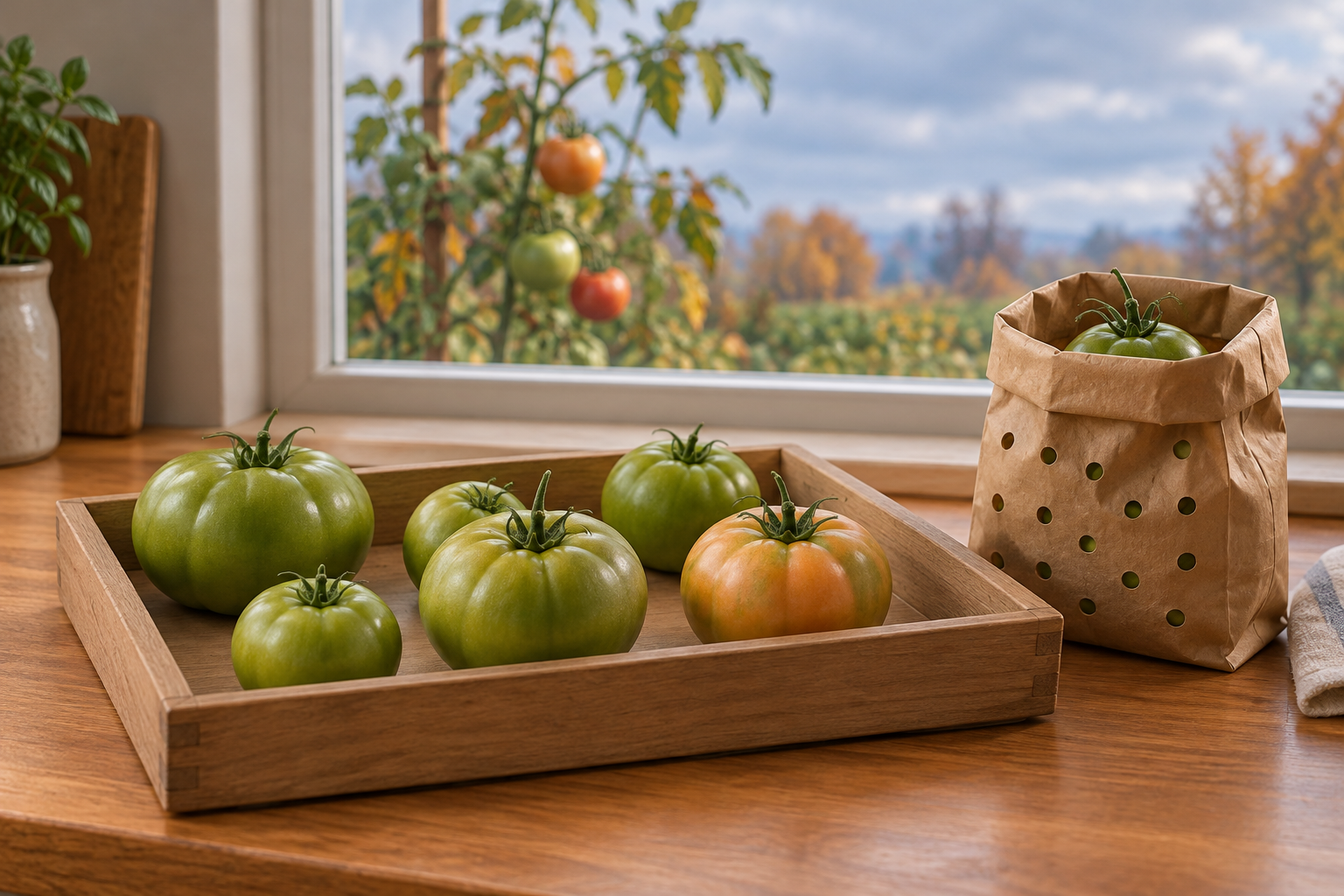
For a larger harvest, arrange tomatoes in a single layer at room temperature, with space between the fruit. University of Minnesota Extension says light is not necessary for this method, so a sunny windowsill is not required. Spacing also makes it easier to inspect each tomato.
For a smaller batch, Illinois Extension describes a perforated paper-bag method: place tomatoes stem-end up in the bag, fold the top, and check the fruit daily. Choose the approach that makes regular checks easiest. These are alternative ways to manage harvested fruit, not a promise that one will work faster for every tomato.
- Use a spaced, single-layer arrangement when you want to see and sort each tomato easily.
- Use a perforated paper bag for a smaller batch you want to keep together.
- Keep expectations flexible: the fruit’s maturity affects how it responds.
| Method | How to arrange the fruit | Useful when | What to expect |
|---|---|---|---|
| Single-layer arrangement | Set tomatoes apart in one layer at room temperature. | You have a larger harvest or want to inspect each tomato easily. | Light is not necessary; fruit may ripen at different rates. |
| Perforated paper bag | Place tomatoes stem-end up in a perforated bag and fold the top. | You have a smaller batch you want to keep together. | Check daily; timing varies with how underripe the fruit is. |
Check progress and adjust expectations
Regular checks help you spot changes and remove fruit that is deteriorating, without relying on a fixed ripening schedule.
Inspect the tomatoes regularly. If you use a paper bag, check it daily, as Illinois Extension recommends. Look for changes in color and condition, and move fruit that is ripening to a separate spot if that makes the remaining tomatoes easier to monitor.
The time needed varies, in part because tomatoes picked at different stages of development do not respond alike. Some mature-green fruit may ripen satisfactorily; other fruit may remain green or have disappointing flavor. Variety and maturity matter, so indoor ripening is best treated as an opportunity to use suitable fruit—not a guarantee that every tomato will match one ripened on the plant.
If a tomato becomes soft or shows signs of deterioration, remove it from the group rather than expecting it to improve. Keeping the rest of the harvest visible makes it easier to follow changes and make decisions about each tomato.
- Check bagged fruit daily and inspect tray fruit regularly.
- Separate tomatoes as they ripen if that makes the remaining fruit easier to track.
- Remove fruit that is deteriorating from the group.
What to do with tomatoes unlikely to ripen
Do not give every harvested tomato the same job: focus indoor ripening space on the better candidates and decide separately how to use the rest.
Very small or uniformly dark-green tomatoes are less likely to develop good flavor indoors. If you have fruit like this, you can choose a recipe specifically written for green tomatoes rather than waiting for it to ripen. That is a culinary option, not another method for ripening the fruit.
If you do not want to use the less mature tomatoes, you can simply leave them out of your ripening batch. The main practical point is to reserve your indoor space and attention for fruit that appears more fully developed, while remembering that appearance cannot guarantee the outcome.
- Use a recipe that specifically calls for green tomatoes if you want to cook the fruit while green.
- Keep lower-probability fruit separate from tomatoes you are monitoring for ripening.
A quick harvest-to-ripening checklist
Keep the process simple: respond to the forecast, sort carefully, choose one storage arrangement, and check the fruit.
You do not need to make every tomato ripen indoors. A sensible plan is to harvest before frost, prioritize mature-green fruit, and monitor the results. If a tomato does not seem likely to ripen, decide whether to use it green instead of leaving it indefinitely in the main batch.
- Check your local forecast for frost or a killing freeze.
- Harvest tomatoes before frost reaches the plants.
- Sort fruit that appears fully developed from very small or uniformly dark-green fruit.
- Arrange the better candidates in a spaced, single layer at room temperature, or use a perforated paper bag.
- Check the fruit regularly, remove deteriorating tomatoes, and use suitable green fruit in a recipe written for it.
Frequently asked questions
Should I pick green tomatoes before the first frost?
If frost is forecast for your area, bring tomatoes indoors before it reaches the plants. The right timing depends on your local forecast, not a universal date.
Will every green tomato ripen indoors?
No. Fully developed, mature-green tomatoes may ripen satisfactorily, but very unripe fruit—especially fruit that is uniformly dark green—is less likely to develop good flavor. Results vary.
How can I tell if a green tomato is mature enough to ripen?
There is no guaranteed visual test in this guidance. As a practical clue, prioritize fruit that appears fully developed compared with smaller tomatoes of the same variety. Very small or uniformly dark-green fruit is less promising, but size and color alone cannot guarantee the result.
Do green tomatoes need sunlight to ripen indoors?
No special light is necessary for the room-temperature, single-layer method described by University of Minnesota Extension. Spacing the tomatoes apart makes them easier to inspect.
How often should I check tomatoes in a paper bag?
Check them daily. Illinois Extension recommends daily checks and notes that the time needed varies with how underripe the tomatoes were when picked.
Sources & further reading
Explore the original sources behind this article. Our editorial perspective is separate from the organizations we reference.
- [S1] Growing tomatoes in home gardens | UMN Extensionextension.umn.edu
- [S2] Stalled Green Tomatoes: Why won’t they turn red? | Good Growing | Illinois Extension | Illinoisextension.illinois.edu
- [S3] Tomato | Home Vegetable Gardening | Illinois Extension | Illinoisextension.illinois.edu