Hosting a Potluck With Food Allergies: Labels, Serving, and a Backup Plan
Plan a more considerate potluck by asking about allergies early, sharing confirmed ingredient information, reducing cross-contact, and handling uncertain dishes honestly.
Start the food-allergy conversation early
A brief, private check-in gives the host time to coordinate while letting each guest identify what information would be useful.
If you are hosting a potluck with food allergies, contact guests before the menu is settled. Ask whether anyone has a food allergy and what information or arrangements would help them decide what to eat. When possible, ask privately so no one has to share personal health information with the group.
A useful message is specific but open-ended: “I’m planning the potluck menu. Are there any food allergies I should know about, and what ingredient or preparation details would help you?” A guest may ask for ingredient lists, original packaging, separate serving utensils, or the option to bring food they prefer.
Avoid asking a guest to certify your kitchen or promise that a dish will be suitable for them. Needs and comfort levels differ. FARE recommends discussing food needs ahead of a gathering and notes that a guest may bring food they can rely on when the shared menu is uncertain. The aim is clear communication and informed choice—not a guarantee.
- Ask early enough to adjust the menu or preparation plan.
- Ask what information would help rather than assuming everyone needs the same arrangement.
- Agree how contributors can tell you if a recipe or ingredient changes.
Share confirmed ingredients—and identify unknowns
Useful dish information makes clear what the cook knows, what has changed, and what cannot be verified.
Ask each contributor for the dish’s ingredients and any preparation details they can confirm. If a packaged ingredient is used, keep its packaging available or share a readable photo of its label so the guest can review it. For homemade dishes, request the ingredient list and note substitutions.
In the United States, FDA-regulated packaged foods are subject to allergen-labeling requirements for major food allergens. A packaged ingredient’s label can provide useful information about that product, but it does not verify every ingredient or handling step in a homemade or unpackaged potluck dish. A dish card also cannot establish whether cross-contact occurred during preparation or serving.
Write cards in plain, factual language. For example: “Ingredients reported by the cook: wheat flour, butter, eggs.” If a detail is unknown, say “not confirmed.” Do not treat “not listed” as proof that an ingredient is absent, and avoid broad claims such as “allergy-friendly” or “safe for everyone.” The guest—not the host or the card—decides whether the available information is enough for them.
- Keep packaging or a clear label photo when practical.
- Record substitutions and recipe changes, not only the dish’s usual ingredients.
- Distinguish “not confirmed” from “confirmed absent.”
- Do not infer ingredients from a dish’s name or appearance.
Reduce cross-contact during preparation
Separation and careful cleaning can reduce opportunities for accidental allergen transfer, but they cannot guarantee that a dish is suitable for an individual.
The FDA defines cross-contact as the unintentional introduction of a food allergen into another food. FARE describes precautions such as thoroughly washing kitchen tools and surfaces and keeping foods and utensils separate. These are practical steps to reduce risk, not proof that a particular dish is safe for a particular guest.
If you are preparing food for someone with an allergy, ask what preparation information matters to them. Clean the work surface and equipment, wash your hands, and use separate, clean utensils and containers where practical. Keep ingredients apart and cover the dish while it waits or travels. Explain what you did without presenting those precautions as a guarantee.
Do not assume that removing a visible ingredient from a finished dish makes it suitable. If you cannot confirm how the dish was prepared, say so plainly and let the guest decide whether to avoid it.
- Clean work surfaces and equipment before preparation.
- Use separate, clean utensils and keep ingredients and finished foods apart where practical.
- Cover dishes while they wait or travel.
- Explain what you can and cannot confirm; do not describe precautions as a guarantee.
Make the serving area easier to navigate
A consistent setup helps guests find dish information and reduces avoidable confusion about shared utensils.
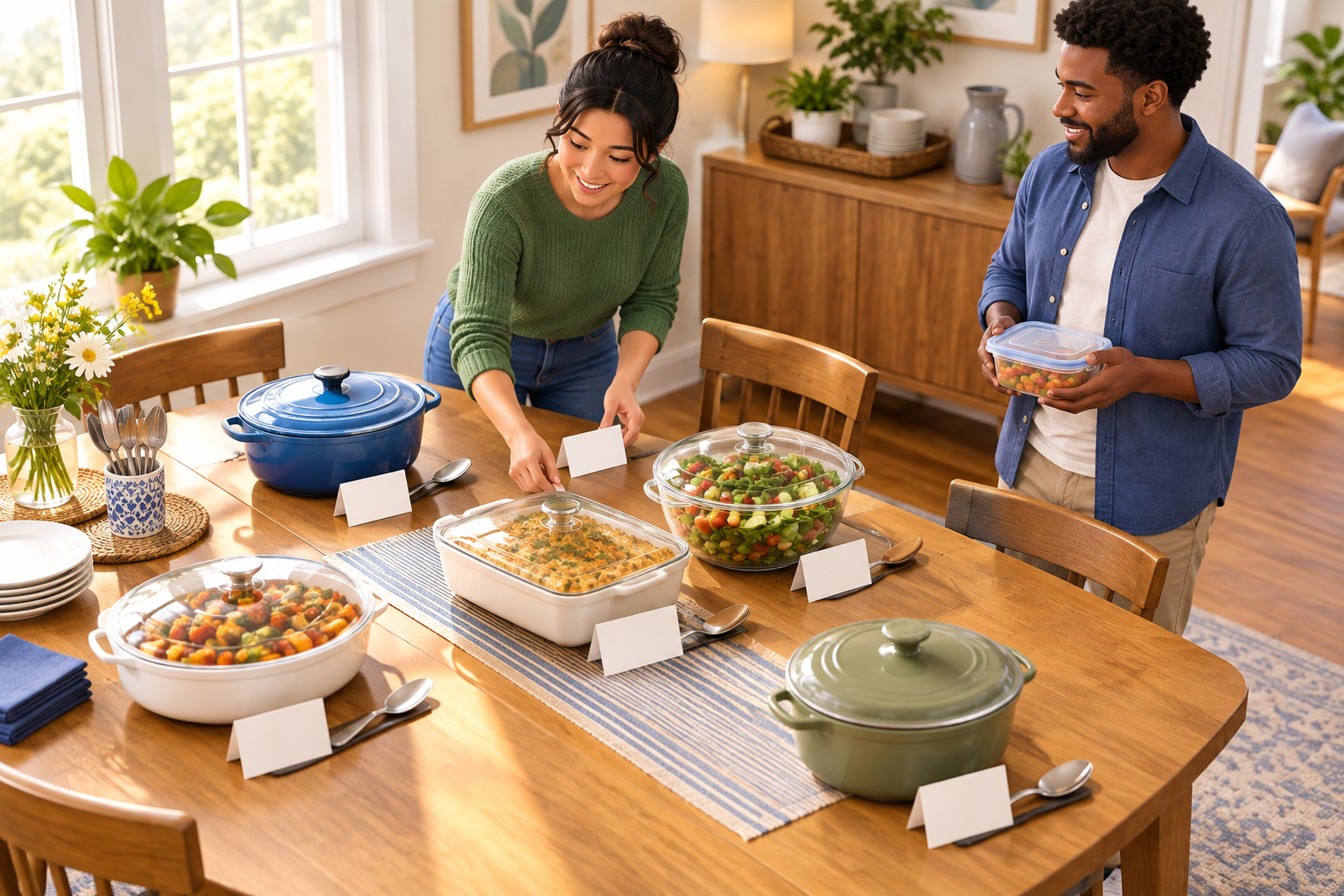
Place each dish with its ingredient card and a dedicated serving utensil. Keep utensils with their dishes, and remind guests not to move them between bowls or trays. Leave space between dishes where practical, and keep food covered until serving if that works for the meal.
Make questions easy to ask without drawing attention to anyone. You could stay nearby or tell guests where to find each cook. If a utensil is moved, food spills between dishes, or a card becomes separated from its dish, explain what happened. Do not try to restore certainty by removing visible food or simply returning a utensil to its original place.
- Use one serving utensil per dish and keep it with that dish.
- Place ingredient cards where guests can read them before serving.
- If food or utensils become mixed, tell guests rather than guessing.
- Offer a discreet way to ask the host or cook a question.
Handle dishes you cannot verify without guessing
Honest uncertainty gives a guest a better basis for deciding than reassurance unsupported by details.
A contributor may arrive without packaging, forget a recipe detail, or be unsure about a sauce or seasoning blend. Mark that detail as unknown and tell the guest. Do not guess based on how the dish looks, tastes, or is usually made.
Use the table as a guide to clear communication, not as a way to classify dishes as safe. The person with the allergy decides what they are comfortable eating. If they prefer to skip a dish or bring their own food, accept that without asking them to justify the choice. FARE’s gathering guidance supports discussing needs in advance and allowing guests to bring food they can rely on when the shared menu is uncertain.
| Situation | Helpful host response | Avoid |
|---|---|---|
| A packaged ingredient is available | Keep the package or share its label information for the guest to review. | Assume it verifies every preparation and serving step. |
| A homemade dish has an ingredient list | Share the list and the preparation details the cook can confirm. | Treat a handwritten card as proof that cross-contact did not occur. |
| An ingredient or preparation detail is unknown | Say it is unknown and let the guest decide whether to avoid the dish. | Guess or offer reassurance without evidence. |
| A guest prefers to bring food | Make space for it and help keep it separate if requested. | Pressure them to try shared food or explain their choice. |
Use a simple host checklist and message
A short plan keeps the focus on accurate information, practical precautions, and each guest’s freedom to choose.
You do not need to certify every dish to be a considerate host. Gather information, reduce avoidable cross-contact, and leave decisions to each guest. Check that the information beside a dish still matches what is being served, especially if a contributor changed the recipe.
A message you can adapt
“I’m looking forward to our potluck. Please tell me privately if you have a food allergy and what information or arrangements would help. I’ll ask contributors for ingredient details and share what they can confirm, but I can’t guarantee that a dish is suitable for you. You’re welcome to bring food you prefer, and there’s no pressure to eat anything you’re unsure about.”
- Before the event, ask guests privately about allergies and useful arrangements.
- Ask contributors for ingredient lists and preparation details they can confirm; request updates if recipes change.
- Plan where dishes, cards, and separate serving utensils will go. Leave room for a guest’s own food if requested.
- On the day, clean preparation surfaces and equipment, keep dishes covered where practical, and use separate utensils.
- Put clear ingredient information beside each dish and identify unknown details honestly.
- Let guests ask questions, skip dishes, or bring their own food without pressure.
Frequently asked questions
Should I label a potluck dish “allergy-friendly”?
It is clearer to list the ingredients and preparation details the cook can confirm. “Allergy-friendly” can imply a level of safety you may not be able to verify. Share the facts and let the guest decide whether they are enough.
Can I make a dish suitable by removing an allergen from it?
Do not assume that removing a visible ingredient makes the finished dish suitable. It may already be mixed through the food, and handling can create cross-contact. Explain what you do not know and let the guest decide.
Is a packaged-food label enough to verify a potluck dish?
A label provides information about that packaged ingredient, but it does not describe every step in a homemade dish’s preparation or serving. Share the packaging information and other details you know without promising that the finished dish is safe.
What if a guest is unsure about every dish?
Respect their decision. Offer a no-pressure option to bring their own food, help keep it separate if requested, and make it easy to decline food without being singled out. For individual precautions or an emergency plan, the guest should follow guidance from their healthcare professional.
Sources & further reading
Explore the original sources behind this article. Our editorial perspective is separate from the organizations we reference.
- [S1] Food Allergies | FDAfda.gov
- [S2] Parties - FoodAllergy.orgfoodallergy.org
- [S3] Steps for a Safe Kitchen - FoodAllergy.orgfoodallergy.org
- [S4] Avoiding Cross-Contact - FoodAllergy.orgfoodallergy.org