Power Outage Food Safety: What to Do Before, During, and After
Keep refrigerator and freezer doors closed, prepare a cooler if the outage continues, and use appliance temperatures—not taste or smell—to decide what food is safe.
Power outage food safety: the short answer
Start by protecting the cold air already inside the appliances; make decisions based on temperature and time, not guesswork.
During a power outage, keep refrigerator and freezer doors closed. An unopened refrigerator can keep food cold for about four hours. A full freezer can stay cold for about 48 hours, or about 24 hours if it is half full. Those are general estimates: appliance design, how full it is, room conditions, door openings, and added cold sources can change the result.
If power has been out for more than four hours, move refrigerated perishables to a cooler packed with ice or cold packs if you can keep them at 40°F or below. When power returns, check appliance thermometers and assess foods individually. Never taste food to see whether it is safe.
Before an outage: prepare a simple food-safety kit
A few low-cost preparations make it easier to protect food and assess conditions if electricity is interrupted.
Keep an appliance thermometer in both the refrigerator and freezer so you can check actual temperatures instead of relying on how cold an appliance feels. The refrigerator should be kept at 40°F or below. Make sure the thermometer is easy to read without leaving the door open for long.
Have a cooler and ice or reusable cold packs available. If severe weather is forecast, freeze water in clean containers ahead of time, leaving room for expansion, and keep a supply of ice if practical. Avoid overfilling the freezer: leaving space for air circulation can help it operate effectively, while a fuller freezer generally holds cold longer during an outage.
If you take medicine that needs refrigeration, follow its storage instructions and ask a pharmacist or prescriber what to do after a power interruption. Food-safety guidance does not determine whether a particular medicine remains usable.
- Check that refrigerator and freezer thermometers are working and visible.
- Keep a cooler, ice, or frozen gel packs where you can reach them.
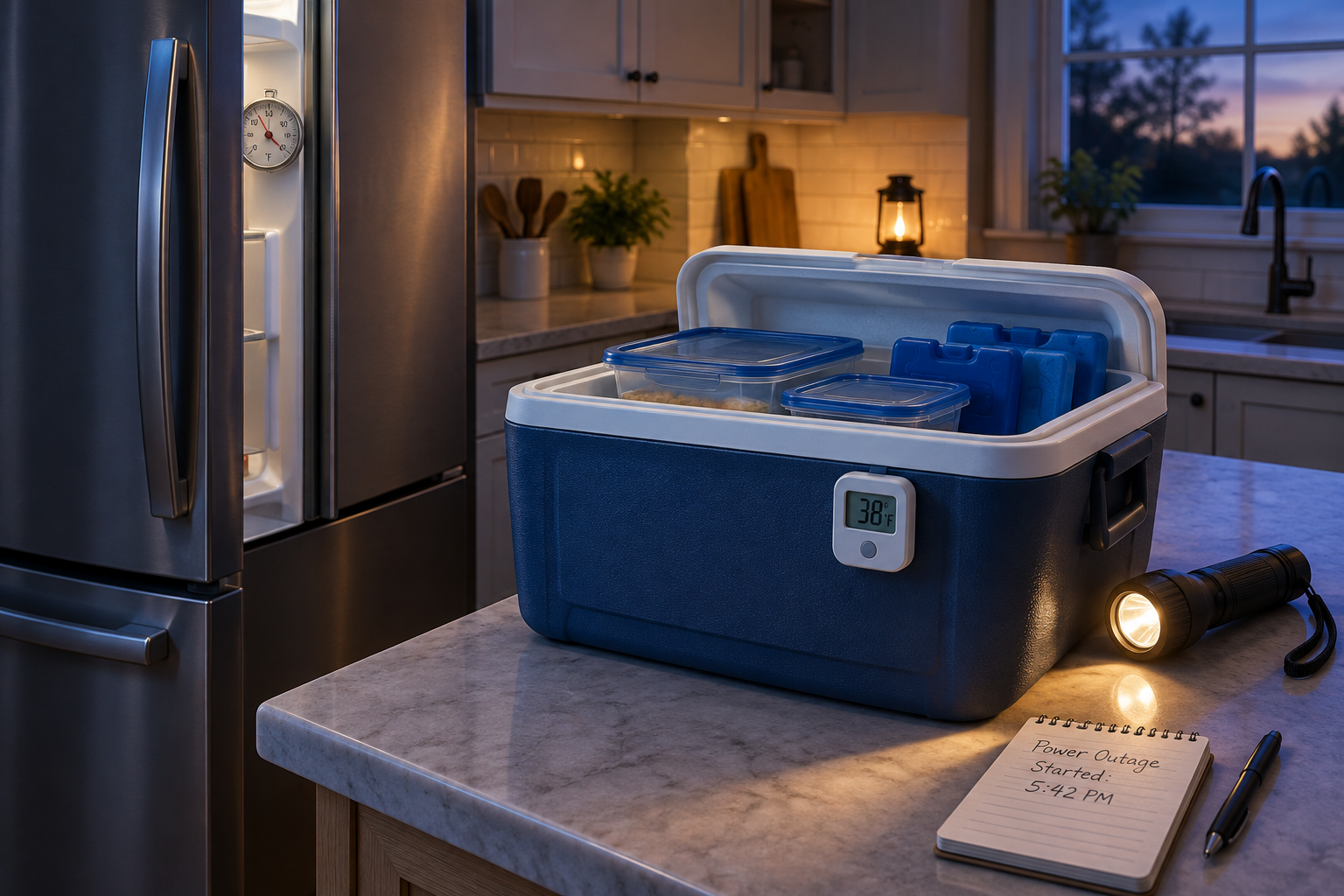
- Make a note of the time power fails so you can track the outage duration.
When the power goes out: keep both doors closed
The first practical action is restraint: opening the doors releases the cold air that is helping preserve food.
Write down when the outage began, then leave the refrigerator and freezer shut. Avoid opening them to check food, move items around, or search for snacks. If you need something, decide what to retrieve before opening the door and take it out quickly.
The FDA’s approximate holding times assume the doors remain closed: about four hours for a refrigerator, about 48 hours for a full freezer, and about 24 hours for a half-full freezer. These estimates are not a promise that every item will stay safe for that long. A frequently opened appliance, a warm room, or a freezer that was not fully cold at the start can change the outcome.
Do not put food outdoors in snow or cold weather as a substitute refrigerator. Outside temperatures fluctuate, food may be exposed to animals or contamination, and the temperature around the food may not remain controlled. Use a cooler with ice or cold packs instead.
If the outage continues: use a cooler carefully
A cooler can help protect refrigerated food, but only if it stays cold enough and is handled efficiently.
Once the outage is expected to last beyond about four hours, prepare a cooler for perishable refrigerated foods. Transfer them promptly, group similar items together, and surround them with enough ice or cold packs to maintain a temperature of 40°F or below. Put the thermometer where it can give a useful reading without repeatedly unpacking the cooler.
Keep the cooler closed and place it in a cool, shaded indoor location. Separate raw meat, poultry, or seafood from ready-to-eat foods, and keep raw items contained so their juices cannot reach other food. If you have more than one cooler, using one for frequently accessed drinks can help keep the food cooler closed.
Check the temperature rather than assuming that ice is enough. Add ice or cold packs as needed. If you cannot keep the food at 40°F or below, or do not know how long it has been warmer, consult official guidance for the specific food and err on the side of discarding questionable perishables.
- Choose a clean cooler and add ice or cold packs before transferring food.
- Move perishable foods quickly, keeping raw animal foods contained and separate.
- Use a thermometer to confirm the cooler remains at 40°F or below.
- Keep the lid closed and replenish ice or packs when needed.
When power returns: check temperatures before keeping food
A quick, organized assessment can prevent both unnecessary waste and risky decisions.
Read the refrigerator and freezer thermometers before rearranging items. If you know a refrigerator stayed at 40°F or below, its food has remained under refrigeration conditions. If food was warmer, consider how long it was exposed and consult the official food-by-food chart; do not assume that chilling it again makes it safe.
For frozen food, the FDA says items that still contain ice crystals or are at 40°F or below can be refrozen or cooked. Quality may change after thawing and refreezing, but safety decisions should follow temperature and condition guidance rather than a food’s appearance alone. If an item thawed and you cannot establish its temperature or handling history, check the official chart for that food.
Use the chart rather than trying to create one rule for every item. Different foods have different guidance, and a refrigerator outage is not the same as a freezer outage. If an item is not covered clearly or you cannot determine how warm it became, avoid tasting it and discard it when safety is uncertain.
| What you find | Practical next step |
|---|---|
| Refrigerator food remained at 40°F or below | Keep it refrigerated and use normal food-specific handling guidance. |
| Frozen food still has ice crystals or is at 40°F or below | It can generally be refrozen or cooked, according to FDA guidance. |
| Perishable food became warmer or its temperature history is unclear | Check the official food-specific chart; discard it if guidance says to or safety cannot be established. |
| Food looks or smells normal, but its temperature history is uncertain | Do not taste it or use appearance and odor as proof of safety. |
Common mistakes that can make the decision harder
Avoid actions that release cold air or replace reliable temperature checks with unreliable sensory clues.
Repeatedly opening the refrigerator or freezer to inspect food can warm the interior faster. Instead, note the outage start time, leave the doors closed, and make one planned transfer to a cooler if needed.
Do not taste a questionable item, even a small amount. The USDA Food Safety and Inspection Service advises against tasting food to test its safety. A food can be unsafe without an obvious change in smell, color, or texture, so those clues are not a substitute for temperature and time guidance.
Do not treat the estimated hold times as automatic discard deadlines or guarantees. A full freezer may hold cold longer than a half-full one, but an individual appliance’s condition and how often it is opened matter. Likewise, food rescued in a properly monitored cooler is not governed simply by the time the household was without power.
- Do not taste food to test its safety.
- Do not rely on smell, appearance, outdoor cold, or the appliance display alone.
- Do not assume refreezing makes food safe if it was already held at an unsafe temperature.
A quick keep, check, or discard checklist
Use this recap to make a calm first pass, then verify uncertain foods against official guidance.
The safest approach is to separate what you know from what you are guessing. Record the outage time, read the thermometers, and use the FDA or USDA guidance for each food rather than deciding based on a single rule for the whole refrigerator or freezer.
- Keep: food that remained properly cold, using the applicable food-specific storage guidance.
- Check: items with uncertain temperature histories, using the official food-by-food guidance before deciding.
- Discard: foods the official guidance identifies as unsafe, and questionable perishables when you cannot establish safe handling.
- Never taste food to decide whether it is safe.
Frequently asked questions
How long will a refrigerator stay cold without power?
An unopened refrigerator keeps food cold for about four hours, according to FDA guidance. Treat this as a general estimate, not a guarantee; appliance conditions and door openings affect how quickly food warms.
How long can food stay in a freezer during a power outage?
A full freezer can stay cold for about 48 hours, or about 24 hours if it is half full, provided the door stays closed. These are approximate holding times, not assurances about every appliance or food item.
Can I refreeze food after a power outage?
FDA guidance says frozen food that still has ice crystals or is at 40°F or below can be refrozen or cooked. If it is warmer or its temperature history is unclear, check the official guidance for that specific food rather than guessing.
Can I tell whether food is safe by smelling or tasting it?
No. Do not taste food to test its safety, and do not rely on smell or appearance. Use temperature information and official food-by-food guidance.
Should I put food outside if it is cold or snowy?
No. Outdoor conditions are not a controlled substitute for refrigeration and can fluctuate or expose food to contamination. Use a cooler with ice or cold packs and monitor its temperature.
Sources & further reading
Explore the original sources behind this article. Our editorial perspective is separate from the organizations we reference.