How to Freeze Pie Crust: Disks, Rolled Sheets, or Pan-Fitted Shells?
Freeze pie crust as a dough disk, a rolled sheet, or a shell fitted to its pan. Choose based on freezer space and how much work you want to leave for baking day.
Can you freeze pie crust ahead? Yes—choose the format first
The best make-ahead option depends on whether freezer space or convenience matters more.
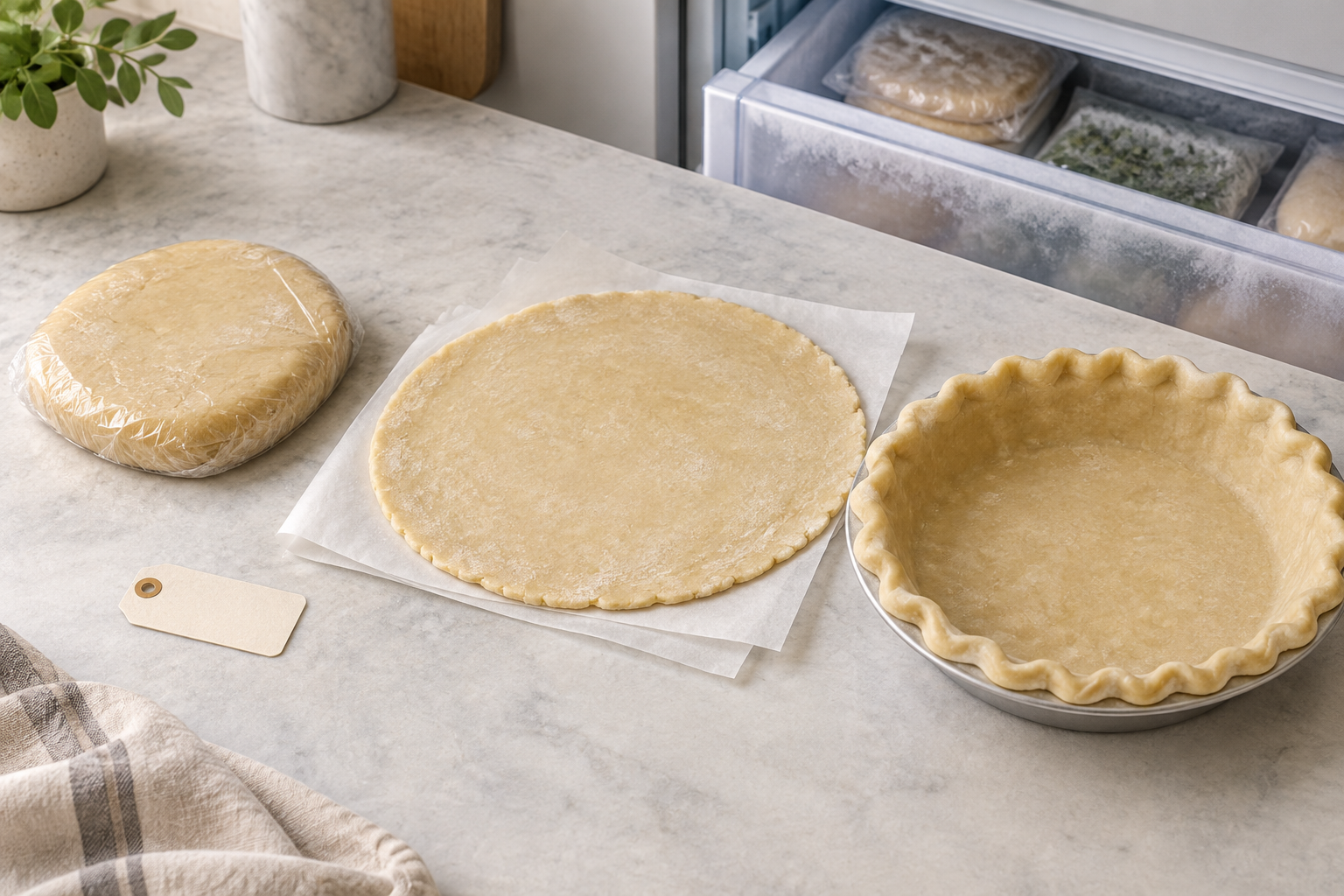
Yes. You can freeze pie crust as a dough disk, as rolled pastry, or already fitted into a pie pan. The choice determines how much work remains on baking day: disks need rolling, flat sheets need shaping, and pan-fitted shells are closest to ready for filling or baking.
For a small freezer or a pie you have not chosen a pan for yet, a disk is compact. If you want to skip rolling later, freeze the dough rolled flat. If you know which pan and recipe you will use, a fitted shell can save the most hands-on preparation. These are different ways to organize the same make-ahead task, not interchangeable baking instructions.
Compare dough disks, rolled sheets, and pan-fitted shells
Use this comparison to match the crust format to your available space and the work you want to do now.
The freezer-space comparison assumes you are storing one crust. Actual room needed depends on your pan, packaging, and how many crusts you are preparing.
| Format | Freezer-space trade-off | Work left for baking day | Thawing and use |
|---|---|---|---|
| Dough disk | Most compact; easy to stack when well wrapped. | Thaw, then roll and shape. | Thaw in the refrigerator before rolling. Allow enough time for the dough to become workable, following your recipe. |
| Rolled pastry sheet | Stores flat; can be stacked with separators, but takes more room than a disk. | Less rolling; you may still need to fit it into a pan or trim it. | Thaw flat in the refrigerator before shaping, as directed by the recipe. |
| Shell fitted to its pan | Uses the pan’s footprint and can be awkward to stack or protect. | Least shaping work; the shell is already in place. | Penn State Extension says pastry frozen in a pan can be baked without thawing. Follow the recipe for the particular pie. |
How to freeze pie crust so it is easy to identify and use
Careful wrapping and labeling make the crust simpler to handle later, especially when several components are prepared ahead.
Before freezing, decide whether the dough will be a disk, a flat round, or a shell in its pan. If the recipe makes enough for a double crust, mark whether the package contains one crust or both. For a rolled sheet, use a flat surface and separators between sheets to help keep them apart; Penn State Extension describes freezing rolled dough circles flat with separators.
Wrap the dough or pastry snugly so it is protected from air, then place it in a freezer-safe bag or other suitable outer packaging. For a shell in a pan, protect the rim and cover the pastry so it is less exposed to freezer air and less likely to be bumped or crushed. If the pan is not suitable for the freezer, follow the recipe’s or pan maker’s guidance before freezing it in place.
Label each package with the type of crust, the number of crusts, and the date frozen. Storage-time recommendations can differ by recipe and source, so do not assume one duration fits every dough. Use the storage guidance for your recipe, and make a note of any special thawing or baking instructions.
- Prepare the crust in the format you plan to use: disk, rolled sheet, or pan-fitted shell.
- Wrap it securely and add outer freezer packaging; use separators for stacked flat pastry.
- Label the package with its format, quantity, date, and any recipe-specific instructions.
- Place it where it can stay protected from being crushed, particularly if it is already in a pan.
Thaw or bake from frozen? The format matters
A flat piece of pastry and a crust in its pan do not necessarily follow the same thawing path.
For a frozen dough disk or flat sheet, plan to thaw in the refrigerator before rolling or shaping. Penn State Extension specifically advises refrigerator thawing for frozen sheets before shaping. Avoid trying to force cold, stiff pastry into a pan; it may be difficult to work with and more prone to cracking. Follow your recipe’s directions for when the dough is ready to roll.
A shell already fitted into a pie pan is different. Penn State says unbaked pastry frozen in a pie pan can be baked without thawing. That does not mean every filling, crust recipe, or oven schedule uses the same method. Check whether your recipe calls for a frozen shell, a thawed shell, or a parbaked one, and follow its temperature and baking cues rather than adding a fixed amount of time on your own.
King Arthur Baking also describes freezing rolled pastry in its pie pan as a way to skip rolling and shaping later. Treat this as a convenient preparation option, not a substitute for the specific recipe’s baking directions.
When to freeze a parbaked shell
A partially baked shell can be a useful make-ahead component for some pies, but the recipe determines the method.
Some pie recipes call for a crust to be baked briefly before the filling goes in. King Arthur Baking describes freezing a parbaked shell for a pie such as pumpkin, then adding the filling and baking without thawing. This can move some oven work earlier, but parbaking is recipe-dependent: crust ingredients, filling, and bake sequence all matter.
If your recipe calls for parbaking, follow its directions for how far to bake the shell, how to cool it, how to protect it in the freezer, and whether to add the filling while the shell is frozen or thawed. Do not assume an unbaked-shell method applies to a parbaked crust, or that a parbaking method is suitable for every pie.
Keep fruit filling separate if crust texture matters
Freezing a crust and freezing a filled pie are different make-ahead choices.
A frozen, unbaked crust is not the same thing as a fully assembled pie in the freezer. Penn State Extension notes that fruit filling can soften the lower crust during freezing and recommends freezing the filling and crust separately for better crust quality. If you want to prepare both components ahead, keep them separate unless your recipe specifically gives directions for freezing the assembled pie.
This separation also makes your baking-day plan clearer: thaw or prepare the filling as its instructions require, then combine it with the crust in the sequence your pie recipe specifies. Freezing components separately does not guarantee a particular texture, but it avoids treating an assembled fruit pie as though it were just a frozen crust.
Plan backward from serving day
A simple schedule can prevent a make-ahead crust from becoming a last-minute thawing problem.
Start with the pie recipe and serving time, then work backward from its required steps. For example, if you are making a pumpkin pie for a holiday meal, you might prepare a pan-fitted shell in advance, label it with the recipe and date, and freeze it. On baking day, check whether the recipe calls for an unbaked or parbaked crust and whether it expects the shell to go into the oven frozen. If it requires a parbaked shell, schedule that step and cooling time earlier instead of assuming the frozen shell is ready for filling.
If you choose a disk or rolled sheet, include refrigerator thawing and shaping in your schedule. Do not rely on a universal number of hours: dough size and recipe vary. If plans change, keep the dough frozen and follow the recipe’s storage guidance rather than thawing it early with no clear use in mind.
The practical next step is to choose your pie recipe first. Then select the crust format that matches its instructions, your freezer, and the amount of work you want to leave for baking day.
Frequently asked questions
Can you freeze homemade pie dough?
Yes. Freeze it as a wrapped disk, rolled pastry, or a shell fitted to its pan. Choose the form based on freezer space and how much shaping you want to do later, and follow the recipe’s storage guidance.
Should pie dough be frozen as a disk or rolled out?
A disk saves space, while rolled pastry can reduce rolling work later. Flat sheets should be thawed in the refrigerator before shaping, and Penn State Extension describes using separators when freezing rolled circles flat.
Can you bake a frozen pie crust without thawing it?
A shell frozen in its pie pan may be baked without thawing according to Penn State Extension, but check your specific recipe. Frozen disks and flat pastry generally need refrigerator thawing before rolling or shaping.
Can you freeze pie crust in the pan?
Yes, if the pan and recipe are suitable for freezer storage. Protect the shell from being crushed, label it, and check the recipe to see whether it should be baked from frozen, thawed, or parbaked.
Can you freeze pie crust with fruit filling already in it?
That is different from freezing the crust alone. Penn State Extension notes that fruit filling can soften the lower crust during freezing and recommends freezing filling and crust separately for better crust quality.
Sources & further reading
Explore the original sources behind this article. Our editorial perspective is separate from the organizations we reference.
- [S1] Freezing Pies and Pie Fillingsextension.psu.edu
- [S2] Things bakers know: Don’t freeze disks of pie dough — do this instead | King Arthur Bakingkingarthurbaking.com
- [S3] How to Bake Pie | King Arthur Bakingkingarthurbaking.com