How to Mail Homemade Cookies: Choose Sturdy Treats and Pack Them Well
Choose firm cookies or bars, cool them completely, and use a snug inner container plus cushioning in a sturdy outer box. Learn when a cookie gift needs more than ordinary shipping.
Choose cookies that can handle a trip
The recipe determines how much protection the package needs—and whether ordinary shipping is appropriate at all.
For mailing, choose a cookie that is sturdy before it ever reaches the box. Firm, chewy cookies and bar cookies are practical candidates because they are less fragile than thin, crisp, or intricately shaped treats. Kansas State University Extension recommends firm, chewy cookies and bars for food gifts sent by mail. That is useful selection guidance, not a promise that any particular batch will arrive intact. (Source: Kansas State University Extension, October 19, 2023.)
Think about the whole cookie, not just its base. A soft center, brittle edge, loose crumb, delicate icing, or tall decoration can make a treat more vulnerable to pressure and movement. A simple sturdy cookie may be a better gift for a long journey than a visually elaborate one. Brownies or other bars can also be easier to arrange in a flat, snug container, provided the recipe is suitable for storage at room temperature.
Avoid treating a recipe as shelf-stable just because it is called a cookie. Kansas State advises caution with recipes containing cream cheese or high amounts of dairy. For any recipe with a filling or topping that needs refrigeration, check reliable food-safety guidance for that specific food rather than assuming it can travel like a plain cookie. (Source: Kansas State University Extension, October 19, 2023.)
- More suitable starting points: firm, chewy cookies and sturdy bar cookies made with a recipe appropriate for room-temperature storage.
- More fragile choices: thin crisp cookies, brittle shapes, delicate decorations, or treats with soft components that can smear or shift.
- Pause before mailing: cream-cheese fillings, dairy-heavy components, or other ingredients that require refrigeration.
| Treat type | What to consider | Packing approach |
|---|---|---|
| Firm, chewy cookie | A sturdier shape is a sensible choice, but recipe and handling still matter. | Wrap pairs or small groups and fit them snugly in an inner container. |
| Bar cookie | A flat shape may be easier to arrange, but soft or perishable toppings change the shipping question. | Separate layers with suitable wrapping and limit movement inside the container. |
| Thin, crisp, or delicate cookie | Edges and decorations may be more vulnerable to pressure and shaking. | Choose another treat if you cannot protect it without crushing or crowding. |
| Cookie with a perishable filling or topping | May need temperature control rather than ordinary parcel handling. | Do not mail as a routine cookie box unless appropriate cold-shipping safeguards are arranged. |
Cool and group the cookies before wrapping
Good packing starts only after the baked goods are ready to be enclosed.
Let cookies cool completely on a rack before packing. Warm cookies can release moisture into their wrapping or container, which may affect their texture. Cooling also makes them less likely to bend or break as you handle them. Follow the recipe’s directions for cooling and storing; there is no single storage-life estimate that applies to every homemade cookie.
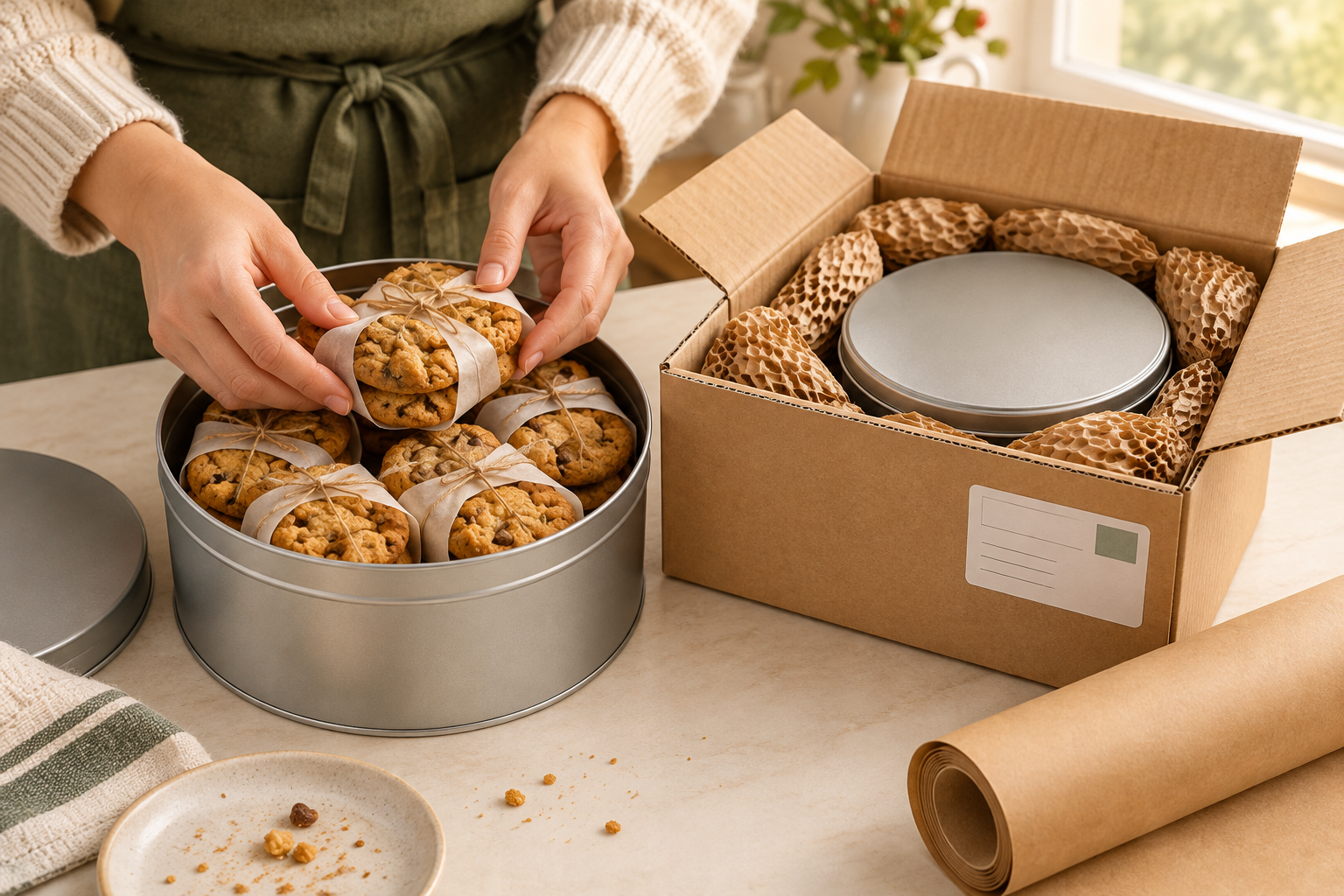
Sort the batch by shape and size before wrapping. Keep bars together with similar bars, and avoid placing a heavy or unusually large cookie on top of smaller, delicate pieces. For round cookies, wrap pairs back-to-back, as Kansas State Extension recommends, or package pieces individually if their edges or decorations need extra protection. Use food-safe wrapping that fits without squeezing.
If you are sending several varieties, separate them so flavors, crumbs, and decorations do not mix. For example, place a sturdy plain cookie group in one wrapped bundle and a more delicate—but still suitable for mailing—variety in another. A little organization makes it easier to pack each group snugly without pressing on the cookies.
- Wait until the cookies are fully cool.
- Group similar shapes and sizes.
- Wrap pairs back-to-back or package individual pieces when added separation is useful.
- Keep different varieties apart if they are likely to crumble, smear, or transfer odors.
Build two layers of protection
A container around the cookies and cushioning around that container serve different purposes.
Put the wrapped cookies in a snug tin or small box. Kansas State Extension recommends placing a small tin or box inside a larger cushioned shipping box. The inner container helps keep the cookies together; the outer package protects that container from knocks and gives you room to cushion it. (Source: Kansas State University Extension, October 19, 2023.)
Choose an inner container that is large enough to avoid squeezing the cookies but not so roomy that they slide around. If the container has space at the top or sides, add suitable clean packing material or adjust the arrangement. Avoid packing so tightly that the lid presses on decorations or the top layer.
Next, select a sturdy shipping box with space for cushioning around the inner container. USPS package-preparation guidance says to use cushioning and secure contents so they do not shift. Fill the space on all sides, including above and below, with appropriate packing material. Close the outer box temporarily and move it gently: if the inner container slides or thumps, add or reposition cushioning. (Source: USPS Postal Explorer, Preparing Packages.)
Use cushioning that holds its position during handling. Loose scraps that settle to one side may leave an unprotected gap. The aim is not to make the box impossible to open; it is to keep the inner container from moving freely and to reduce direct impact.
- Inner layer: snug tin or small box containing the wrapped cookies.
- Outer layer: sturdy shipping box with cushioning around the inner container.
- Test: gently tilt or move the closed box and add cushioning if you feel the contents shift.
Seal, label, and plan the handoff
A well-packed box still needs a clear destination and a recipient who knows to expect it.
Close the shipping box and reinforce its seams with packaging tape. USPS guidance recommends securing package contents and reinforcing box seams; follow the carrier’s current instructions for preparing and labeling your particular parcel. (Source: USPS Postal Explorer, Preparing Packages.)
Write or print the recipient’s complete address clearly, including any apartment, unit, or suite number. Check the ZIP Code and return address against information you trust rather than relying on a rushed memory. As a practical backup, place a second copy of the destination address inside the box in case the outside label becomes unreadable. This is a precaution, not a guarantee against loss.
Tell the recipient that the gift is on its way and ask them to bring it inside promptly. That can help avoid a box sitting unattended, especially in heat or wet weather. Choose a mailing service and timing that fit your plans, but do not promise a specific arrival condition: transit time, handling, and weather can vary. Check the carrier’s current service details before sending if timing matters.
- Recheck the full delivery address and return address.
- Tape the box seams securely.
- Put a backup address note inside as a practical precaution.
- Let the recipient know to look for the parcel and bring it inside.
Know when ordinary cookie mailing is not enough
A cookie gift that needs cold storage is a different shipping problem from a shelf-stable baked treat.
USPS says it does not provide refrigeration for mailed items. Its guidance for cold shipments describes special packaging and handling requirements, so a regular box with a cold pack should not be treated as an automatic solution. (Source: USPS, How Do I Keep My Mailed Item Cold or Refrigerated?)
FoodSafety.gov distinguishes shelf-stable food gifts from perishable foods and advises using a sturdy box and a cold source, such as frozen gel packs or dry ice, when shipping perishable food prepared at home. That does not mean every cookie needs cold shipping; it means the food’s ingredients and storage needs matter. (Source: FoodSafety.gov, Holiday Tips for Food Gifts.)
If a recipe includes a filling or topping that requires refrigeration, first determine whether it is suitable to ship and what temperature-control method and carrier requirements apply. Dry ice and other cold-shipping methods may involve specific rules, packaging, or labels; this guide does not provide instructions for those shipments. If the requirements are unclear, choose a shelf-stable alternative or use a qualified shipping option designed for the food.
- Do not assume ordinary USPS mail will keep food cold.
- Do not describe a cookie as shelf-stable without a recipe or food-safety basis.
- For perishable components, check current official guidance and applicable carrier requirements before shipping.
Use this pre-shipping checklist
A final check catches the common problems: the wrong recipe, warm cookies, empty space, and an incomplete address.
Before taking the package to the carrier, run through these steps. Adjust the wrapping and cushioning to the shape and fragility of the actual cookies rather than trying to force every batch into one packing method.
- Confirm the recipe is appropriate for the intended storage and shipping conditions; set aside anything that needs cold handling unless you have arranged the right safeguards.
- Cool cookies completely and group them by size, shape, and fragility.
- Wrap pairs or individual pieces as needed, then place them in a snug tin or small box.
- Center the inner container inside a sturdy shipping box and cushion it on all sides.
- Close the box, move it gently, and add cushioning if the contents shift.
- Reinforce seams, verify both addresses, and notify the recipient that the package is coming.
Frequently asked questions
Which homemade cookies are best to mail?
Firm, chewy cookies and sturdy bar cookies are sensible starting points because they are generally less fragile than thin, crisp, or delicate treats. Choose a recipe suited to room-temperature storage, and remember that packaging cannot guarantee how a specific batch will arrive.
Should I wrap cookies individually?
Not always. Wrapping pairs back-to-back can work well for sturdy cookies; individual wrapping can give more separation to pieces that are fragile or likely to crumble. In either case, avoid squeezing them and place the wrapped cookies in a snug inner container.
Can I mail cookies with cream cheese frosting or filling?
Do not assume they can travel as an ordinary cookie gift. Kansas State Extension advises caution with cream-cheese and dairy-heavy recipes, and USPS does not refrigerate mailed items. Check food-safety and carrier guidance for the specific treat, or choose a recipe that does not require cold handling.
Does adding a cold pack make a perishable cookie safe to mail?
Not by itself. Perishable food may require a suitable cold source, packaging, and handling plan, and ordinary mail is not refrigerated. Verify the current official food-safety and carrier requirements before sending; if you cannot meet them, choose a different gift.
Sources & further reading
Explore the original sources behind this article. Our editorial perspective is separate from the organizations we reference.
- [S1] Mailing Food Gifts | K-State | Kansas State Universityk-state.edu
- [S2] Preparing Packages | Postal Explorerpe.usps.com
- [S3] faq.usps.comfaq.usps.com
- [S4] Holiday Tips for Food Gifts | FoodSafety.govfoodsafety.gov