How to Plant Garlic in Fall: Let Local Frost Timing Set the Date
Choose garlic suited to your climate, prepare a well-drained bed, and plant cloves point-side up. Use local frost or ground-freeze guidance—not a nationwide calendar date—to decide when to plant.
How to plant garlic in fall: check local timing first
Start with a local planting recommendation, because a calendar date from another region may not fit your garden.
To plant garlic in fall, first check whether the recommended planting window is still open where you live. Garlic grows from individual cloves, and fall planting gives them a cold period before bulb formation. But the right timing depends on local conditions, so a date that works in one state may not suit another.
Regional extension services use different timing cues. Penn State Extension advises planting about three weeks before the ground freezes, while Illinois Extension gives advice relative to the local killing frost. These are recommendations for their respective regions, not competing rules for the whole country.
If you are considering planting in late October, do not assume you have either missed the window or should plant immediately. Look up advice from your state or county extension service, note the cue it uses, and compare it with local conditions. If the ground is already frozen or the suggested window appears to have passed, ask your local extension service whether planting now is appropriate.
- Search your state or county extension service’s website for fall garlic planting guidance.
- Check whether its timing cue is a killing frost, expected ground freeze, or another local measure.
- Use that regional recommendation—not a date copied from another climate—to decide when to plant.
| Regional source | Timing cue | How to use it |
|---|---|---|
| Penn State Extension | About three weeks before the ground freezes | Use as regional guidance; check the conditions and recommendation where you garden. |
| Illinois Extension | Timing relative to the local killing frost | Follow the advice for Illinois conditions rather than treating it as a national date. |
Choose garlic suited to your region
Regional suitability matters more than choosing a type based on a universal hardneck-or-softneck rule.
Garlic varieties are commonly grouped as hardneck or softneck, but neither type is the best choice for every U.S. garden. Illinois Extension discusses both types, while Minnesota Extension advises cold-climate gardeners to choose varieties adapted to their conditions. Look for planting stock with a named variety and information about where it is suited to grow.
Ask a local extension service or a reputable supplier which options suit your climate. Check that the garlic is sold as planting stock rather than assuming any bulb will perform well in a garden. Grocery-store garlic is not automatically unsuitable, but its variety may not fit your region, and its storage or treatment history may be unclear.
Before buying, estimate how much space you have and check the supplier’s information about the number of cloves in a bulb. Clove counts vary, and you will need enough room to follow the spacing advice for your area.
- Look for named planting stock and regional suitability information.
- Choose according to your local climate, not the hardneck or softneck label alone.
- Treat grocery-store garlic as an uncertain option rather than a guaranteed substitute.
Prepare a bed with well-drained soil
A site that drains well is a practical starting point for preparing a garlic bed.
Choose a planting area where water does not persistently collect. Illinois Extension identifies well-drained soil as an important condition for growing garlic. If your intended bed stays soggy after rain, consider a different site or consult local guidance about preparing the area before planting.
Clear the planting area so you can place cloves at a consistent depth and see where you have planted them. Prepare the bed before separating cloves, since the cloves are best planted soon after you split the bulb. If you are unsure whether your site is suitable or how to prepare it, ask your local extension service for advice that reflects your soil and climate.
Decide where the rows will go before you start. A simple layout helps you follow the spacing recommendation for your region, use the available bed efficiently, and keep track of what you planted.
- Choose a bed with well-drained soil.
- Prepare the planting area before separating cloves.
- Lay out rows so you can follow local spacing guidance.
Separate and plant the cloves
The basic method is simple; use regional advice for the exact planting depth and spacing.
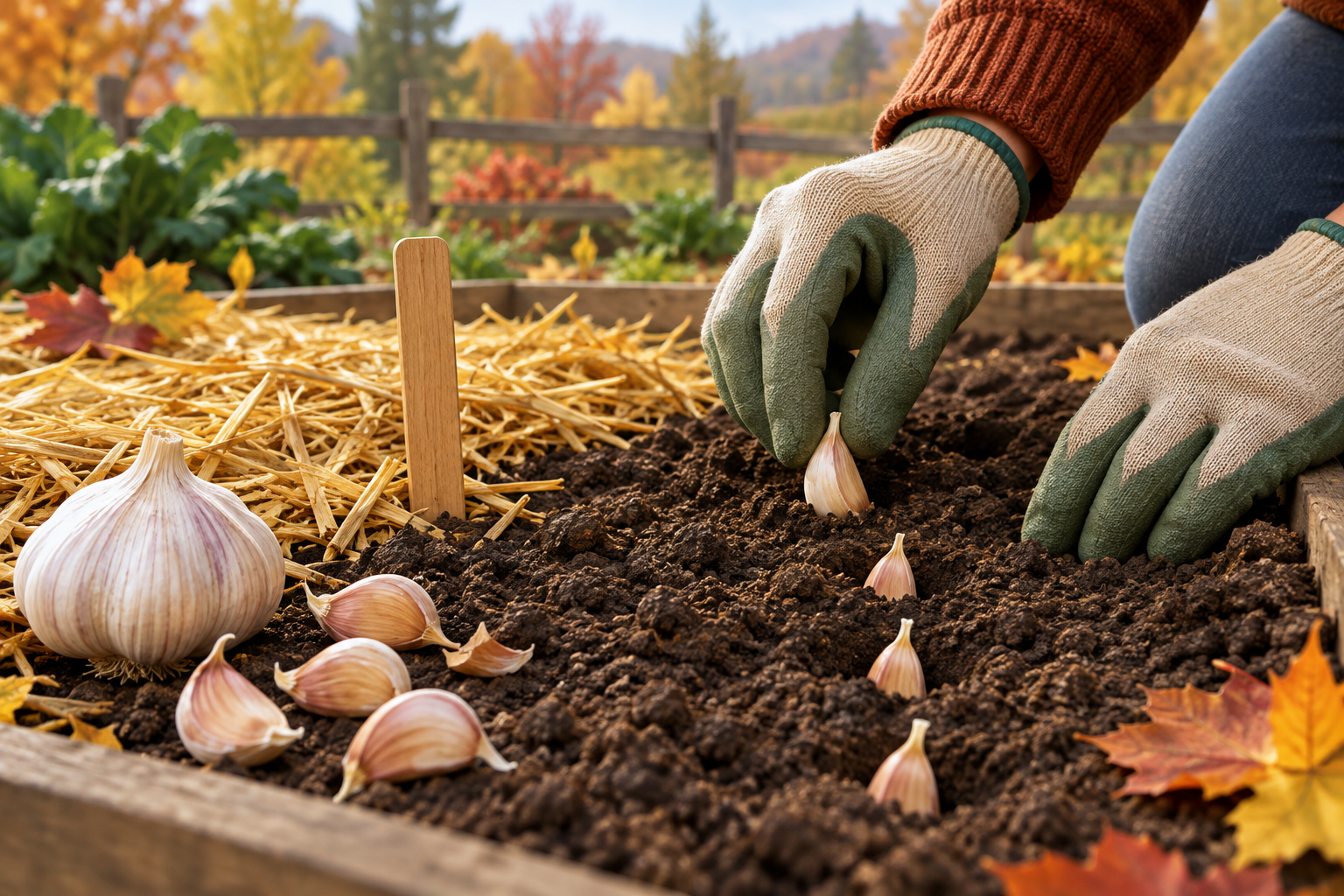
A garlic bulb contains individual cloves, and each clove is planted separately. Split the bulb close to planting time and select intact cloves. Place each one point-side up, then cover it with soil at the depth recommended for your area.
Depth and spacing recommendations can vary. Illinois Extension advises planting about 2–3 inches deep and spacing cloves 3–6 inches apart. Treat those measurements as Illinois guidance; if your local extension service gives different measurements, use the advice intended for your region. Leave enough space between rows to work in the bed later.
Once the cloves are in place, label the variety and planting date. That small record can help you identify the planting next season and compare how different varieties or planting dates performed in your own garden.
- Separate the bulb into individual cloves shortly before planting.
- Set cloves point-side up.
- Use local recommendations for depth and spacing; Illinois guidance is about 2–3 inches deep and 3–6 inches apart.
- Confirm that the local planting window is suitable.
- Lay out the rows using the spacing recommended for your area.
- Separate the bulb into individual cloves shortly before planting.
- Set each clove point-side up at the recommended depth and cover it with soil.
- Label the variety and planting date.
Mulch the bed and check it through winter
Mulch has useful roles, but the recommended material and amount depend on the region.
Mulch can help moderate winter temperature changes and suppress weeds. Illinois Extension recommends straw or leaf mulch. The University of Minnesota recommends a 3–4-inch layer in its Minnesota guidance; that depth is a regional example, not a universal rule.
Choose suitable mulch and follow local recommendations for when and how much to apply. Advice for a cold Minnesota garden may not match a milder climate or a different site. If you use leaves, refer to local guidance on material and upkeep.
As you care for the bed, make a note of the mulch material and amount you used. This gives you a useful reference next season, especially if you want to compare how the bed responds under your local winter conditions.
- Straw and leaves are examples of mulch used in extension guidance.
- Minnesota’s 3–4-inch depth applies to its regional recommendation, not every garden.
- Keep a note of the mulch material and amount used.
Plan for spring growth and a variable harvest
Keep regional guidance close as the season changes, and treat harvest dates as local expectations rather than guarantees.
Garlic can resume growth in spring, but the schedule for care and harvest depends on the variety and local climate. Follow regional advice as the season progresses. The University of Minnesota gives late June to late July as a harvest window for its area; it is not a prediction for gardens across the United States.
Keep a short record of the variety, planting date, bed location, and mulch used. Add brief notes as the plants grow and when you harvest. If growth or timing differs from your expectations, those details can help you ask a more specific question of your extension service and make a better-informed choice next season.
Avoid judging your results against a promised bulb size or nationwide harvest date. Variety, climate, and growing conditions affect what happens. The regional recommendations in this guide are useful starting points, not guarantees for an individual garden.
- Use local extension guidance for spring care and harvest cues.
- Record planting details so you can learn from the bed next season.
- Treat regional harvest windows as examples, not nationwide promises.
Frequently asked questions
Is late October too late to plant garlic?
It depends on your location and current conditions. Check regional extension guidance, which may use the expected ground-freeze date or local killing frost as its timing cue. One nationwide date cannot answer this for every garden.
How deep and far apart should garlic cloves be planted?
Recommendations vary by region. Illinois Extension advises planting about 2–3 inches deep and spacing cloves 3–6 inches apart. Check your local extension service for measurements suited to your area.
Can I plant garlic from the grocery store?
It is not automatically unsuitable, but the variety may not be adapted to your climate, and its storage or treatment history may be unclear. Region-suited planting stock is a more dependable option to investigate.
How thick should garlic mulch be?
Follow regional advice because conditions differ. The University of Minnesota recommends 3–4 inches in its Minnesota guidance, while Illinois Extension recommends straw or leaf mulch. These examples do not establish a universal depth.
When will fall-planted garlic be ready to harvest?
Harvest timing depends on variety, climate, and growing conditions. Minnesota Extension gives late June to late July as a regional example, not a nationwide harvest window. Check local guidance for harvest cues.
Sources & further reading
Explore the original sources behind this article. Our editorial perspective is separate from the organizations we reference.
- [S1] Growing Garlic - Fall Plantingextension.psu.edu
- [S2] Ready, Set, Garlic! | Good Growing | Illinois Extension | Illinoisextension.illinois.edu
- [S3] Growing garlic in home gardens | UMN Extensionextension.umn.edu