Best By, Sell By, or Use By? How to Read Food Date Labels
In the U.S., most package dates are quality cues, not automatic safety deadlines. Learn what common phrases mean, how storage changes the decision, and why infant formula is different.
A package date is not always a safety deadline
Start with two separate questions: what the label is communicating, and how the food has been stored.
If a packaged food is past its printed date, the date alone usually cannot tell you whether it is safe to eat. In the United States, most food date labels are not federally required safety deadlines, and phrases such as “Best By,” “Sell By,” and “Use By” do not have one uniform meaning across all products. They often relate to quality or inventory rather than a definitive point when food becomes unsafe.
That does not mean a past-date food is automatically fine. A label cannot confirm that a refrigerated item stayed cold, that a package remained intact, or that food was handled safely after opening. Treat the date as one clue—not a substitute for storage history and product-specific instructions.
- What does this product’s wording indicate?
- Was it stored and handled as directed, including after opening?
What “Best By,” “Sell By,” and “Use By” can tell you
Read the wording as a product-specific cue, not as a universal promise about safety.
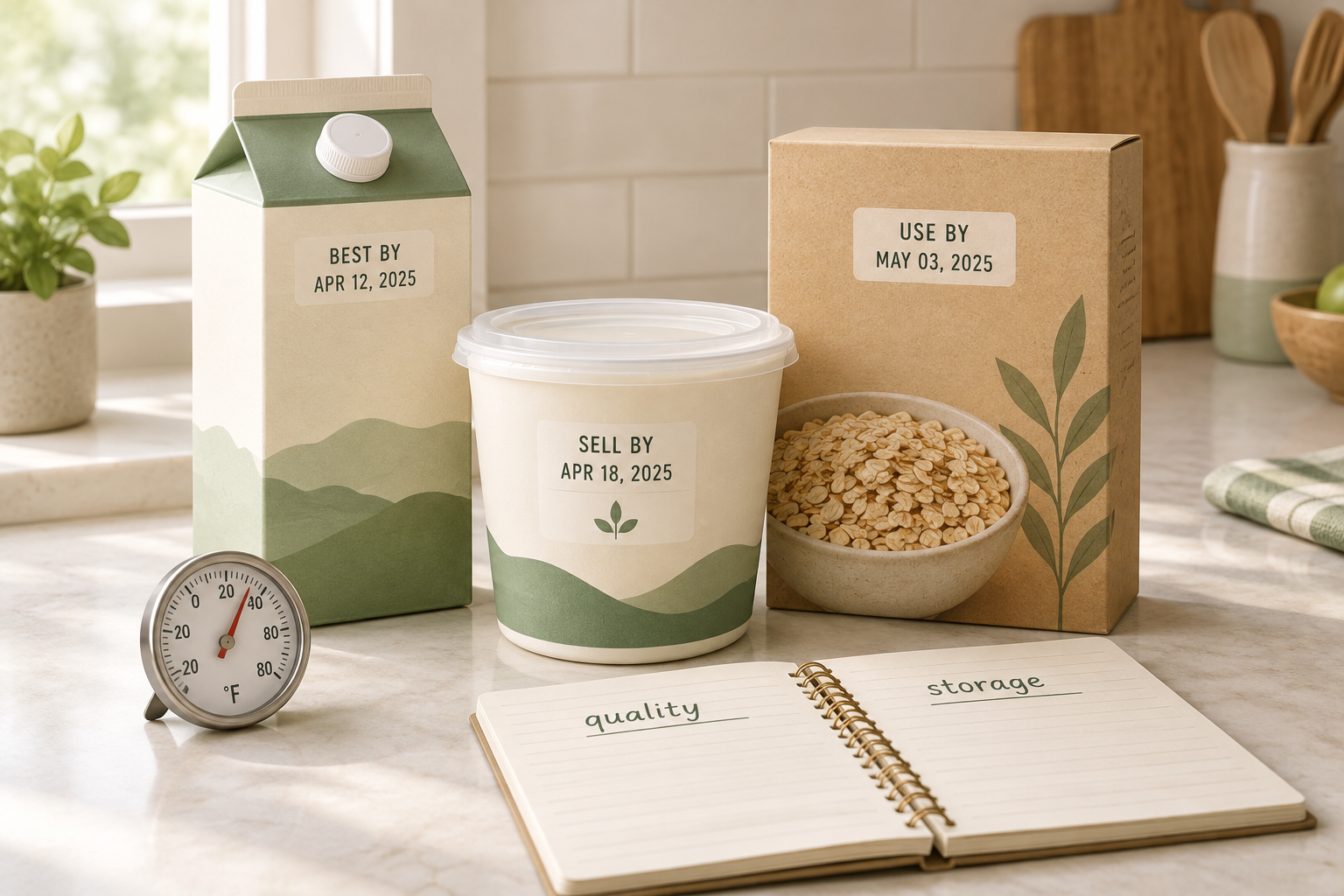
The Food and Drug Administration describes “Best if Used By” as indicating when a product is expected to be at its best quality or flavor. Other phrases may serve different purposes, and manufacturers do not use every term in exactly the same way. The words alone do not establish how long a food remains safe under every possible storage condition.
A “Sell By” date may help a store manage stock, but it does not tell you how long food has been sitting in your refrigerator. “Use By” can sound like a hard safety cutoff; for most packaged foods, the phrase is not a universal federal safety deadline. Check the specific product’s instructions, especially if it says to keep the item refrigerated or gives directions for use after opening.
The label may also include a date code, lot number, or other information that is not a consumer-facing safety instruction. If the wording is unclear, look for product guidance from the manufacturer rather than assuming the phrase has the same meaning on every package.
| Label phrase | How to read it | What it cannot tell you |
|---|---|---|
| Best By or Best if Used By | Often signals when the product is expected to have its best quality or flavor. | Whether the food was stored safely or is safe in every circumstance. |
| Sell By | May help a retailer manage stock. | How long the item has been in your refrigerator or how it was handled. |
| Use By | Meaning can depend on the product and label; check its specific directions. | A universal safety cutoff for all packaged foods. |
| Infant formula: Use By | Follow the date; FDA says not to use formula after it. | A cue that can be treated like an ordinary quality date. |
The important exception: infant formula
Do not apply the general guidance for other packaged foods to infant formula.
The FDA advises caregivers not to use infant formula after its “Use By” date. The date is specific to formula and is an important exception to the general discussion of quality-based package dates. If the date has passed, do not feed the formula to an infant; follow the product’s instructions for disposal or contact the manufacturer or a healthcare professional if you have questions about an alternative.
Check the date before buying or preparing formula, and read the label for preparation and storage instructions. Those directions matter independently of the printed date.
Check what happened after you brought the food home
Storage history can change the decision even when the printed date has not passed.
A package date assumes neither perfect nor known handling in your home. Consider whether the food was kept at the temperature stated on its label, whether it was left out, whether the package was damaged, and when it was opened. Once opened, the product’s instructions may call for refrigeration or a shorter period of use; follow those directions rather than relying on the original date alone.
For example, a refrigerated package that is still within its printed date is not automatically safe if you know it spent a long time unrefrigerated. By contrast, a date passing does not by itself prove that a properly stored product has become unsafe. If you cannot establish a safe storage history, do not use the date to fill in what you do not know.
Use a food-specific reference for refrigerator and freezer storage times. FoodSafety.gov’s cold-storage chart provides guidance by food type, which is more useful than treating every item in the refrigerator as if it had the same storage window. The USDA also notes that food kept properly at 40°F or below may remain safe after a date passes; that is not a guarantee for every food or every handling history.
- Read the package’s storage directions, including instructions for opened products.
- Consider whether refrigeration was consistent and whether the package stayed intact.
- Look up the food itself in an official cold-storage chart when you need a storage-time reference.
Why smell and appearance are not safety tests
Spoilage clues can matter, but their absence cannot prove food is safe.
Mold, unusual texture, leaking packaging, or an off odor can be reasons to discard a product. But food can contain disease-causing bacteria without an obvious change in smell, taste, or appearance. A normal-looking package is not a safety certificate, and a date label cannot replace safe handling.
Never taste a food to check whether it is safe. If you see clear spoilage or package damage, discard it. If you are uncertain because storage or handling is unknown, choose the cautious option rather than trying to settle the question with a sniff or a small bite.
A quick checklist for a past-date package
Use the label, storage history, and food-specific guidance together; stop if a critical detail is unknown.
This checklist is a practical way to organize the decision, not a guarantee that any particular item is safe. It is intended for general U.S. grocery shopping; follow official guidance and the product’s own instructions for the food in front of you.
- Read the exact wording. Treat “Best By,” “Sell By,” and “Use By” as product-specific cues, not interchangeable safety promises.
- Check for the exception. If it is infant formula past its Use By date, do not use it.
- Review storage and handling. Consider refrigeration, time out of storage, package condition, and whether the item has been opened.
- Consult food-specific guidance. Check an official cold-storage chart and the package directions rather than applying one time limit to every food.
- Do not taste-test. If there are spoilage signs, unsafe handling, or important gaps in the storage history, discard the food.
What to do next
Use a reliable reference for the product rather than trying to decode the date in isolation.
For a food in your kitchen now, start with the exact package wording and storage instructions, then compare your handling history with an official, food-specific storage chart. If the product has a special use or safety instruction, follow that instruction. For infant formula, the FDA’s Use By guidance applies.
For future shopping, place refrigerated and frozen foods away promptly, keep packages labeled with opening dates if that helps your household track them, and avoid relying on smell or appearance as proof of safety. The useful question is not simply “Has the date passed?” It is “What does this label mean for this product, and do I know it was stored and handled as directed?”
Frequently asked questions
Can I eat food after its Best By date?
The date alone does not determine whether a food is safe. “Best By” often refers to expected quality, but you should also consider the product’s storage instructions, handling history, package condition, and food-specific storage guidance. Do not rely on appearance or smell to rule out harmful bacteria.
Does Sell By mean the food is unsafe after that day?
Not necessarily. “Sell By” may help a retailer manage stock and is not a universal safety deadline for consumers. It also cannot tell you how the food was stored after purchase.
Is a Use By date always a safety deadline?
No single meaning applies to every packaged food in the U.S. Check the product’s instructions. Infant formula is a specific exception: the FDA says not to use it after its Use By date.
Can I smell or taste food to check whether it is safe?
No. Harmful bacteria may not change a food’s smell, taste, or appearance, and you should never taste food as a safety test. Discard food with clear spoilage signs or an uncertain safety history.
Where can I check how long a food keeps in the refrigerator or freezer?
Use FoodSafety.gov’s cold-storage chart for food-specific refrigerator and freezer guidance, and follow the product’s own storage instructions. A printed package date is not a replacement for that information.
Sources & further reading
Explore the original sources behind this article. Our editorial perspective is separate from the organizations we reference.
- [S1] How to Cut Food Waste and Maintain Food Safety | FDAfda.gov
- [S2] Is food safe after the date expires?ask.fsis.usda.gov
- [S3] Handling Infant Formula Safely: What You Need to Know | FDAfda.gov
- [S4] Cold Food Storage Chart | FoodSafety.govfoodsafety.gov
- [S5] Can bacteria grow in the refrigerator?ask.fsis.usda.gov