How to Roast Winter Squash: Halves or Pieces, Then Check for Tenderness
Choose halves when you want squash you can scoop, or peeled pieces when you want ready-to-serve chunks. Follow a reliable starting method, then test the thickest part for tenderness.
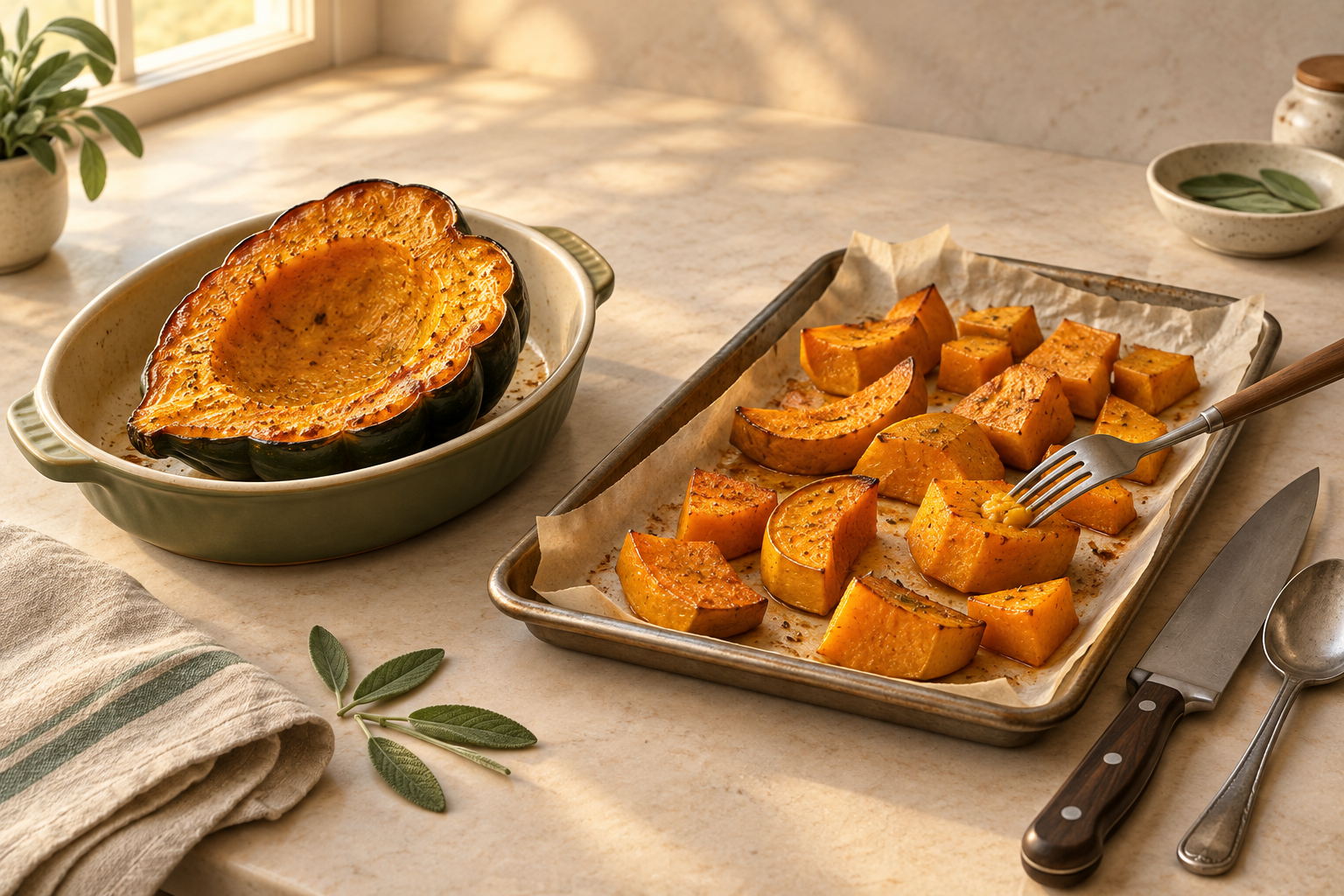
Choose halves or pieces based on how you want to serve the squash
The shape determines how much cutting you do before roasting and how you will use the cooked flesh.
For a simple side you can scoop, roast the squash in halves with the cut sides down. This works well when you want broad portions or plan to remove the soft flesh after cooking. Acorn squash is often manageable this way; a larger squash can be cut into more sections if that is easier to handle.
Choose peeled pieces when you want chunks to serve as they are or add to another dish. Pieces take more preparation because you need to peel and cut the squash before roasting. Cut them to roughly similar sizes so you can check them consistently.
Neither shape is automatically the better choice. Think about what you want on the plate: halves keep the squash in a scoopable form, while pieces are already portioned. Utah State University Extension describes both approaches—halves baked cut-side down with a little water, or peeled pieces roasted at 400°F for about 20–30 minutes until tender. The Extension cautions that cooking times vary.
- Choose halves if you want to scoop or mash the flesh after roasting.
- Choose pieces if you want ready-to-serve chunks or squash to add to another dish.
- Use the time for pieces as a starting point; don’t transfer it to halves.
| Shape | Preparation | What the source guidance says |
|---|---|---|
| Halves | Cut in half and remove seeds and strings; leave the skin on | Bake cut-side down with a little water; no fixed temperature or time is specified |
| Peeled pieces | Peel, remove seeds and strings, and cut into similar-sized chunks | Roast at 400°F for about 20–30 minutes, until tender; timing varies |
Prepare the squash and cut it carefully
A clean, stable work surface and a deliberate cutting approach make hard-skinned squash easier to manage.
Winter squash includes varieties such as acorn, butternut, spaghetti squash, and pumpkins. Their shapes and rinds differ, so use the method that suits the squash in front of you rather than assuming every variety will be equally easy to cut.
Rinse the outside under running water and dry it before cutting. Place the squash on a stable cutting board. If it rocks, carefully trim a small amount from the bottom to create a flat base. Use a sharp knife, keep your hands out of its path, and work slowly. If the knife gets stuck, don’t force it toward yourself.
After cutting the squash open, scoop out the seeds and stringy material with a sturdy spoon. For halves, keep the skin on and set the pieces cut-side down in a baking dish with a little water. For a pieces method, peel the squash and cut the flesh into similar-sized chunks. A vegetable peeler may work on some squash; if the rind is too hard or awkward, use a method or recipe suited to that variety rather than struggling with the tool.
- Rinse and dry the squash.
- Set it on a stable cutting board and take time to secure it before cutting.
- Cut it in half, then remove the seeds and strings.
- For halves, leave the skin on and place them cut-side down in a baking dish with a little water. For pieces, peel and cut the flesh into similar-sized chunks.
Roast peeled pieces at 400°F, using the time as a guide
The published timing is a useful first check, but the squash itself—not the clock—determines when it is ready.
For peeled, cut winter squash, heat the oven to 400°F. Utah State University Extension gives about 20–30 minutes as a starting range, cooking until the pieces are tender. Begin checking around the lower end of that range. The time can vary with the variety, size of the pieces, and oven, so allow extra time if the centers are still firm.
Arrange pieces in a single layer on a baking sheet. If pieces vary considerably in size, the smaller ones may become tender before the largest; check the largest pieces first and remove any that are ready if needed. When you test a piece, use a fork or the tip of a knife at its thickest point. It should enter easily. If it meets resistance, return the squash to the oven and check again after a short interval.
Salt and pepper are simple seasoning options. Herbs or spices can also suit the rest of the meal. These are flexible serving suggestions, not a tested recipe; if the squash will go into a separately seasoned soup or sauce, keep the initial seasoning modest.
- Cut pieces to a similar size to make checking easier.
- Treat 20–30 minutes at 400°F as an approximate starting range.
- Test the largest pieces before deciding the batch is done.
Roast halves and test the center for tenderness
The available method describes how to arrange halves, but it does not provide a fixed time or oven temperature for them.
For halves, set the squash cut-side down in a baking dish with a little water, as described by Utah State University Extension. Its guidance does not specify a roasting temperature or a fixed cooking time for this method. Use a suitable recipe for your variety and size rather than borrowing the 400°F and 20–30-minute timing given for peeled pieces.
To check a half, carefully lift or turn it enough to reach the flesh. Insert a fork or the tip of a knife into the thickest area. The flesh should be soft enough for the utensil to enter easily and soft enough to scoop. If the center is firm, return the squash to the oven and test again later.
The surface alone is not a dependable doneness test: a softened edge does not tell you whether the thickest part is ready. Take care when handling the hot dish, and use the fork or knife test in the center before serving.
Serve the roasted squash or use it in another dish
Decide whether you want the squash to keep its shape or become soft flesh for mixing, mashing, or blending.
Serve a roasted half as a scoopable side, or remove its tender flesh from the skin and mash it lightly. Peeled pieces can be served as chunks or added to a grain bowl, pasta, or soup. These are adaptable ways to use roasted squash, not fixed recipes.
If you are cooking ahead, choose the shape according to what the next dish requires. Pieces may be convenient when you want distinct chunks; halves can suit a dish where you will scoop out and mash or blend the flesh. Check tenderness before adding the squash to another preparation, especially if it needs to be soft enough to mash smoothly.
Store leftovers promptly and safely
Portion the cooked squash into shallow containers so it can be refrigerated or frozen without leaving it out for an extended period.
Transfer leftover squash into shallow containers and refrigerate promptly. USDA Food Safety and Inspection Service guidance says to refrigerate leftovers within two hours, or within one hour if the surrounding temperature is above 90°F. Use refrigerated leftovers within three to four days or freeze them.
If you have a large batch, divide it among several shallow containers instead of leaving it in one deep container. Marking the date on each container can help you keep track of when it was stored. Freeze portions you do not expect to use within the recommended refrigerated period.
For your next batch, decide whether halves or pieces better suit the meal, use the published time only for peeled pieces, and check the thickest part for tenderness. Store any leftovers promptly rather than leaving them on the counter to cool for an extended period.
Frequently asked questions
What temperature should I use to roast winter squash?
For peeled, cut pieces, Utah State University Extension gives 400°F. Its guidance for halves describes placing them cut-side down with a little water but does not specify an oven temperature. For halves, use a suitable recipe for the variety and size.
How long do winter squash pieces take to roast?
About 20–30 minutes at 400°F is a starting range for peeled pieces, not a guarantee. Check the largest pieces with a fork or the tip of a knife, and continue roasting if the center is still firm.
How can I tell when roasted squash is done?
Test the thickest part with a fork or the tip of a knife. The utensil should enter easily, and the flesh should be soft enough to scoop. If it is still firm, roast longer and check again.
Do I need to peel winter squash before roasting it?
Not for the halved method described by Utah State University Extension: the halves are roasted cut-side down, and you can scoop out the flesh afterward. Its method for pieces uses peeled squash. Choose a method that suits your variety and intended use.
How long can I keep roasted squash in the refrigerator?
USDA FSIS advises using refrigerated leftovers within three to four days. Refrigerate them within two hours, or within one hour if the surrounding temperature is above 90°F, and store them in shallow containers.
Sources & further reading
Explore the original sources behind this article. Our editorial perspective is separate from the organizations we reference.
- [S1] Fruit and Vegetable Guide Series: Winter Squash | USUextension.usu.edu
- [S2] How do I handle leftovers safely?ask.fsis.usda.gov