Pickleball Doubles Scoring Explained: What the Three Numbers Mean
Read a traditional pickleball doubles score call in order, follow the serving partners, and recognize when a side-out happens. Then check whether your game uses side-out or rally scoring.
Pickleball doubles scoring: what the three numbers mean
Start by identifying who is serving; the call is reported from that team’s perspective.
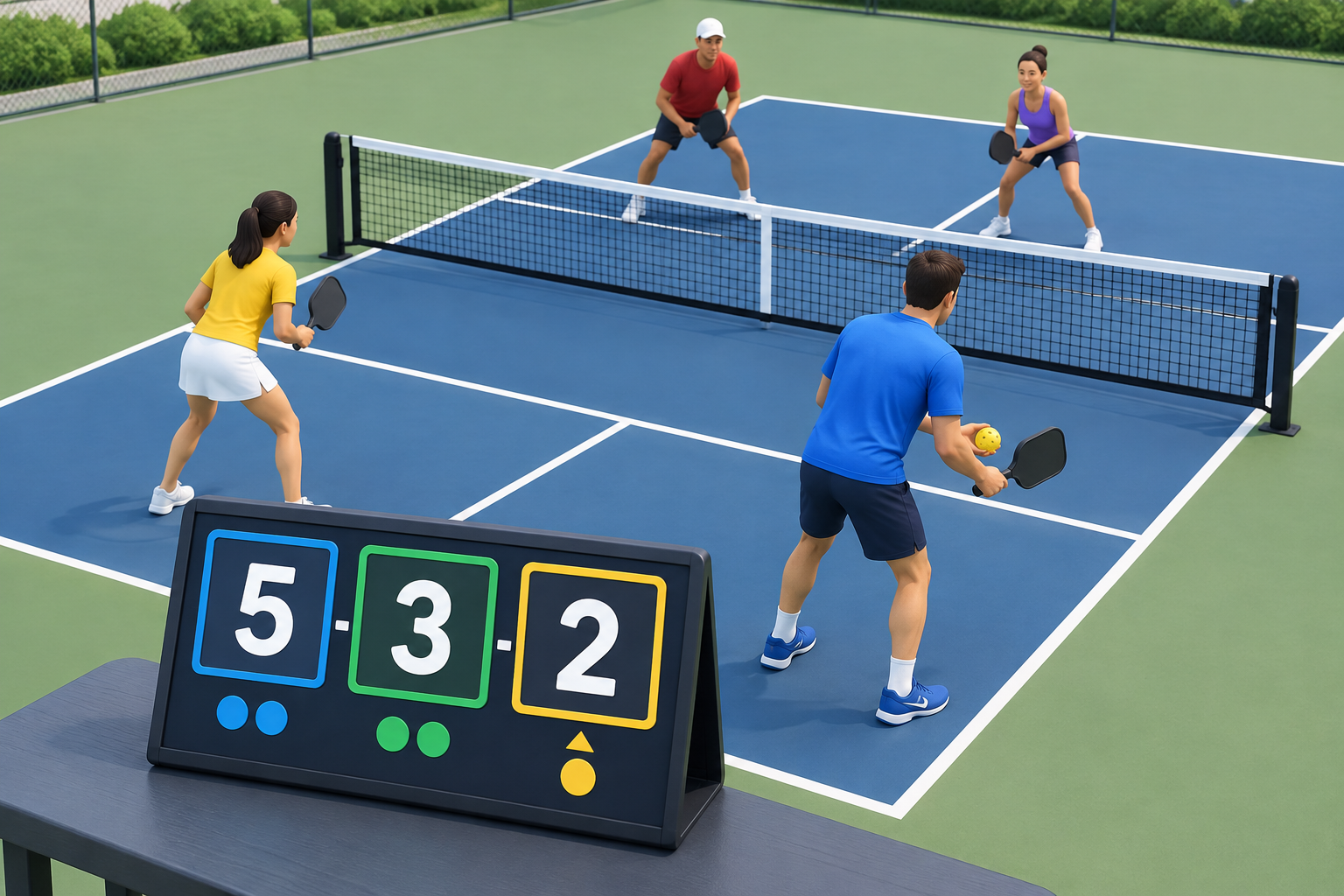
In traditional pickleball doubles side-out scoring, a three-number call gives the serving team’s score, the receiving team’s score, and the server number, in that order. The last number is either 1 or 2: it tells you whether the first or second server in the current service turn is serving.
So “5-3-2” means the serving team has 5 points, the receiving team has 3, and the second server is up. It does not mean that one partner is permanently “server 2.” The server number changes as the team’s service turn progresses. USA Pickleball’s beginner guide describes this call and the traditional service sequence.
- First number: serving team’s score.
- Second number: receiving team’s score.
- Third number: server number for the current service turn.
What happens after a rally? Follow the serve
The score call helps you tell whether a point was won, a partner takes over, or the serve changes teams.
After the opening service turn, each team typically has two servers in its turn. The first server continues until that team commits a fault. Then the serve passes to the partner, who is server 2. If the second server’s team commits a fault, the service turn ends and the other team gets the serve; this change is called a side-out.
Under traditional side-out scoring, only the serving team scores a point. If the receiving team wins a rally, it does not add a point; the service sequence continues or changes according to the rules. A fault by the serving team’s first server generally sends the serve to the partner, while a fault by its second server creates the side-out. The applicable rules determine what counts as a fault.
Why pickleball starts with “0-0-2”
The opening call marks a special first service turn, rather than the usual two-server sequence.
In traditional doubles side-out scoring, the opening call is “0-0-2.” The starting team has only one server in that first turn. If that player faults, the serve goes to the other team instead of passing to a partner as a second server.
After that initial side-out, the usual two-server sequence applies to service turns. The “2” in the opening call is therefore a convention for the starting turn; it does not mean that the second partner should serve first. USA Pickleball’s guide explains this opening exception as part of the traditional scoring sequence.
If you are joining a casual game, ask whether players are using this conventional opening and side-out scoring. A local group or event may specify another format or procedure.
Use the score as a court-position check
The score can help you check positions when you know which partner served first in the game.
In traditional doubles play, the partner who served first for a team in the game serves from the right court when that team’s score is even and the left court when it is odd. The partner stands on the opposite side. This gives players a useful way to check their positions, but it depends on remembering which player served first for that team.
For example, at a team score of 5, that first server should be on the left when the team is serving; at 6, on the right. As a serving team scores, its partners change sides. If you are unsure about the starting order or a position during play, pause and confirm it with the other players rather than guessing from the score alone.
Side-out scoring or rally scoring?
The key distinction is whether the receiving team can earn a point by winning a rally.
The familiar three-number call is tied to traditional side-out scoring, but pickleball games do not all use that format. USA Pickleball also describes rally scoring, in which a point is awarded after every rally. That means the receiving team can score by winning a rally, unlike in traditional side-out scoring.
Before a game, ask which scoring format is in use and how the score and serving order should be called. The table summarizes the basic difference; event rules or local instructions should settle details such as the precise call and service procedure. USA Pickleball’s rules materials include a 2026 rulebook, so players in organized events can check the applicable current rules alongside event instructions.
| Question | Traditional side-out scoring | Rally scoring |
|---|---|---|
| Who can score? | Only the serving team. | A point is awarded after every rally. |
| If the receiving team wins a rally | It does not score; the service sequence may continue or eventually change. | It earns a point. |
| What should you check? | The current score and server number. | The format’s scoring and service-call instructions. |
A quick routine for reading the call
Use the same short sequence each time you hear the score, then check what the rally changes.
When you hear a traditional call such as “5-3-2,” identify the serving team, read its score, read the receiving team’s score, and note whether server 1 or server 2 is serving. After the rally, check whether the serving team scored, whether a first-server fault passed the serve to the partner, or whether a second-server fault ended the turn.
For instance, if the serving team wins a rally at 5-3-2, its score becomes 6 and the call becomes 6-3-2. If the second server faults instead, the other team takes over serving; under side-out scoring, that fault does not award the receiving team a point. At the start, remember the special 0-0-2 convention. If the game uses rally scoring, use the agreed rally-scoring procedure instead.
- Identify which team is serving.
- Read the serving score, receiving score, and server number in order.
- After the rally, check whether a point was scored, the partner takes over, or a side-out occurred.
- Confirm the event or group’s instructions if it uses rally scoring or a local variation.
Frequently asked questions
What does 5-3-2 mean in pickleball doubles?
In traditional side-out scoring, the serving team has 5 points, the receiving team has 3, and server 2—the second server in the current service turn—is serving.
Why does pickleball start with 0-0-2?
The starting team has only one server in its first service turn. If that player faults, the serve goes to the other team rather than to a partner.
Does server 1 always mean the same partner?
No. Server number identifies the first or second server in the current service turn. It is not a permanent role for one player throughout the game.
Does the receiving team get a point when it wins a rally?
Not under traditional side-out scoring. Rally scoring awards a point after every rally, including one won by the receiving team.
Do all pickleball doubles games use a three-number call?
No. Scoring formats and calling procedures can vary. Confirm the format and instructions for your recreational game or organized event.
Sources & further reading
Explore the original sources behind this article. Our editorial perspective is separate from the organizations we reference.
- [S1] Pickleball Scoring & Positioning – Side Out Scoring | USA Pickleballusapickleball.org
- [S2] Essential Pickleball Rules Summary for Beginnersusapickleball.org
- [S3] Official USA Pickleball Rulebookusapickleball.org
- [S4] usapickleball.org