How to Prepare Your Houseplants Before a Holiday Trip
Match your plant-care plan to each houseplant, your home conditions, and the length of your trip. Learn when ordinary care is enough, when to ask for a sitter, and how to test a watering setup before you leave.
Start with a plant-by-plant trip plan
A useful plan begins with each plant’s needs, not a single watering schedule for the whole collection.
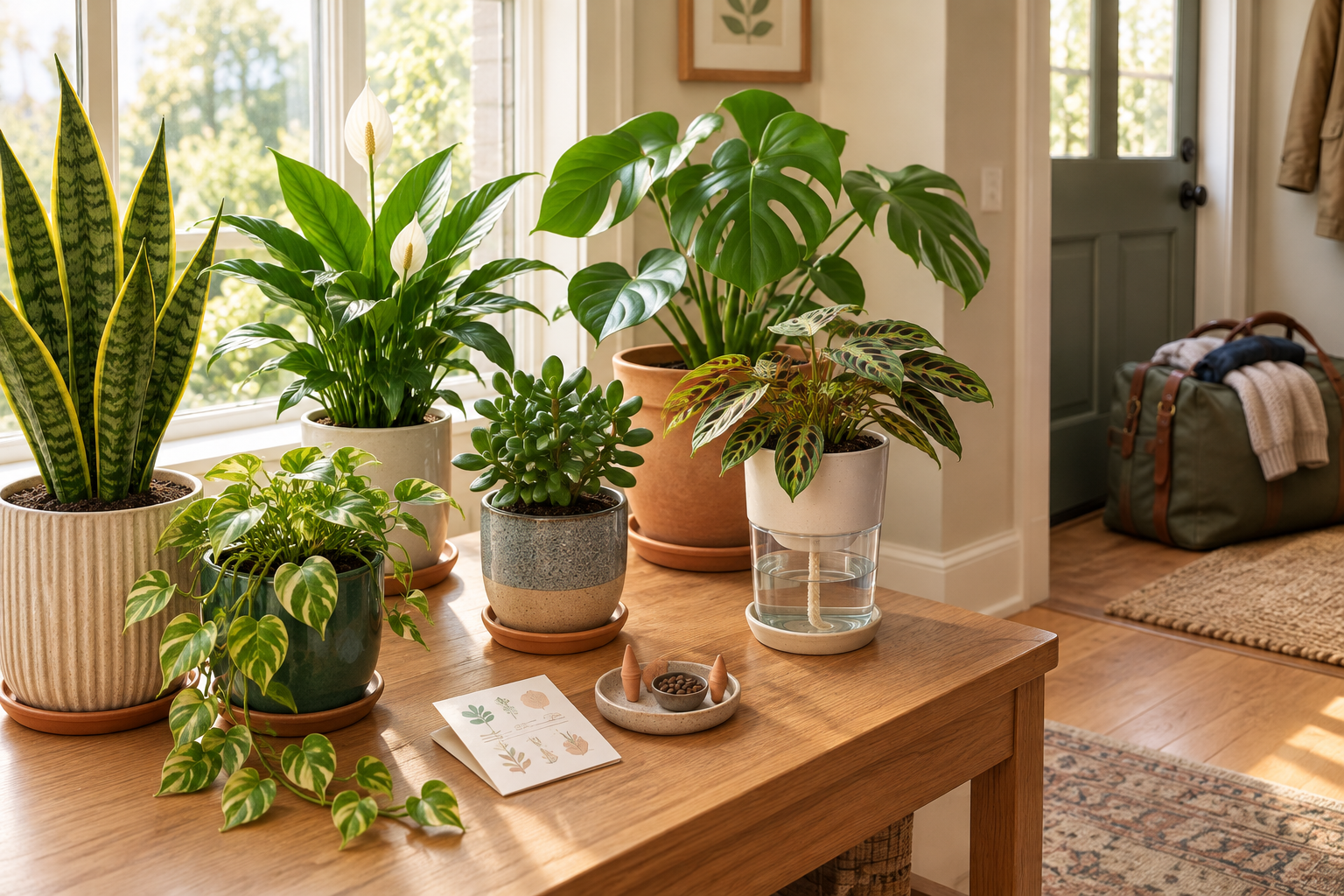
Before you leave, make a short list of your plants. Note where each one sits, what its pot is made of, whether it has drainage holes, and how you usually tell when it needs water. Include any care needs you already know, such as a preference for evenly moist soil or a longer dry period between waterings.
These details matter because water use varies with the plant and its growing conditions. Pot size and material, light, temperature, humidity, potting mix, and drainage can all affect how quickly soil dries. Illinois Extension advises checking the soil rather than relying on a fixed schedule, since the plant and its conditions both influence watering needs.
For example, two plants in the same room may not need water at the same time: one might be in a small pot near a bright window, while another sits in a larger container farther from the light. Use your normal observations and plant-specific guidance to plan for the time you will be away.
- Plant name and its usual signs of needing water
- Current soil moisture and pot size or material
- Drainage holes and any saucer or cover pot
- Usual light and temperature conditions
- Visible pests or health concerns that may need attention
Check the soil before watering
Water plants that need it, but do not try to make every pot last longer by saturating it before you go.
Inspect each plant shortly before departure instead of watering the collection by habit. Check the potting mix in a way that suits the plant: feeling the surface is useful for many common houseplants, while others may need the mix to dry further or remain more consistently moist. If you are unsure, consult reliable care guidance for that plant.
If a plant is ready for water, water it thoroughly and let excess drain away. Empty the saucer or outer pot afterward. The University of Maryland Extension advises against leaving houseplants sitting in drained water, so a watering arrangement should not result in a pot remaining waterlogged.
If the soil is still moist, skip the extra watering. A plant that is already unusually wet, struggling, or showing pests may need attention before you leave—not another dose of water. The goal is to leave each plant in a suitable condition, not to compensate for your absence by changing its normal care without a reason.
Choose between ordinary care, a sitter, and self-watering
Pick the simplest option that fits the trip and the plant; no device or timetable works as a guarantee for every home.
For a short absence, some plants may need no special arrangement beyond their usual care and a check before you go. There is no universal number of days that a houseplant can go without water: a small pot in a warm, bright spot can dry differently from a larger pot in a cooler location, and plant types vary.
For a longer trip, or for plants that need frequent attention, ask someone to check in. A sitter can respond to changing conditions, notice a problem, and avoid watering a pot whose soil is already wet. If a sitter is not available, a self-watering container, wick, or other arrangement may suit some plants and pots.
The University of Florida IFAS Extension describes several vacation-care options, including self-watering containers, pebble trays, and wicks. Treat any duration estimates as planning guidance, not a promise: how a method performs depends on the plant, pot, mix, and home conditions.
| Approach | May be suitable for | What to check |
|---|---|---|
| Ordinary care | A brief absence when plants are not due for frequent watering | Soil moisture, plant needs, and room conditions |
| Plant sitter | Longer trips, thirsty plants, or plants that need observation | That the helper knows which plants need attention and how to check |
| Wick or reservoir | A compatible plant and pot, after a successful trial | Water delivery, soil moisture, and drainage |
| Pebble tray | A limited humidity-support option for an appropriate setup | That it is not being relied on as a substitute for watering the pot |
Prepare the room without disrupting plant needs
Reduce avoidable stress while preserving the conditions each plant is used to receiving.
Keep plants in locations that suit their light needs. Do not move every plant to a dark room just because you will be away: different plants need different amounts of light, and a convenient location for one may not suit another. If you change a plant’s position, make sure the new spot is still appropriate for it.
Avoid placing plants where they may experience a sharp temperature change or conditions that dry the soil unusually quickly. You can group plants if their light and watering needs are compatible, which may make a sitter’s visit easier. Do not crowd them together if that would make it harder to inspect the soil or put a plant in unsuitable conditions.
Before leaving, remove dead leaves that are easy to reach, make sure pots are stable, and keep saucers accessible. Avoid adding unnecessary changes—such as repotting or fertilizing—immediately before a trip unless there is a specific reason to do so.
- Keep each plant in suitable light.
- Avoid hot drafts, heating sources, or sudden temperature changes.
- Separate plants with different watering needs so a sitter can tell them apart.
- Make sure pots are stable and drainage saucers are easy to check.
Test a watering setup before departure
A trial can uncover poor water flow, excess moisture, or drainage problems while you still have time to choose another plan.
Do not set up a new wick or watering device for the first time on the morning you leave. Test it in advance using the same pot, mix, water source, and placement you plan to use during the trip. Then observe whether water reaches the soil as intended and whether excess drains away.
Check whether the soil becomes wetter than the plant needs, whether a reservoir empties too quickly or fails to supply water, and whether water collects in an outer pot or saucer. If the results are unclear, adjust or abandon the method rather than assuming it will work unattended.
The University of Saskatchewan recommends testing a watering method before departure and watering thoroughly before leaving. A trial makes it easier to find problems in advance, but it does not guarantee the same result for every plant or over every trip. A wick that works for one pot may behave differently with another mix or container.
If you cannot test the setup, or the plant is already unwell or particularly sensitive to moisture changes, a person checking in may be the more cautious choice.
Leave a clear plant-sitter checklist
Give your helper a way to decide what each plant needs, rather than asking them to water everything on a fixed date.
Keep instructions short, visible, and specific. Label plants or group them only when their care needs match. Tell your sitter how to contact you if a plant looks unwell or a watering setup is not working as expected.
Instead of writing “water the plants,” give a plant-specific instruction such as: “Check the pothos soil; water only if the top layer is dry, then empty the saucer.” Write separate instructions for plants with different needs. If a plant should not be watered unless a particular condition is met, say so plainly.
- Which plants to check and which, if any, to leave alone
- How to judge whether each plant needs water
- How much water or which tested method to use
- Whether to empty a saucer or check a reservoir
- Your contact details and what to do if a plant looks unwell
Know when to arrange a human check-in
If you cannot confidently match a plant’s needs to the time away, plan for someone to look in rather than relying on a fixed estimate.
Arrange a sitter or another check-in when the trip is long relative to a plant’s normal watering needs, when it dries quickly, or when its condition is already concerning. A device cannot notice a sudden change, identify a pest problem, or respond if a reservoir empties, a wick stops working, or water spills.
Before you go, make one last pass through the collection: check each plant, water only those that need it, confirm drainage, and make sure any tested setup is behaving as expected. Put instructions where the sitter can find them.
When you return, check the soil and the plants’ condition before resuming your usual routine. If you are unsure how long a particular plant can manage, treat that uncertainty as a reason to arrange a check-in—not as a reason to rely on an untested setup.
- List each plant’s watering needs, pot, drainage, and location.
- Check soil moisture and water only plants that are due.
- Choose ordinary care, a tested watering method, or a sitter for each plant.
- Trial any new setup while you are still home.
- Leave concise, plant-specific instructions and a way to reach you.
- On your return, check soil and plant condition before watering again.
Frequently asked questions
How long can houseplants go without water while I’m away?
There is no reliable number that applies to every houseplant. The interval depends on the plant, pot, mix, drainage, light, temperature, humidity, and other conditions. Check each plant’s usual needs and arrange a sitter for plants that need frequent attention or for a longer absence.
Should I water all my plants right before a trip?
No. Check the soil and water only plants that need it. Let excess drain away and empty the saucer or outer pot; do not saturate the soil or leave pots sitting in runoff to try to extend the time between watering.
Do pebble trays water plants while I’m away?
A pebble tray is one option discussed for vacation plant care, but it should not be treated as a substitute for watering the pot or as a solution for every plant. Choose an approach that suits the plant and test it before your trip.
Can I use a wick watering system for a holiday?
A wick may suit some plant-and-pot combinations, but how it delivers water can vary with the wick, mix, container, and conditions. Test it in advance and check soil moisture and drainage. If the result is uncertain or the plant needs close attention, arrange a sitter.
Should I move my houseplants to a darker room while I travel?
Not automatically. Light needs vary by plant. Keep each one in an appropriate location rather than moving the whole collection somewhere darker for convenience.
Sources & further reading
Explore the original sources behind this article. Our editorial perspective is separate from the organizations we reference.
- [S1] Watering | Houseplants | Illinois Extension | Illinoisextension.illinois.edu
- [S2] Vacation Plant Care – Gardening Solutionsgardeningsolutions.ifas.ufl.edu
- [S3] Watering Indoor Plants | University of Maryland Extensionextension.umd.edu
- [S4] Watering houseplants & containers while on vacation - Gardening at USask - College of Agriculture and Bioresources | University of Saskatchewangardening.usask.ca