How to Propagate Pothos: Find the Node, Then Root the Cutting
A pothos cutting needs a node, not just a leaf. Learn where to cut, how to root the vine in water or propagation medium, and when to consider potting it.
How to propagate pothos from a vine cutting
The practical starting point is the stem node: include one in every cutting you want to root.
To propagate pothos, choose a healthy section of vine that includes at least one node, then root that node in water or a suitable propagation medium. The leaf helps you identify the node, but the leaf alone is not the part to root. Place the cutting in bright, indirect light and check it periodically for roots and signs of deterioration.
North Carolina State Extension notes that pothos vines have aerial roots at their nodes and root easily in water. Stem cuttings are also a common way to propagate houseplants, according to Penn State Extension. Neither method comes with a universal rooting deadline: conditions and the individual cutting matter.
Gather a healthy vine, clean and sharp scissors or pruners, and either a clean container of water or a small pot with drainage and a suitable propagation medium. Before cutting, decide where the cutting will root so you can prepare the setup without leaving the fresh cut to dry.
- Choose a firm, healthy section of vine.
- Keep at least one node on every cutting.
- Use water or damp propagation medium to keep the node in contact with moisture.
- Check the cutting’s condition rather than expecting roots by a particular date.
Find the node before you cut
A close look at the stem helps you select a cutting that can root, even when no aerial root is obvious.
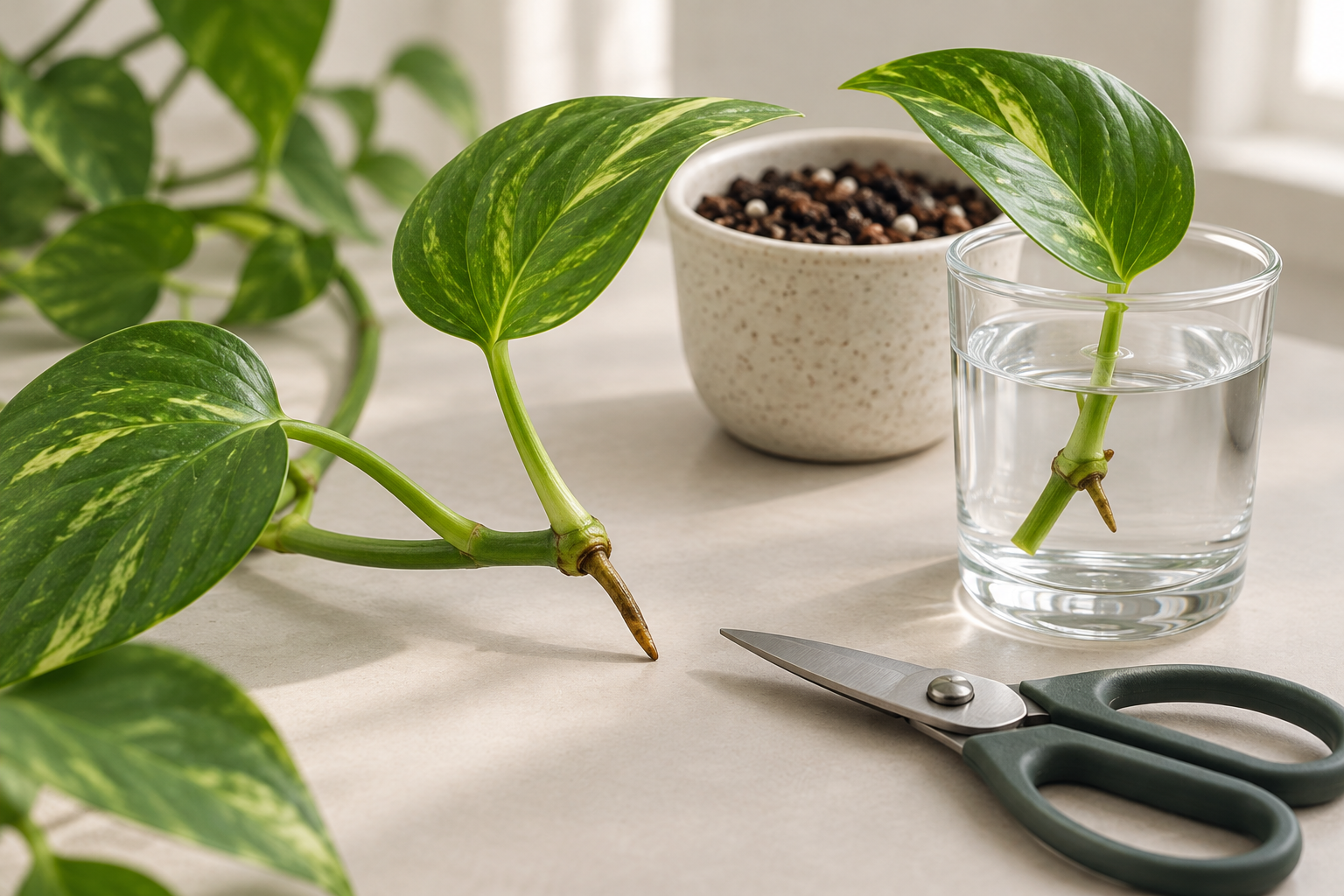
Trace the vine to the point where a leaf stalk joins the stem. That junction is a node. A small aerial root may grow from it, but its absence does not mean you have found the wrong place: use the leaf-and-stem junction as your guide. The length of stem between two nodes is called an internode.
Choose a node on a firm, healthy part of the vine. One simple cutting can include a node and its attached leaf. If you divide a longer vine into several pieces, check each piece separately; each one needs a node to grow as an individual stem cutting. Penn State Extension’s pothos guidance describes nodes as places where roots and leaves can develop.
For example, if a leaf sits midway along a trailing stem and a short brown aerial root emerges beside its stalk, the junction is the node to keep. Make your cut on the stem just below that point, leaving the node on the piece you plan to root.
- Node: the point on the stem where a leaf attaches and roots or new growth can develop.
- Aerial root: a root growing from the vine above the potting mix; it can help you spot a node.
- Internode: the stem section between two nodes.
Take and prepare the cutting
A clean cut and a quick node check make it easier to set up either rooting method.
Use clean, sharp scissors or pruners, as Penn State Extension recommends for houseplant cuttings. Cut just below the node you want to keep. Handle any aerial root gently rather than pulling or scraping it off.
If a leaf would sit beneath the waterline or below the surface of the rooting medium, remove that leaf before planting the cutting. Leaves left submerged or buried can deteriorate and make the setup harder to keep tidy. Keep the remaining leaf above the water or medium.
Before moving on, check that the cutting still includes its node. If you accidentally cut on the wrong side of the junction, choose another section of vine rather than trying to root a piece that has only a leaf and leaf stalk.
- Choose a healthy vine and identify the node you want the cutting to keep.
- With a clean, sharp tool, cut the stem just below that node.
- Remove any leaf that would sit underwater or below the surface of the medium.
- Confirm that the node remains on the cutting.
Choose water or propagation medium
Both options can root a node, but they differ in how easily you can observe the process and how you manage moisture.
For water propagation, place the cutting in a clean, stable container so at least one node is below the waterline and the leaf stays above it. A clear glass makes roots easy to see. Check occasionally that the node remains submerged and the cutting is still firm. If the water becomes cloudy, replace it with fresh water.
For a medium-based setup, use a small pot with drainage and a suitable propagation medium. Moisten the medium so it is damp rather than saturated, then position the cutting with the node in contact with the medium and the leaf above its surface. Check the moisture periodically and follow the medium’s care needs; do not let the cutting dry out or sit in waterlogged material.
The choice is about the setup that suits you, not a promise that one route is universally better. Water offers a visible view of root development. Medium keeps the node in a growing material from the outset, but roots are less visible. Avoid repeatedly lifting a cutting from the medium or pulling it from the water just to inspect it.
| Consideration | Water | Propagation medium |
|---|---|---|
| Setup | Keep a node below the waterline in a stable, clean container. | Set a node into damp medium in a small pot with drainage. |
| Checking progress | Roots can be observed through a clear container. | Roots are less visible; check the cutting gently without disturbing it. |
| Moisture attention | Check that the node remains submerged; refresh cloudy water. | Keep the medium from drying out or becoming waterlogged. |
| Useful if | You want to see whether roots are developing. | You prefer to start the cutting in a growing medium. |
Set the cutting up for steady growth
A suitable location and occasional checks are more helpful than constant repositioning.
Place the cutting in bright, indirect light. Penn State Extension includes bright, indirect light in its general guidance for propagating houseplants. Choose a spot with good light that does not leave the cutting in strong direct sun for long periods, and keep it somewhere stable enough that the container will not be knocked over.
Season affects what to expect. Penn State Extension says pothos stem-cutting propagation is more successful during the spring-to-summer growing season. You can try indoors at other times, but growth may be slower, especially when natural light is limited. As of October 29, 2026, fall propagation is an option to try rather than the source-supported best season.
Check the node, stem, and leaf periodically. A firm cutting with no visible roots may simply need more time. A soft or mushy stem, or one that is visibly declining, calls for closer inspection. If you are trying several cuttings, label the date and keep their conditions similar; this helps you compare them without treating one result as a rule for all pothos.
Check for roots and decide when to pot
Use visible development and the cutting’s condition to decide what to do next, rather than a calendar target.
In water, look for roots emerging from the node. In medium, roots may be harder to see, so avoid pulling the cutting out just to check. In either setup, look for a cutting that remains firm and appears healthy. The extension sources do not set one rooting time or root length that applies to every cutting.
If roots are visible and developed enough to handle, you can consider moving the cutting into a small pot with drainage and suitable houseplant potting mix. Handle the roots gently and settle the mix around them without forcing them into place. Water according to the potting mix’s needs, then continue with bright, indirect light. A water-rooted cutting may need time to adjust to potting mix; the transfer is not a guarantee of success.
If no roots are visible but the cutting remains firm, continue the chosen method and monitor it. If the stem is deteriorating, reassess whether a healthy node remains. Avoid discarding a sound cutting solely because it has not rooted by a particular day.
- Roots visible and cutting firm: consider potting carefully if the roots can be handled.
- No roots visible but cutting healthy: continue monitoring without disturbing it.
- Stem soft or deteriorating: inspect the node and reassess whether a healthy portion remains.
Keep pothos cuttings away from children and pets
Plan for safety before you start, since propagation creates fresh plant material and a container that could be reached or knocked over.
North Carolina State Extension identifies pothos as poisonous to people and pets. Keep the vine, rooted cuttings, fallen leaves, and trimmed stems out of reach of children and animals. Set the container on a stable surface in a place they cannot access, and clear away plant trimmings when you finish.
Frequently asked questions
Can I propagate pothos from a leaf without a node?
Not with this stem-cutting method. Use a piece of vine that includes a node, the point where a leaf attaches to the stem and roots or new growth can develop.
Can I root a pothos cutting in water or propagation medium?
Yes. For water, keep a node below the waterline and the leaf above it. For medium, place the node in damp propagation material in a pot with drainage and keep the leaf above the surface.
How long does pothos take to root?
There is no single reliable timetable for every cutting. Check for roots at the node and make sure the stem remains firm rather than relying on a promised number of days.
When should I move a water-rooted pothos cutting into soil?
Consider potting it when roots are visible and developed enough to handle gently. There is no universal root length that guarantees a successful transition; move it carefully and allow time to adjust.
Can I propagate pothos in fall or winter?
You can try indoors, but Penn State Extension identifies spring through summer as the more successful growing-season window for pothos cuttings. Outside that period, progress may be slower.
Sources & further reading
Explore the original sources behind this article. Our editorial perspective is separate from the organizations we reference.
- [S1] Taro Vine - Epipremnum aureum | North Carolina Extension Gardener Plant Toolboxplants.ces.ncsu.edu
- [S2] Propagating Houseplantsextension.psu.edu
- [S3] Pothos as a Houseplantextension.psu.edu