How to Put Up Outdoor Holiday Lights: A Ground-Level Safety Checklist
Plan a modest outdoor display from the ground, inspect each light string and cord, check outdoor-use labels and GFCI protection, and know when to stop.
Plan outdoor holiday lights from the ground
Choose the location and cord route before unpacking or plugging in the decorations.
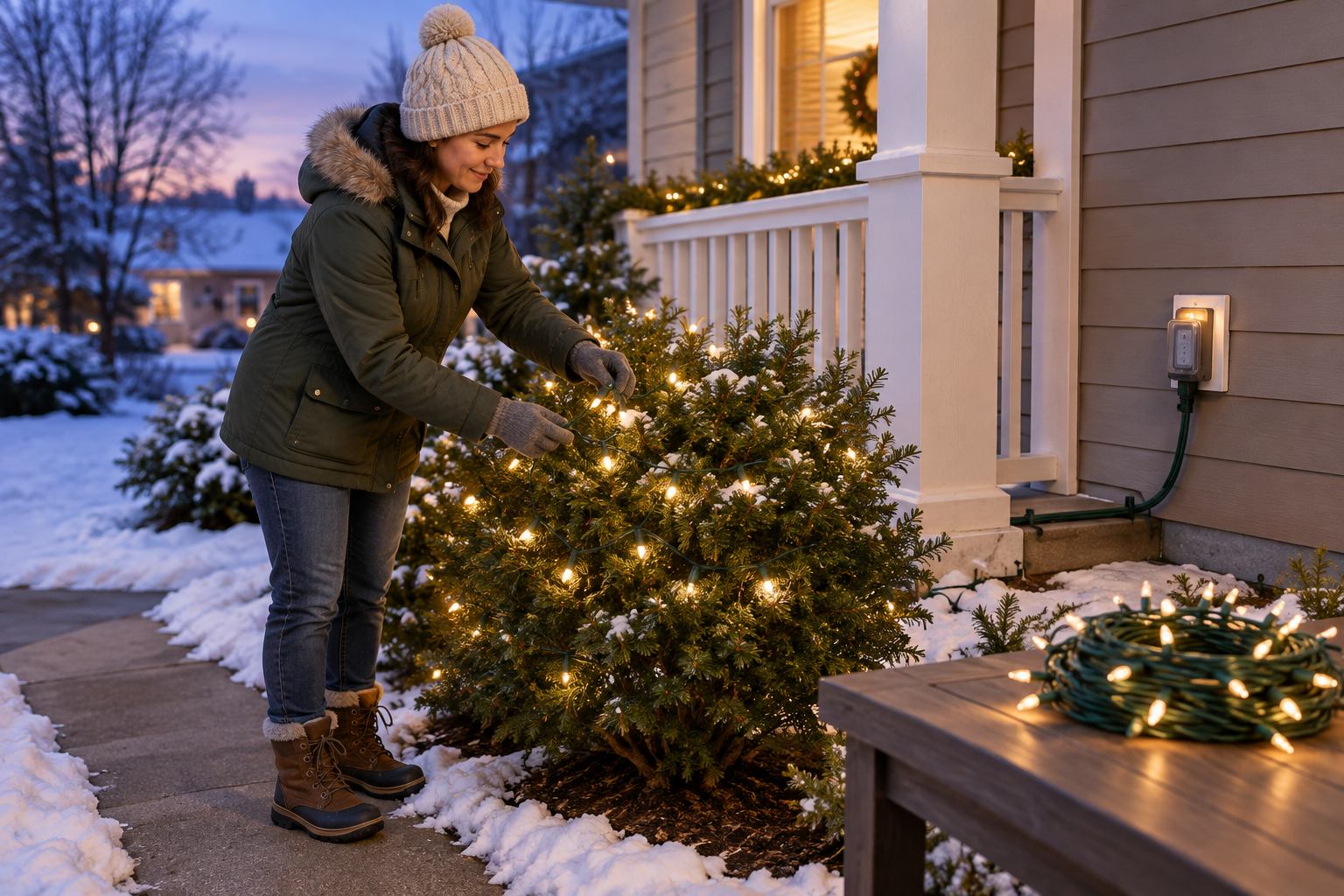
For a modest outdoor holiday-light display, start with features you can reach while standing securely on the ground: a low shrub, porch railing, or small tree within easy reach. The practical benefit of planning first is that you can spot an awkward route or an unreachable area before you are holding lights and looking for a workaround.
Sketch where the lights will go and how the cord will reach the power source. Consider whether the route crosses a walkway, passes through snow or standing water, or depends on a connection arrangement the product instructions do not allow. If the layout cannot avoid those problems, choose another location or scale back the display.
Keep this beginner guide to ground-level work. If the plan requires roof access or brings you near overhead power lines, do not improvise a climbing or electrical task. Choose a reachable feature or seek qualified help.
- Pick a reachable location and map the cord route.
- Identify walkways, wet areas, and other obstacles along the route.
- Change the plan if it requires roof access or work near overhead lines.
Inspect every light string and extension cord
A visual inspection can reveal obvious damage, but it cannot certify questionable wiring.
Unplug each light string before inspecting it. Check the full length for broken or cracked sockets, frayed or bare wires, and loose connections. Inspect extension cords too, including plugs and connection points. The U.S. Consumer Product Safety Commission (CPSC) recommends checking light strings for these kinds of defects and making sure extension cords are in good condition.
Set damaged items aside so they are not accidentally put back into use. Do not try to make a damaged string usable by covering the defect with tape. If a cord has been pinched or cut, or you cannot tell whether it is in good condition, leave it out of the display and use an undamaged product suited to the job.
Check stored decorations as carefully as new ones. Storage does not establish that a cord or light string is still in good condition.
- Inspect sockets, wires, plugs, and connections.
- Keep damaged or uncertain items out of the setup.
Check outdoor labels, instructions, and GFCI protection
Use the ratings and directions for the specific products rather than assuming similar-looking items have the same limits.
Check the packaging, product labels, and instructions for every light string and extension cord. Use products labeled for outdoor use in an outdoor display; do not assume a covered porch makes an indoor-only product suitable. Confirm that an extension cord is rated for its intended use and is in good condition.
Follow the manufacturer’s instructions for connections and use. Do not assume that all strings can be connected to one another or that a particular connection limit applies to every type of light. CPSC guidance recommends outdoor lights with a GFCI-protected receptacle or a portable GFCI.
If you are unsure whether an outlet has GFCI protection or whether the outlet or circuit is suitable for your setup, do not modify it or experiment with connections. A renter can ask the landlord or building maintenance; a homeowner who remains unsure can consult a qualified electrician.
- Look for outdoor-use labeling on both lights and extension cords.
- Read the instructions for the specific product’s connection limits.
- Pause if you cannot confirm the outlet or circuit is appropriate.
Place and secure lights without damaging cords
Keep the route clear and use fastening methods that leave the cord insulation intact.
Keep outdoor lights and cords clear of snow and standing water, and do not leave cords where people need to walk. If the only available route crosses a walkway or puts a connection in a wet area, change the layout instead of trying to conceal the problem. Follow the product instructions for placement and use.
Secure decorations with a method that will not cut, pierce, crush, or scrape the cord insulation. ESFI advises keeping outdoor decorations and cords clear of snow and standing water and fastening lights without damaging insulation.
Once the lights are in place, look over the route from the ground. Check that the cord has not been trapped under an object or caught in a door, and that connections follow the product instructions. If the arrangement cannot be kept clear and undamaged, simplify it or choose another location.
Know when to stop and ask for help
Some questions are beyond a basic decorating check; decide how you will handle them before starting.
This checklist covers consumer-level checks, not a diagnosis of home wiring. Stop if the plan involves changing an outlet or wiring, working near overhead power lines, or relying on an uncertain electrical setup. Do not try different connections until something works.
Use this decision table to choose a sensible next step when a concern comes up. If you cannot resolve it by checking product instructions or changing the display to a reachable location, leave that part of the setup unused.
| Situation | Practical next step |
|---|---|
| The display requires roof access or work near overhead power lines | Do not improvise; choose a ground-level location or seek qualified help. |
| You are unsure about GFCI protection or outlet suitability | Ask building maintenance or a qualified electrician rather than modifying the outlet. |
| The cord route crosses a walkway or runs through a wet area | Change the layout or leave that part of the display out. |
Make switching the display off part of the routine
Plan how the lights will be turned off before the first time you plug them in.
ESFI advises turning decorations off before leaving home or going to sleep. Choose a routine you can follow, such as switching them off as part of your evening check, and make sure everyone in the household knows how the display is controlled.
Weather or movement can change an arrangement after installation. If cords or connections are no longer positioned as intended, turn the display off and reassess the setup before using it again. Do not handle wet electrical connections. If you cannot resolve the concern by following the product instructions, leave the lights off and seek appropriate help.
Frequently asked questions
Can I use indoor holiday lights outside if they are under a porch?
Do not assume that a covered location makes an indoor-only product suitable outdoors. Check the product label and instructions; use lights labeled for outdoor use for an outdoor display.
How many outdoor light strings can I connect?
There is no single connection limit for every product. Follow the instructions for the specific lights and cords. CPSC’s three-connected-set limit applies to incandescent lights, not all light strings.
Do outdoor holiday lights need GFCI protection?
CPSC guidance recommends using outdoor lights with a GFCI-protected receptacle or portable GFCI. If you are unsure about the outlet or circuit, ask building maintenance or a qualified electrician rather than modifying it.
What should I do if an old light string has a frayed wire or cracked socket?
Do not plug it in or try to cover the damage with tape. Set it aside and use an undamaged product labeled for outdoor use and appropriate for the job.
Can I put lights on my roof if I am careful?
This guide is limited to ground-level decorating. If the display requires roof access or work near overhead power lines, do not improvise; choose a reachable location or seek qualified help.
Sources & further reading
Explore the original sources behind this article. Our editorial perspective is separate from the organizations we reference.