How to Read Your Drinking-Water Report—and What It Can’t Tell You About Your Tap
Find the report for your water system, make sense of its results and violation notices, and learn why system-wide lead figures are not a test of your home’s tap.
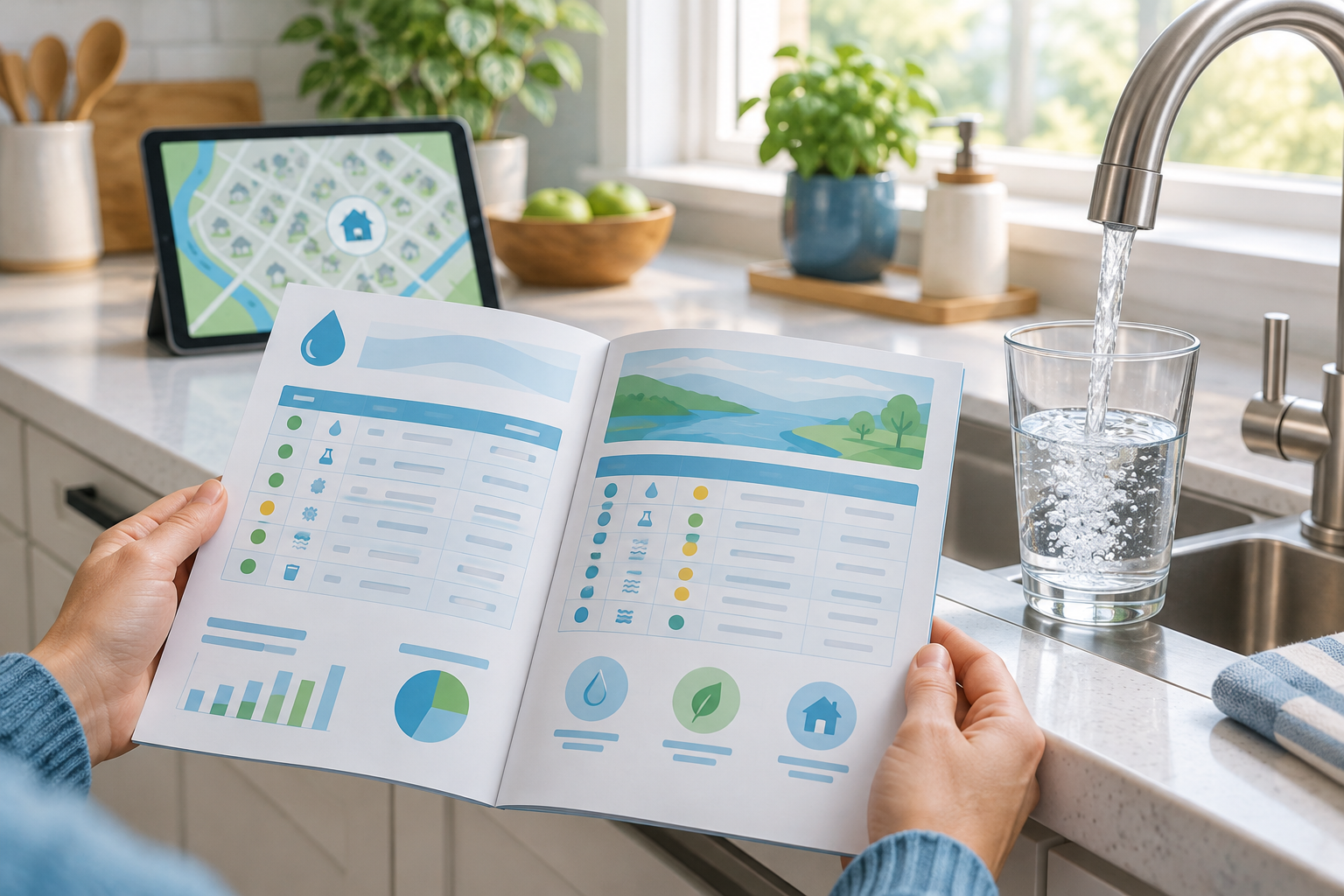
Find the report for the water system serving your home
Start by identifying your supplier and the type of water system; a city name alone may not point to the right report.
A Consumer Confidence Report (CCR), also called a drinking-water quality report, is an annual report provided by community water systems. These systems serve the same people year-round. The report describes the system’s water source, monitoring results, health information, and any violations. Not every type of public water system is covered by this annual-report process, so check the system named on the report rather than assuming that any nearby utility’s document applies to you.
If you pay the water bill, look for the supplier’s name and website there. You can also use the U.S. Environmental Protection Agency’s drinking-water data tools to find available local reports. If you rent or someone else pays the bill, ask your landlord or building manager for the water provider’s name and the report. They may be able to clarify which utility serves the building.
- Match the report’s water-system name to the supplier for your address.
- Check the reporting period shown on the report; an annual report covers a defined period, not necessarily conditions at this moment.
- If you use a private well, you generally will not receive a community-system CCR. Ask your local health department about private-well testing guidance.
Start with the water source and report period
The report’s opening details establish which system and monitoring period its results describe.
Find the section that names the water source and describes the system. It may explain where the water comes from and provide context about monitoring or treatment. Then note the dates or reporting year covered. These details help you interpret the rest of the document, but they do not make it a sample taken from your kitchen faucet.
Reports may also include general health information about particular contaminants. Treat that information as background, not as evidence that a contaminant was detected. To see what the report says about the system’s monitoring, look for the relevant row in the results table and read its notes. CDC recommends checking the table and violation details rather than drawing conclusions from general health language alone.
How to read the results table
A number only makes sense alongside its label, unit, benchmark, and explanation.
Report layouts differ, so use the document’s own glossary or table notes when available. Look for the name of the substance or measure, the unit, the reported result, and any standard or benchmark shown beside it. A result may describe a sample, a range, or a system-level summary, depending on the contaminant and the reporting rules. Do not compare figures until you know they measure the same thing and use the same units.
Terms such as maximum contaminant level and action level have specific meanings and are not interchangeable. Read the report’s definitions and explanations for the particular contaminant. A listed detection tells you that the report recorded the substance in the relevant monitoring; it does not automatically describe the water at every home. Likewise, a table should not be treated as a test for every possible contaminant at every tap.
If a row is unclear, note the exact contaminant, result, unit, and reporting period, then ask the utility what the entry means. That is more useful than trying to infer risk from a number without its context.
- Identify the result, unit, and benchmark before interpreting a row.
- Read footnotes that explain sampling, ranges, or other qualifications.
- Look for the report’s explicit statement about whether a standard was met or a violation occurred; do not infer a violation from a number alone.
| Report section | What to check | What it does not establish by itself |
|---|---|---|
| System name and water source | Whether this is the system serving your address and what source it describes | The condition of every household tap |
| Results table | Substance, unit, result, benchmark, and explanatory notes | A complete account of every possible contaminant or household exposure |
| Violation notice | What happened, when, any stated health risk, and the response | That every customer experienced harm |
| Lead and copper information | The sampling explanation and system-level figures | The lead level in your individual home |
What lead results mean—and what they do not mean
System sampling and a test at one home’s tap answer different questions.
EPA explains that reported lead and copper figures include a 90th-percentile result from system sampling. This is a system-level statistic based on sampled locations; it is not a reading from every home. The lead action level is a trigger for required system actions, not a threshold that certifies an individual home’s water as safe below that level.
Plumbing materials can differ from one home to another, so a system-wide figure cannot establish whether lead is present at a particular tap. An action-level exceedance is important information about the system and its required response, but it is not your household’s test result. A figure below the action level does not prove that lead is absent from every home, either.
If you are concerned about lead in your home’s water, contact the utility or local health department and ask what home-specific testing is appropriate. If you rent, ask your landlord or building manager about access and how testing can be arranged. Do not use a system figure, a neighbor’s result, or a general statement in the report as a substitute for a test of your own water.
If the report lists a violation, read the notice closely
The notice’s explanation and corrective steps give the context needed to understand what the violation concerns.
Look for what requirement was not met, when it happened, how long it lasted, whether the report identifies a health risk, and what the utility is doing in response. CDC advises readers to check these details. A violation may involve a monitoring or reporting requirement, among other possibilities, so the word alone does not tell you exactly what happened.
Do not assume that any violation automatically means immediate harm, and do not dismiss it without reading the notice. Follow instructions in the notice and check for any related current communication from the utility. If the report refers to another notice or corrective action, ask the utility where to find it and whether it applies to your service area.
Turn the report into useful follow-up questions
You do not need to decode every technical term before asking the utility or health department for clarification.
A focused question can help you get a useful explanation. Refer to the system name, report period, and exact row or notice you are asking about. For example, ask what a particular result and unit represent, whether a listed issue has been addressed, or where to find the utility’s current instructions.
For lead concerns, be explicit that you want to understand what the system data says and whether home-specific sampling is appropriate. The utility can explain its system information; it should not be treated as having tested your individual tap unless a sample from your home was actually tested. Renters can ask the building manager or landlord to help coordinate access or contact the relevant parties.
If you have a private well, a nearby community water system’s CCR is not a substitute for information about your well. Contact your local health department for guidance relevant to private wells.
A simple reading and follow-up checklist
Use this sequence to keep the report’s scope clear and identify the right next step:
- Confirm the system name, service area, and reporting period.
- Read the water-source description, results table, footnotes, and any violation notice.
- Write down the exact row or statement you want explained.
- Ask the utility about system monitoring, results, or corrective actions.
- If your concern is lead at your home, ask the utility or health department about appropriate home-specific testing.
Frequently asked questions
How do I find the Consumer Confidence Report for my address?
Check your water bill or utility website, ask your landlord or building manager, or use EPA’s drinking-water data tools to find available reports. Confirm that the report names the system serving your address and covers the period you want to review.
Do all public water systems provide an annual Consumer Confidence Report?
The annual CCR process applies to community water systems, which serve the same people year-round. It does not apply to every type of public water system. Check which system serves your address and ask the utility if you are unsure.
Does a health-effects statement mean a contaminant was found in my water?
No. General health information does not by itself show that the contaminant was detected. Check the results table, its notes, and any related violation details.
Does a low system-wide lead result prove my tap has no lead?
No. The reported figures reflect system sampling, not a test of every household. Because results can differ between homes, ask the utility or local health department about appropriate testing for a home-specific concern.
What should I do if the report lists a violation?
Read the notice for what happened, how long it lasted, whether a health risk was identified, and what the utility is doing. Follow any current instructions and contact the utility or local health department if something is unclear.
Do private-well owners receive a Consumer Confidence Report?
The annual CCR process for community water systems generally does not cover private wells. Contact your local health department for guidance about testing and caring for a private well.
Sources & further reading
Explore the original sources behind this article. Our editorial perspective is separate from the organizations we reference.