Soccer Offside Explained: Three Checks to Make When the Pass Is Played
To understand a possible offside call, freeze the moment a teammate plays the ball, check the attacker’s position against the halfway line, ball, and second-last opponent, then ask whether they become involved in play.
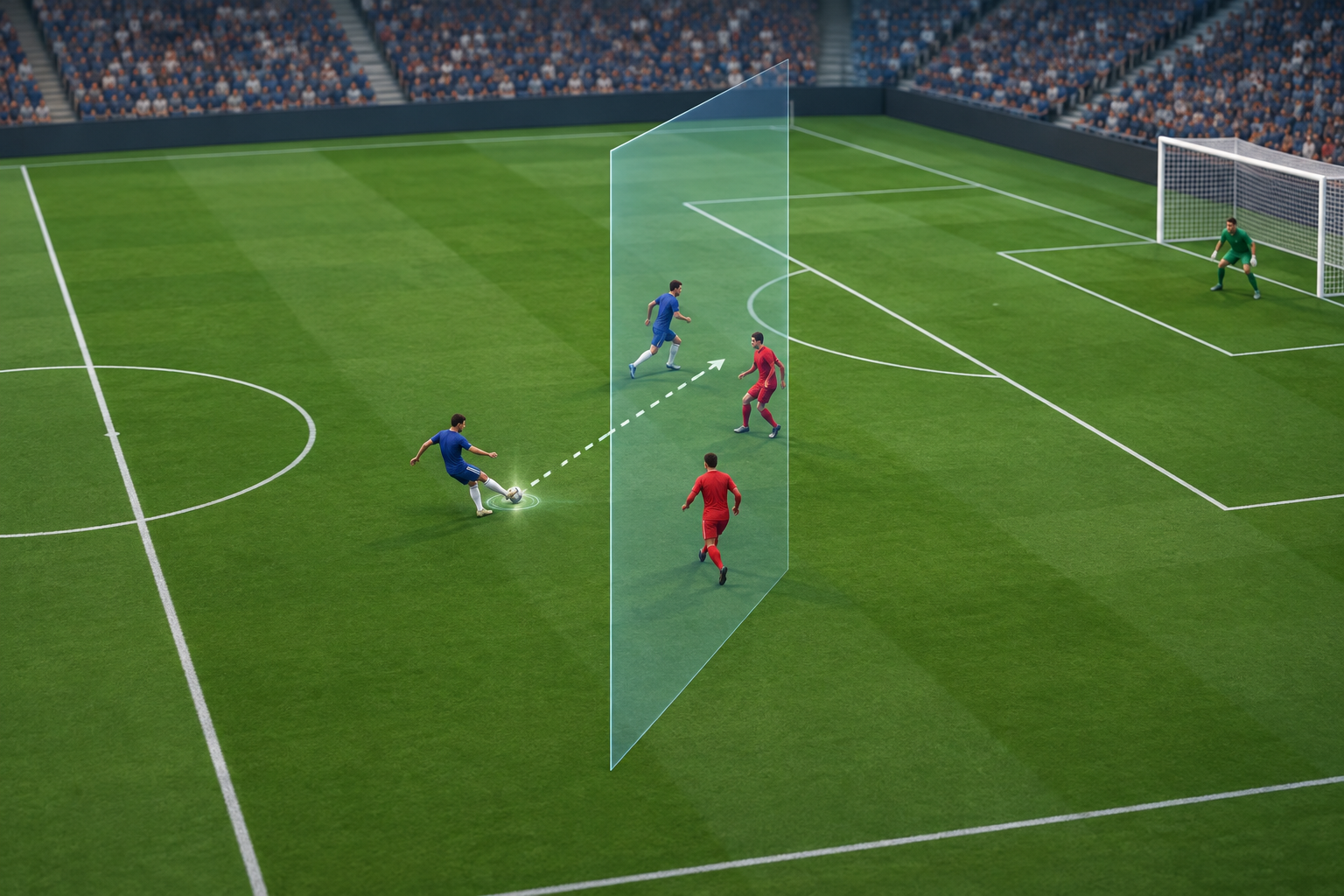
The three-check method for understanding soccer offside
Use the moment of the pass, the attacker’s position, and their involvement to make sense of most ordinary offside decisions.
To judge a possible offside call, freeze the play when the attacker’s teammate plays or touches the ball. Check whether the attacker is in the opponents’ half and closer to the goal line than both the ball and the second-last opponent. Then ask whether the attacker becomes involved in play. If the first two checks show an offside position and the third shows involvement, an offside offence may be called.
This is more useful than simply asking whether an attacker is standing close to the goal. A player can be beyond the defenders without committing an offence, while a player who appears to be level at the pass may be in an onside position. The official rule is set out in IFAB Law 11; UEFA’s simplified explanation also emphasizes that being level with the ball or second-last opponent is not offside position.
- Check 1: When did the teammate play or touch the ball?
- Check 2: Was the attacker in an offside position at that moment?
- Check 3: Did the attacker become involved in active play?
Check one: Freeze the moment the pass is played
The key reference point is the teammate’s touch, not the attacker’s later position.
Imagine a midfielder releasing a through ball as a forward starts a run. To judge the forward’s position, look at the instant the midfielder plays or touches the ball. Do not use the moment the forward reaches it, the moment the defender turns, or the moment the pass crosses a line on the pitch.
The forward may run beyond the defenders after the pass and still be onside if they were level with, or behind, the relevant line when the teammate played the ball. Conversely, an attacker who was in an offside position at that instant does not become onside simply by running back toward the ball afterward.
When watching a replay, try to pause at the first relevant touch. Broadcast angles may not line up perfectly with the player and ball, so a single frame or camera view may not settle a close call. The viewing method helps explain the rule; it does not replace the officials’ assessment.
Check two: Compare the attacker with the ball and defenders
An offside position depends on three reference points, not simply the nearest defender.
At the moment of the teammate’s touch, an attacker is in an offside position only if an eligible part of the head, body, or feet is in the opponents’ half and nearer the opponents’ goal line than both the ball and the second-last opponent. Hands and arms do not count, including for goalkeepers.
The second-last opponent is not automatically the goalkeeper. The goalkeeper is one opponent, but another opponent may be farther from the goal line; what matters is the position of the two opponents nearest that goal line. Compare the attacker with the second-last opponent, then check the ball as well. The attacker must be nearer the goal line than both to be in an offside position.
Being level with the second-last opponent is not offside position. Neither is being level with the ball. The halfway line matters too: a player still in their own half cannot be in an offside position. These checks explain why a forward can look beyond a defender in a wide-angle view but still be level with another opponent or with the ball.
- Use the goal line as the direction of comparison.
- Count eligible body parts, not hands or arms.
- Check both the ball and the second-last opponent.
- If the attacker is level with either reference point, they are not in an offside position.
Check three: Did the player become involved?
An offside position becomes an offence only when the player’s actions meet the involvement test.
A player is not penalized just for being in an offside position. They must become involved in active play. The clearest example is playing or touching the ball passed or touched by a teammate. If a forward starts in an offside position and then controls that pass, the position and involvement checks point toward an offence.
Involvement can also mean interfering with an opponent—for example, affecting an opponent’s ability to play the ball. This can depend on what happened around the players, not just where they were standing. A player who does not touch the pass might still affect an opponent’s view or attempt to play the ball, but viewers should be cautious about judging close situations from one angle.
A player may also gain an advantage by playing a ball that rebounds or deflects to them from the goal frame, an opponent, or a deliberate save. These situations are harder to assess than a straightforward pass. A save and an opponent’s deliberate play are not interchangeable in the rule, and whether a contact counts as deliberate play can require judgment.
- Playing or touching a teammate’s pass is the easiest involvement example to spot.
- Interfering with an opponent can matter even without a touch on the ball.
- Rebounds, saves, and deliberate play require more context than the basic position test.
Know the three direct-restart exceptions
The usual offside position rule does not penalize a player for receiving the ball directly from these restarts.
A player is not offside for receiving the ball directly from a goal kick, throw-in, or corner kick. “Directly” is the important word: the exception applies to the player receiving the ball from that restart, rather than serving as a general exemption for everything that follows.
For example, if a player takes a throw-in toward a teammate who is beyond the defenders, that teammate is not offside for receiving the throw directly. If the ball is subsequently played by another teammate, judge a later run using the new moment of that teammate’s touch and the ordinary checks.
- Goal kick
- Throw-in
- Corner kick
Try the three checks on these match situations
These examples separate the position test from the question of involvement.
Apply the checks in order instead of deciding from where the attacker ends up. The examples below assume an ordinary pass in open play unless they specify a restart.
| Situation | Position at the relevant moment | Involvement or restart | How to read it |
|---|---|---|---|
| A runner is level with the second-last opponent when a teammate passes. | Not in an offside position: level is not beyond. | The runner collects the pass. | No offside offence based on this position test. |
| An attacker is beyond the relevant line when the pass is played, but leaves the ball alone and does not affect an opponent. | In an offside position. | No involvement is apparent in this example. | Position alone is not an offence. |
| A teammate takes a throw-in directly to a forward beyond the defenders. | The forward may be beyond the usual offside line. | The ball is received directly from a throw-in. | The direct-restart exception applies. |
| An attacker starts in an offside position and plays a teammate’s pass. | In an offside position when the teammate touches the ball. | The attacker plays the pass. | The position and involvement checks indicate an offside offence. |
What to do with a close or confusing call
Use the method to organize what you see, while recognizing which decisions need more context.
For an ordinary forward pass, ask three questions in order: When was the teammate’s touch? Was the attacker beyond the ball and second-last opponent, in the opponents’ half? Did the attacker play the ball or affect an opponent? That sequence will explain many calls without relying on the misleading shorthand that any attacker beyond a defender is offside.
If the play involves a rebound, a save, a deflection, or a player apparently affecting an opponent without touching the ball, treat your first impression as provisional. The distinction between a deliberate play and a deflection can depend on the circumstances, and interference is judged in context. For a viewer, the useful next step is to replay the moment of the pass and follow the attacker’s actions afterward, rather than treating one still image as conclusive.
- Pause at the teammate’s first relevant touch.
- Locate the halfway line, the ball, and the second-last opponent.
- Check whether an eligible part of the attacker was beyond both the ball and the second-last opponent in the opponents’ half.
- Look for the attacker playing the ball or affecting an opponent.
- If the action involves a save, rebound, or uncertain interference, allow for a closer judgment.
Frequently asked questions
Can a player be offside if they do not touch the ball?
Yes, potentially. An offside-position player can commit an offence by interfering with an opponent, even without touching the ball. Whether their actions count as interference depends on the situation.
Does the goalkeeper determine the offside line?
Not necessarily. The test uses the second-last opponent, who may or may not be the goalkeeper. Compare the attacker with that opponent and with the ball.
Can you be offside in your own half?
No. A player must be in the opponents’ half to be in an offside position.
Is a player offside if they are level with the defender?
No, not on position alone. A player level with the second-last opponent—or level with the ball—is not in an offside position.
Can a player be offside directly from a corner or throw-in?
A player is not penalized for receiving the ball directly from a corner kick, throw-in, or goal kick. A later touch by a teammate creates a new moment for applying the usual position test.
Sources & further reading
Explore the original sources behind this article. Our editorial perspective is separate from the organizations we reference.
- [S1] Law 11 - Offside | IFABtheifab.com
- [S2] BY CATEGORYacademyonline.uefa.com