How to Store Old Family Letters and Documents Without Damaging Them
Protect family letters, certificates, maps, and notes with careful handling, a stable storage spot, and supportive enclosures. Learn what to avoid—and when to ask a conservator.
How to store old family letters and documents
Start by checking condition, then choose a suitable location and enclosure for papers stable enough for routine home storage.
To store old family letters, certificates, maps, or handwritten notes, first check whether they are dry and stable. Handle them gently on a clear surface, place sound items in appropriately sized folders or boxes, and choose an indoor spot that stays cool and stable, away from dampness, heat, leaks, and strong light. Avoid household fixes such as tape, glue, rubber bands, and paper clips.
If an item is wet, moldy, very brittle, or losing flakes of ink or coating, stop routine handling. Do not clean, flatten, or repair it yourself; ask a paper conservator or a preservation service at an archive or library for advice. Home storage can reduce avoidable risks, but it cannot stop all aging or guarantee that a fragile document is safe to handle.
The Library of Congress describes preventive care as a combination of handling, storage conditions, and protective enclosures. Since papers, inks, coatings, and earlier repairs vary, assess items individually rather than applying one storage recipe to an entire collection.
Prepare a safe space and sort gently
A modest setup helps prevent new tears, stains, and mix-ups while you assess a collection.
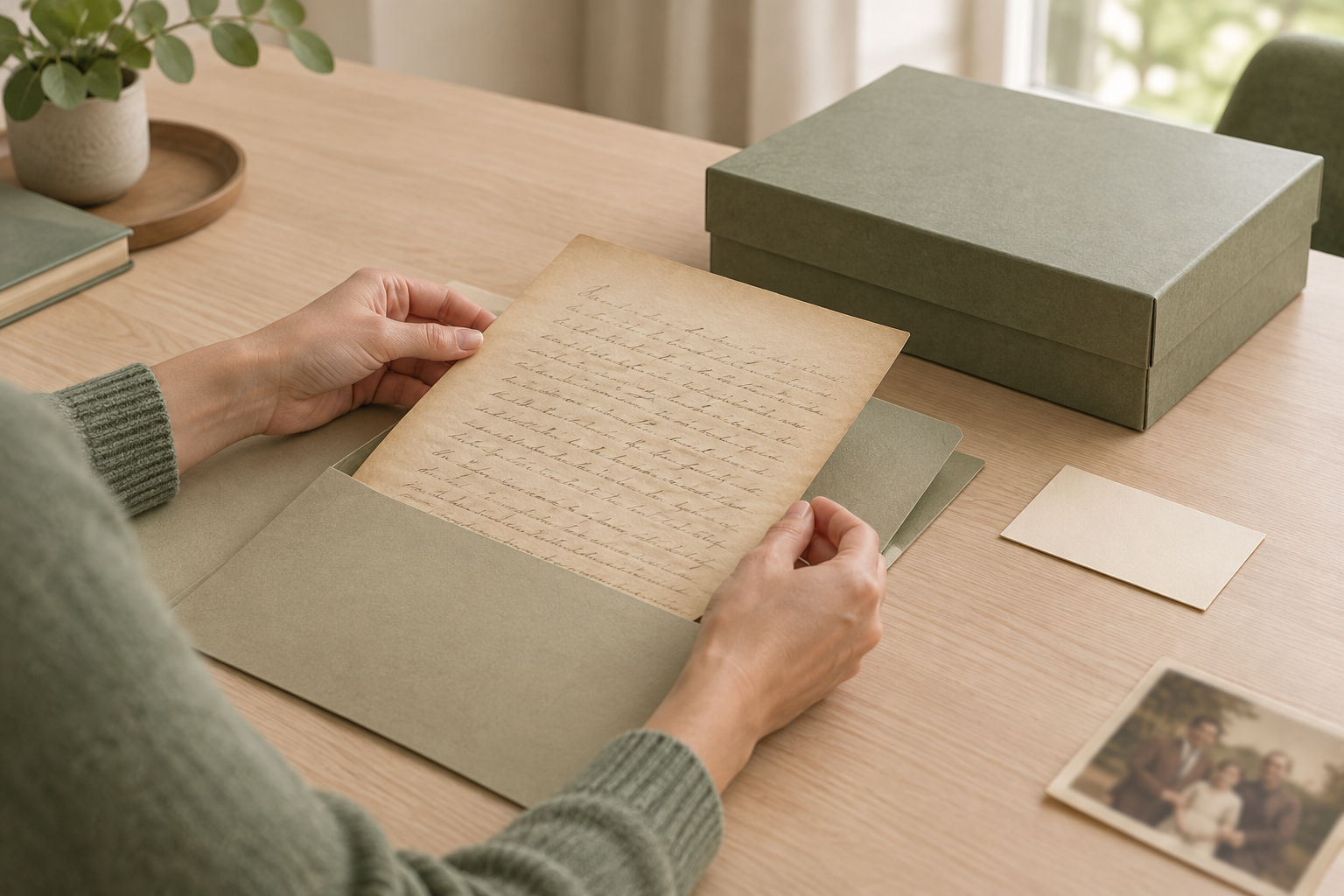
Clear a dry table and move food, drinks, pens, and anything that could snag a page out of reach. Wash and dry your hands; avoid lotion immediately before handling. Work with a small group at a time so papers do not pile up or slide around. The National Archives recommends a clear work surface and clean, lotion-free hands for handling family papers.
Preserve the order in which you found items if it may carry meaning, such as letters kept together in an envelope. Record known names, dates, or context on a separate note or folder, not on the original. For a large or weak sheet, support it from beneath rather than lifting it by a corner. Do not open a tight fold just to inspect it.
- Handle one small group at a time and keep related notes separate from the originals.
- Support large sheets from below and avoid pulling on weak edges.
- Set aside items that appear wet, moldy, brittle, or visibly flaking for a more cautious assessment.
Choose a stable place in the home
The storage location matters as much as the box: a container cannot offset a damp, hot, bright, or leak-prone spot.
A dry interior closet or cabinet may work if it is not against a damp wall and has no leak history. Avoid damp basements, garages, hot attics, and places near pipes, windows with leak risks, heaters, or direct sunlight. Keep enclosures off the floor, where spills or floor-level dampness could reach them.
Prefer a place that remains cool, stable, and relatively dry rather than chasing one precise temperature or humidity target for every home. Materials and household conditions differ. If the current spot is damp, hot, or vulnerable to leaks, moving the collection to a safer location is a useful first improvement.
The National Archives cautions against damp basements, garages, hot attics, and leak risks. The Library of Congress also recommends cool, stable conditions, little light, and flat storage. These are general preventive-care principles, not a guarantee that a specific room suits every document.
| Location | Potential concern | Practical choice |
|---|---|---|
| Dry interior closet or cabinet | May be stable and low-light if there are no damp walls or leaks. | Consider it if it stays dry and does not become hot. |
| Basement or garage | May be damp, leak-prone, or subject to changing conditions. | Avoid if moisture or temperature changes are a concern. |
| Attic or sunny shelf | May expose papers to heat or prolonged light. | Look for a cooler, darker location. |
| Near pipes, a window, or a heater | Raises exposure to leaks, heat, or changing conditions. | Move the collection away from the hazard. |
Choose an enclosure that supports the document
The enclosure should prevent bending and shifting without forcing the paper into an unsuitable material or shape.
For stable documents, choose folders and boxes described as suitable for archival storage of paper. Match the size to the item: a large map needs room to lie flat or another form of full support, while smaller letters can be grouped in folders if they are not tightly packed. A box should close without pressing on its contents.
Store papers flat when practical. If a box must stand upright, arrange folders so documents stay supported rather than leaning, bending, or sliding. Do not overfill it; retrieving one paper should not require pulling hard on another. Keep unusual, coated, repaired, or fragile materials out of a one-size-fits-all enclosure until you have checked what is suitable.
The word “archival” on a product does not establish that it is right for every item. The Library of Congress notes that some media may be sensitive to alkaline materials or static-generating polyester sleeves. If the paper’s surface, ink, or construction is unusual, seek advice before enclosing it.
Avoid quick fixes that can harm originals
Convenient ways of holding or repairing pages can leave marks, stress weak paper, or complicate later treatment.
Keep adhesive tape, glue, rubber bands, and paper clips off old documents. They can mark, crease, stain, or tear paper. Avoid unknown plastic sleeves as well: a convenient-looking material may not suit a document’s ink, coating, or other media.
If a letter is folded, do not force it flat, especially if it feels stiff or cracks when moved. Keep it supported in the shape it naturally holds and ask a conservator if opening or flattening it matters. Do not write on an original to identify it; label the folder or add a separate note instead.
For frequent sharing or display, use a copy when possible. A scan makes a letter easier to read or share, but it does not replace care of the physical original. Store the original away from prolonged light and unnecessary handling.
- Do not attach labels or notes directly to the document.
- Do not press, scrape, clean, or repair a fragile original as a storage shortcut.
- Use a copy for routine sharing when that meets your needs.
Know when to pause and consult a conservator
Some conditions call for expert assessment rather than an ordinary sorting and storage routine.
Stop routine handling if a paper is actively damp, moldy, unusually brittle, stuck to another sheet, or losing ink or surface material. These signs do not identify the exact cause, but they are reasons not to experiment with cleaning, pressing, or repair.
Mold can be a health hazard. The National Archives advises limiting handling and addressing the moisture source; it recommends consulting a conservator for valuable or sentimental items. If the affected area is extensive or the paper is wet, seek qualified guidance rather than attempting treatment at home.
Put stable papers away and make access easier
A short, consistent routine keeps the collection organized without adding unnecessary handling or buying supplies too soon.
After setting aside items that need expert attention, place stable papers in suitable folders or boxes. Keep related papers together when you know their connection, but do not assume items belong together only because they were found in the same container. When uncertain, preserve their original order and note where you found them.
Before buying supplies, first move papers away from an unsafe location and give them appropriate support. Label folders with known names, dates, and context; keep a simple record of where the collection is stored. Check the location occasionally for dampness or new damage, especially after a leak or a change in household conditions. If a document’s condition changes, stop handling it and reassess rather than trying another household fix.
- Clear and dry the work surface; wash and dry your hands.
- Assess each item without scraping it or forcing it open; set aside anything wet, moldy, very brittle, or flaking.
- Place stable papers in a suitably sized enclosure, keeping them flat or supported against bending and shifting.
- Label the folder or a separate note with known details; do not write on the original.
- Store the enclosure in a stable, dry, low-light location away from heat and leak risks.
Frequently asked questions
Should I wear gloves to handle old family letters?
For ordinary, stable paper, clean, dry hands are a practical choice. Avoid handling papers with flaking or unstable surfaces, and ask a conservator about those items.
Are plastic sleeves safe for old documents?
Not necessarily. Paper, ink, and other media vary, and some may be sensitive to static-generating polyester sleeves or alkaline materials. Choose an enclosure for the specific item and seek advice if its surface or construction is unusual.
Can I flatten a folded family letter before storing it?
Do not force it flat, particularly if it is brittle, stiff, or cracking. Keep it supported in its existing shape and consult a conservator if it needs to be opened or flattened.
What should I do if I find mold on family papers?
Limit handling and address the moisture source. Mold can be a health hazard, so consult a conservator, especially for valuable or sentimental material.
Does scanning a letter mean I no longer need to preserve the original?
No. A digital copy can make a letter easier to read or share, but it does not preserve the physical original. Store the paper carefully even if you have a scan.
Sources & further reading
Explore the original sources behind this article. Our editorial perspective is separate from the organizations we reference.
- [S1] How do I preserve my letters or paper documents? - Ask a Librarianask.loc.gov
- [S2] How to Preserve Family Archives (papers and photographs) | National Archivesarchives.gov
- [S3] Tips for Handling Family Papers and Photographs | National Archivesarchives.gov
- [S4] How to Preserve Family Archives (papers and photographs) | National Archivesarchives.gov