How to Verify a Historic Photo’s Caption Before You Share It
Trace a historic photo to its collection, check what its record actually supports, and corroborate important details before sharing a careful caption.
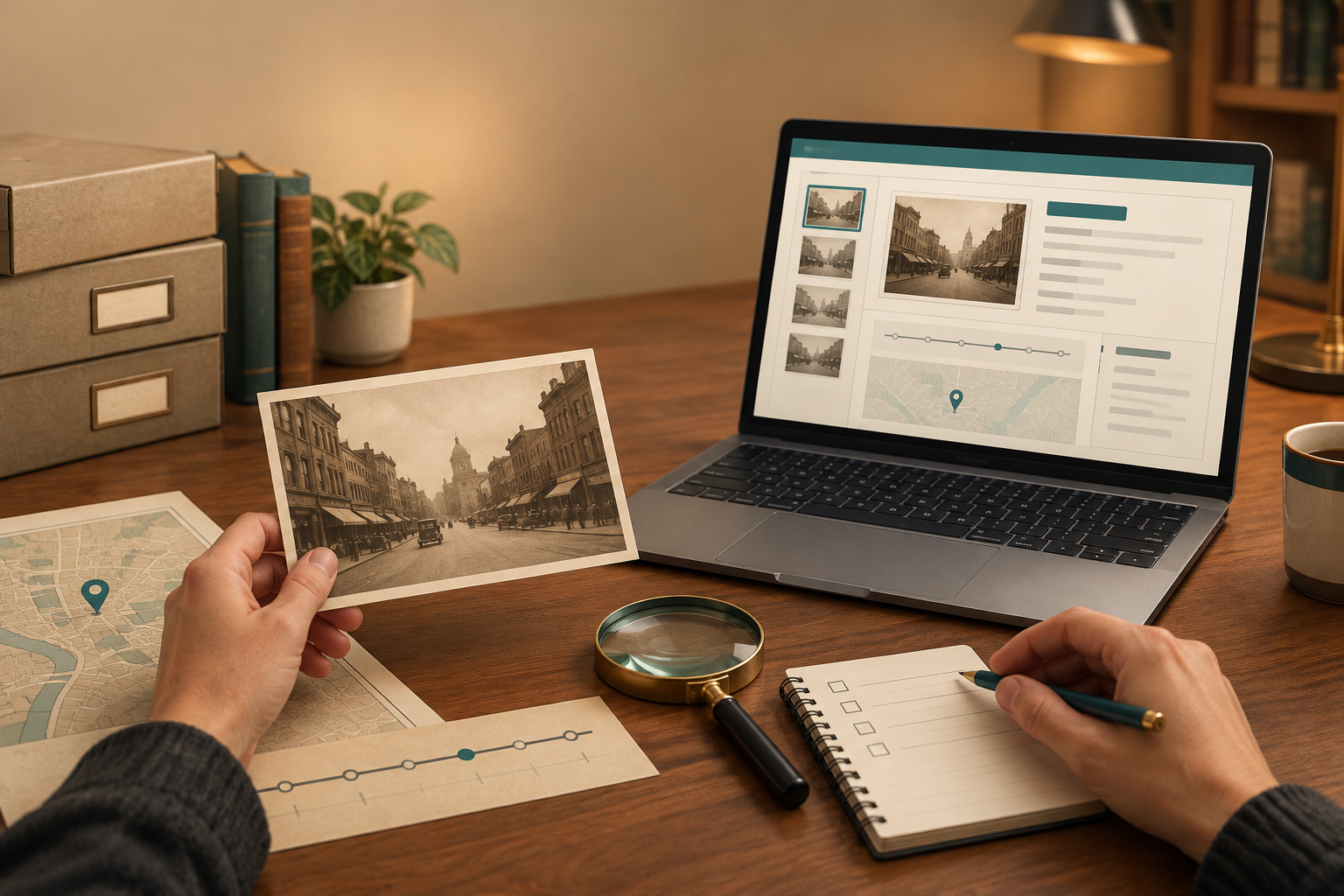
Start by breaking the caption into claims
A caption often combines several claims, and each may have a different level of support.
To verify a historic photo’s caption before sharing it, trace the image to an institutional record, read the full description, and check important details against other evidence. A catalog record can point you toward useful information, but it does not automatically confirm every claim copied into a social media post or website.
Separate the caption into questions: Who made the photograph? What does it show? When was the image created, and when did the scene take place? Where was it taken? Are any people named? A caption might correctly identify a town but misstate the event or date.
For example, consider a post that calls a picture “Workers at the opening of Riverside Bridge, 1912.” That wording makes several claims: the people are workers, the event is a bridge opening, the bridge is Riverside Bridge, and the date is 1912. A convincing-looking image or a caption repeated by many accounts is not enough to establish all four.
- Save the image and the exact caption wording, if practical, so you can compare versions.
- Note where you found it and whether it appears cropped, mirrored, colorized, or otherwise altered.
- Mark each detail as supported, uncertain, or not yet checked.
Trace the image to an institutional record
Start with the archive, library, museum, or historical society most likely to hold or describe the image.
Search the institution named in the image credit or post. Try a distinctive phrase from the caption, then search with a person’s name, place, event, organization, or approximate decade. If the caption produces no result, try shorter combinations and alternate spellings rather than assuming its wording matches the catalog exactly.
The Library of Congress recommends searching with specific names, places, events, or dates, trying alternate terms, and checking related group records or finding aids. Not all images are digitized or individually cataloged. The National Archives Catalog also offers keyword searches and filters, including by material type, date, and whether records have digital objects. Its descriptions may omit individual names, so searching a unit, location, event, or collection can be more useful than searching only for a person.
Keep track of the search terms and catalog sections you try. If you find a likely result, follow links to its collection or series record as well as the individual item. A larger collection description may explain how the photographs were gathered or organized.
- Search the institution named in the credit before relying on an image-sharing site’s description.
- Try historical and modern place names, spelling variations, abbreviations, and broader terms.
- If a search finds nothing, widen it to related collections and finding aids.
Read the full record and compare the image
The exact description, collection context, and qualifications help show what the record does—and does not—claim.
Once you find a possible match, look beyond the title or thumbnail. Note the institution, collection or series, item identifier, listed creator, exact description, date wording, and any explanatory notes. Check whether the item links to related photographs or a finding aid.
Words such as “possibly,” “identified as,” or “caption reads” matter. They can signal that a record reports information supplied with the image or preserves a tentative identification, rather than confirming it independently. The Library of Congress cautions that Prints and Photographs records may contain limited or unconfirmed information, and that original information accompanying a picture can be inaccurate.
Compare the catalog image with the one circulating online. A crop might remove a street sign or another useful clue; a repost might pair a caption with a different photograph altogether. If the images do not match, the record cannot be treated as verification of the post.
Keep separate notes on three things: what the record says, what you can directly observe in the image, and what other sources establish. This helps prevent an inference—such as identifying a building by its appearance—from quietly becoming a stated fact.
- Copy the catalog’s wording and retain its qualifiers.
- Check linked collection records and related items for context.
- Attribute a claim to the record unless you find evidence that supports it independently.
Interpret dates and places carefully
A date attached to a photograph may describe its creation, an estimate, or a range—not necessarily the time of the scene.
Check what the date field means in the specific catalog. In the Library of Congress’s panoramic photograph catalog, the date refers to when the image was created, not necessarily the period depicted. Undated images may be assigned estimated dates, sometimes expressed as a range. Keep terms such as “circa,” “about,” or a date range instead of converting them into an exact year.
A photograph made in 1912 could show a scene from another time, so an image-creation date alone does not establish when an event happened. Look for a note explaining whether the date is documented or estimated. If a record gives a range, use the range in your caption.
Place names need similar care. A location may have had a different historical name, or an identification may be based on a visual resemblance. A period map, directory, event record, or another photograph tied to the same location may help test the claim. Resemblance is a useful clue, but it is not confirmation by itself.
| Record wording | Reasonable conclusion | What it does not establish by itself |
|---|---|---|
| “Photographed circa 1910” | The image is estimated to have been made around that time. | That the event shown happened in 1910. |
| “Caption identifies the location as Riverside” | The recorded caption names Riverside. | That the location has been independently confirmed. |
| “Photographer: Jane Smith” | The catalog attributes the image to Jane Smith. | How the attribution was established, unless the record explains it. |
| No date listed | The online record does not provide a date. | That the image cannot be dated or the circulating date is false. |
Look for independent corroboration
Choose additional evidence that can address the particular claim you want to check.
For a named event, look for a dated newspaper report or another record tied to that event. For an address or business, a period directory may help. A map or planning record might be useful when checking a location. The best source depends on the claim: a report that an event happened does not automatically identify every person in a photograph.
Check whether a second source is genuinely independent. Several sites repeating the same caption may all be copying one post or catalog record. Ask whether the source refers to the same image, place, and event, and whether it explains how the identification was made. A source can strengthen one part of a caption while leaving another unresolved.
Reverse-image search and searches for distinctive visual details can help locate earlier appearances or alternate versions. Use these results as leads, not proof. Search results can repeat an error, and a similar thumbnail may show a different image. Follow promising results back to the underlying record or publication.
Be especially cautious about naming people based only on appearance or comments attached to a post. Look for a reliable identification tied to the photograph, collection, or documented event. If you cannot establish the identity, leave the name out.
- Seek a source independent of the post and, where possible, the catalog record.
- Match each source to the specific claim it can support.
- Treat visual matches and repeated captions as clues to investigate, not confirmation.
Write a caption that matches the evidence
A useful caption can state what is known and clearly qualify what remains uncertain.
Use wording that shows where uncertain information comes from. If a collection identifies the location but not the event, say so. Retain approximate dates and ranges. Do not add a person’s name based only on a family resemblance or a social media comment.
For the Riverside Bridge example, suppose the record says “workers near Riverside Bridge, circa 1910” but does not mention an opening ceremony. A careful caption would be: “Workers near Riverside Bridge, circa 1910, according to the collection record. The event and the people pictured have not been confirmed.” This shares the supported details without repeating the unsupported claim about an opening.
If sources disagree, describe the disagreement or leave out the disputed detail. You do not have to solve every question before sharing an image, but readers should be able to distinguish documented information from interpretation.
- Attribute uncertain details: “The collection record identifies the location as…”
- Keep qualifiers such as “circa,” “possibly,” and date ranges.
- Remove unsupported claims that are not needed to understand the image.
Check reuse information and keep a research note
Verifying a photograph and checking whether you may reuse it are separate tasks.
Before reposting or reproducing an image, check the rights information on that specific item’s record. Being able to view a photograph online does not by itself establish permission to reuse it. Rights information and applicable terms can vary by item and intended use, so do not infer permission from a catalog’s public accessibility.
Keep a brief note with the institution, collection, item identifier, exact record wording, search terms, access date, and any corroborating sources. That gives you a clear trail to revisit if you find new evidence or the description changes.
If you cannot find a record, do not treat the empty result as proof that the caption is wrong. The image may not be digitized, may be described within a group record, or may use terms you have not tried. Broaden the search to related collections or finding aids. If the important details remain unconfirmed, share a qualified caption or wait before identifying the image.
A practical next step is to choose one photograph, list the claims in its caption, and investigate the detail that matters most before sharing. A short, traceable check is more useful than repeating confident wording without knowing where it came from.
Frequently asked questions
Does a Library of Congress catalog entry prove that a photo’s caption is correct?
Not automatically. The Library of Congress notes that catalog information may be limited or unconfirmed and that original information supplied with a picture can be inaccurate. Read the full record and seek independent support for details that matter.
Does a photograph’s catalog date tell me when the event happened?
Not necessarily. In the Library of Congress’s panoramic photograph catalog, the date refers to when the image was created, not necessarily the period shown. An undated image may also have an estimated date or range, so retain the catalog’s qualifiers.
What if I cannot find the photograph in an archive catalog?
A missing result does not prove the image or caption is false. The image may not be digitized, may appear within a group record, or may be described using different terms. Try alternate searches and related collections; qualify details that remain unconfirmed.
Can reverse-image search verify who or what is in a historic photo?
It can help locate other copies or possible sources, but repeated appearances do not establish that a caption is correct. Follow results to an institutional record or reliable publication and check that they show the same image, not a similar photograph or crop.
If a historic photo is online, can I repost it?
Being viewable online does not by itself establish permission to reuse it. Check the rights information on the specific item’s record and consider the terms relevant to your intended use. Identification and reuse are separate checks.
Sources & further reading
Explore the original sources behind this article. Our editorial perspective is separate from the organizations we reference.
- [S1] About the Prints and Photographs Online Catalog (PPOC)loc.gov
- [S2] Panoramic Photographs - Cataloging the Collection - Prints & Photographs Online Catalog (Library of Congress)loc.gov
- [S3] Searching & Viewing - Cold War: Finding Images in the Prints & Photographs Division - Research Guides at Library of Congressguides.loc.gov
- [S4] Using the National Archives Catalog | National Archivesarchives.gov
- [S5] Prints and Photographs Online Catalog Helploc.gov